

Drawings and documents
National Archives restored drawings: drawing
R.J.L. Witty's Patent Drawing for a Method of Constructing Bridges

National Archives, Restored Patent Drawings (Record Group 241) · Full-size scan at the National Archives · Catalog record
Show the text on the drawing Hide (63 words)
Words on the drawing as machine-read by the National Archives; not checked. Useful mainly for searching.
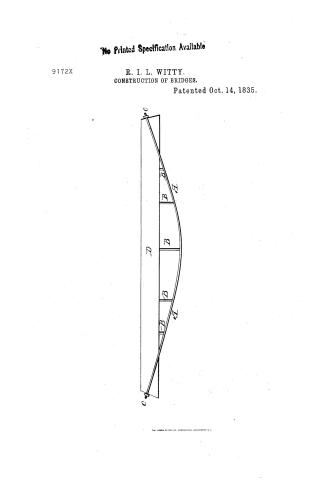
200. 10. / boles-page 89 / Girdets / CAREIFICATION / 9172-4 / Patenled 14 Ditatic 1835 / $/ / DIVISION. / Construction of Bridges / A catenary curve formed of Rods / or / B. Stancheors / C. Bots / D. Beam / BL / 142 / P Stricklands Det / Patent office 1843 / Made under the directions the communicate of Patred / in conformity with ach of 3"March 1837 / n.Liumonth / Patent
USPTO scan
The patent as scanned by the USPTO
-
 Page 1
-
 Page 2


U.S. Patent and Trademark Office · Google Patents
Show the transcription Hide (431 words)
Machine transcription (LightOnOCR) of the pages as scanned by the USPTO, most of them the handwritten copies made when the records were restored after the 1836 fire. Not checked; it can misread handwriting, so compare it with the scan.
Page 1.
No Printed Specification Available
9172X
R. I. L. WITTY.
CONSTRUCTION OF BRIDGES.
Patented Oct. 14, 1835.

THE NORRIS PETERS CO., PHOTO-LITHO., WASHINGTON, D.C.
Page 2.
Oct. 14, 1835 9172X 89
Richard J. L. Willy, Lowell, and State of Massachusetts
The Schedule referred to in these Letters Patent and making part of the same, containing a description in the words of the said Richard J. Willy himself of his improvement in the construction of Bridges.
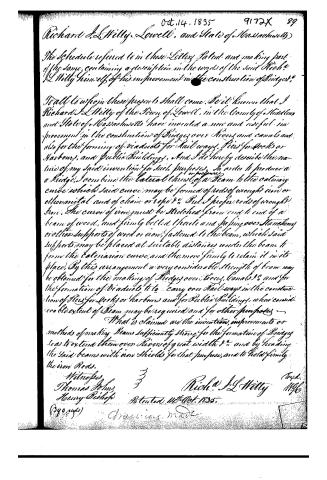
To all to whom these presents shall come, Be it known that I Richard J. L. Willy of the Town of Lowell, in the County of Middlesex and State of Massachusetts have invented a new and useful improvement in the construction of Bridges over Rivers and canals and also for the forming of viaducts for Railways, Piers for Docks or Harbours, and Public Buildings. And I do hereby describe the nature of my said invention for such purposes. In order to produce a Bridge, I combine the lateral thrust of a Beam to the catenary curve which said curve may be formed of rods of wrought iron or other metal and of chain or rope &c. But I prefer rods of wrought iron. The curve of iron must be stretched from end to end of a beam of wood, and firmly bolted thereto and passing over stanchions or other supports of wood or iron, fastened to the beam, which said supports may be placed at suitable distances under the beam to form the catenary curve, and the more firmly to retain it in its place. By this arrangement a very considerable strength of beam may be obtained for the making of Bridges over Rivers, Canals &c. and for the formation of viaducts to carry over Railways in the construction of Piers for Docks or Harbours and for Public Buildings, when considerable extent of Beam may be required and for other purposes.
What is claimed are the invention, improvements or methods of making Beams sufficiently strong for the formation of Bridges so as to extend them over Rivers of great width &c. and by loading the said beams with iron Shields for that purpose, and to hold firmly the iron Rods.
Witnesses
Thomas Johns
Henry Bishop
(399 pgs)
Rich. J. L. Willy
Patented 14th Oct. 1835.
(Toyd. 1836)
Published accounts: journal notice
Notice in the monthly list of patents, with remarks
Journal of the Franklin Institute, new ser., vol. 17 (1836), p. 336 · View the page
42. For Bridges and Viaducts; Richard T. L. Witty, Lowell, Middlesex county, Massachusetts, October 14.
Remarks. We really do not understand what is meant in certain parts of the specification of this bridge; but we will afford a chance of doing so to others, by giving the whole substance of it. "I combine the lateral thrust or pressure of a beam to the catenary curve, which said curve may be formed of rods, wrought iron or other metal, and of chain or rope, &c. But I prefer rods of wrought iron. The curve of iron must be stretched from end to end of a beam of wood, and firmly bolted thereto, and passing over stauncheons or other supports of wood or iron fastened to the beam, which said supports may be placed at suitable distances under the beam to form the catenarian curve, and the more firmly to retain it in its place. By this arrangement a very considerable strength of beam may be obtained for the making of bridges over rivers, canals, &c. and for the formation of viaducts to carry over rail-ways, in the construction of piers for docks or harbours, and for public buildings where considerable extent of beam may be required." What is claimed are the invention, improvements, or methods, of making beams sufficiently strong for the formation of bridges, so as to extend them over rivers of great width, &c. and by heading the said beams with iron shields for that purpose, and to hold firmly the iron rods.
About this record
- Patentee
- the Journal of the Franklin Institute, Journal
- Date
- the Name and Date index of patents, USPTO records, Jim Shaw's X-patent list
- Invention
- the Name and Date index of patents
- Listed in
- the Name and Date index of patents, USPTO records, Jim Shaw's X-patent list, the Journal of the Franklin Institute, Burke's List of Patents (1847)
- The patentee's full name comes from the Franklin Institute's journal.
- The residence comes from the Franklin Institute's journal.
- Burke's 1847 Patent Office list gives the same patent.