

Drawings and documents
National Archives restored drawings: drawing
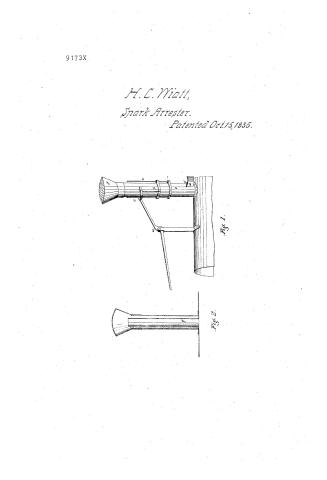
Haut C. Wiatt's Patent Drawing for a Spark Catcher


National Archives, Restored Patent Drawings (Record Group 241) · Full-size scan at the National Archives · Catalog record
Show the text on the drawing Hide (264 words)
Words on the drawing as machine-read by the National Archives; not checked. Useful mainly for searching.
Sheet 1. BOILER - URNACE8 / Spark Arrector / HAUT C. WIATT / CLASSIFICATIO / Spark Catcher. / Royal / Patented's October 1835 / DIVICIÓN / References / inconclusive chimney. / a. / the slide. / THE / Fig. / 1. / Patent office 12 Jan 1839 / e the outer / fig2. the Section inner of the chinney / Made under the direction of the Commission / ripe. / of talents in comformity with act 3 Mar 1837 / Munry LEWholds / Committion of Patents,
Sheet 2. 122. STEAM. / Reiand feled Oct30 1848 CA / 2. BOILERS. / [94] / Spark Arresters & Consumers, / Country of Malifax / State / ab / North Carolina / fo / CLASSIFITATIOR / 9173-4 / IVISION. / On this 27 day age October 1848, / before the subscriber, a Justice ago the / Beach, in and for said County, per- - / son ally appeared Hant C. Wyatt, aff / the town of Wildon, in the County of / Healifax and state of North Carolina and / made solemn oath that he is the Inventor / for of which Letters Patent of the United States / the apparatus for arresting sparks, / were granted to him on the 15th - day of / october, 1835, and that the annexed / drawing is, as he verily believes, a true / deliniation of the invention described / in said Letters Patent
Sheet 3. 122. STEAM. / 2. BOILERS, / [94] / Spark Arresters & Consumers. / CLASEIFICATION / 9X73. / IIV ISION. / HAUT C). WIATT / spark Catcher / Patented 15 October 1835 / Fight / References / Fig. 1. For lowering the chimney / a the lever / cc the rads / e the outer pipes / has / alent Office 12 / / b the slide / lade under the direction of the Co. / d the door / Patents in conformity with act / Fig.2. Section of the chimney g the inner pipe / f the caps / hang leus. / Commission
USPTO scan
The patent as scanned by the USPTO
-
 Page 1
-
 Page 2
-
 Page 3


U.S. Patent and Trademark Office · Google Patents
Show the transcription Hide (449 words)
Machine transcription (LightOnOCR) of the pages as scanned by the USPTO, most of them the handwritten copies made when the records were restored after the 1836 fire. Not checked; it can misread handwriting, so compare it with the scan.
Page 1.
9173X
H. C. Wiatt,
Spark Arrester.
Patented Oct. 15, 1835.
Fig. 1.
Fig. 2.
Page 2.
Oct. 15, 1895
Haut E. Watt 9173X
Letters Patent
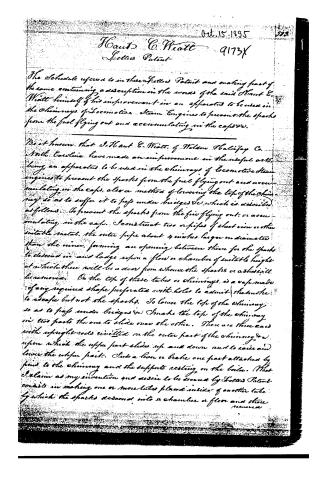
The Schedule referred to in these Letters Patent and making part of the same containing a description in the words of the said Haut E. Watt himself of his improvement in an apparatus to be used in the chimneys of locomotive steam engines to prevent the sparks from the fuel flying out and accumulating in the casks.
Be it known that I, Haut E. Watt, of Walden, Halifax Co., North Carolina, have made an improvement in the useful arts, being an apparatus to be used in the chimneys of locomotive steam engines to prevent the sparks from the fuel flying out and accumulating in the casks, also a method of lowering the top of the chimney so as to suffer it to pass under bridges, etc., which is described as follows: To prevent the sparks from the fire flying out or accumulating in the casks, I construct two or pipes of sheet iron or other suitable metal, the outer pipe about 4 inches larger in diameter than the inner, forming an opening between them for the sparks to descend in and lodge upon a floor or chamber of suitable height at which there will be a door from whence the sparks or ashes will be removed. On the top of these tubes or chimneys is a cap made of any required shape perforated with holes to admit the smoke to escape but not the sparks. To lower the top of the chimney so as to pass under bridges, etc., I make the top of the chimney in two parts, the one to slide over the other. There are three rods with upright rods rivetted on the outer part of the chimney, etc., upon which the upper part slides up and down and to raise and lower the upper part. I use a lever or brake one part attached by pins to the chimney and the supports resting on the boiler. What I claim as my invention and desire to be secured by Letters Patent consists in making one or more tubes placed inside of another tube by which the sparks descend into a chamber or floor and there removed.
Page 3.
removed which prevents them from accumulating and choking the chimney, also the sliding top for passing under bridges &c.
Witness
Clement S. Coote
S. A. Elliot
H. E. Watt
(October 15, 1835)
(Drawing) 3/50
396 mts
Published accounts: journal notice
Notice in the monthly list of patents, with remarks
Journal of the Franklin Institute, new ser., vol. 17 (1836), p. 336 · View the page
In the drawings, the catenarian curve is a straight beam, the lateral thrust of which is to be employed by the patentee; the accompanying sketch exhibits the manner of trussing a beam to form the said catenarian curve, as the patentee calls it. a, the beam, bb, the stauncheons, c c, the iron rod. a C C 43. For a Spark Suppresser; Haut C. Wiatt, Weldon, Halifax county, North Carolina, October 15.
Remarks. This apparatus is to be used on locomotive or other steam engines. It consists principally of two tubes, one covering the other, and exceeding it in diameter about four inches; the inner tube is the chimney, the space between it and the outer is the reservoir into which the sparks are to fall; the outer tube is to have a cap with small perforations, allowing the smoke to escape, but detaining the sparks. The outer tube is made to raise and lower by means of a lever, for passing under bridges, &c. The claim is to this general construction.
DATAMP: illustration
Illustrations from DATAMP
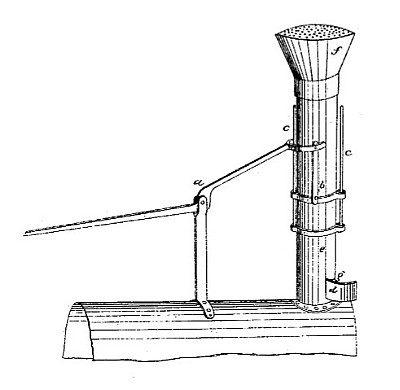

DATAMP (Directory of American Tool and Machinery Patents), via the Internet Archive · Archived DATAMP page
About this record
- Patentee
- DATAMP
- Date
- the Name and Date index of patents, DATAMP, USPTO records
- Invention
- DATAMP
- Listed in
- the Name and Date index of patents, DATAMP, USPTO records, Jim Shaw's X-patent list, the Journal of the Franklin Institute, Burke's List of Patents (1847)
- Burke's 1847 Patent Office list gives the same patent.