

Drawings and documents
National Archives restored drawings: drawing
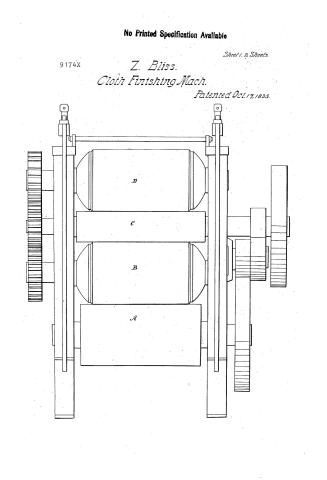
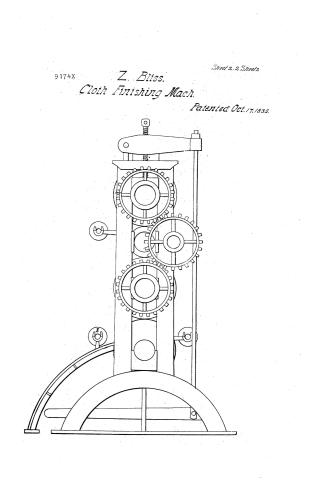
Z. Bliss' Patent Drawing for a Machine for Calendaring Cloth

National Archives, Restored Patent Drawings (Record Group 241) · Full-size scan at the National Archives · Catalog record
Show the text on the drawing Hide (27 words)
Words on the drawing as machine-read by the National Archives; not checked. Useful mainly for searching.
Machine for Calenaerng / CLACSI 10 ATION / 9174 / DIVISION / La / tog / DOII / El / to
USPTO scan
The patent as scanned by the USPTO
-
 Page 1
-
 Page 2
-
 Page 3
-
 Page 4


U.S. Patent and Trademark Office · Google Patents
Show the transcription Hide (698 words)
Machine transcription (LightOnOCR) of the pages as scanned by the USPTO, most of them the handwritten copies made when the records were restored after the 1836 fire. Not checked; it can misread handwriting, so compare it with the scan.
Page 1.
No Printed Specification Available
Sheet 1 of 2 Sheets.
9174X
Z. Bliss.
Cloth Finishing Mach.
Patented Oct. 17, 1835.

Page 2.
9174X
Z. Bliss.
Cloth Finishing Mach.
Patented Oct. 17, 1835.
Sheet 2. 2 Sheets
Page 3.
9174x
Oct, 17, 1835
Lenas Blifs. of Johnston. R. Island.
Letters Patent
The schedule referred to in these Letters Patent, and making part of the same, containing a description in the words of the said Lenas Blifs himself, of his improvement in the machine for Calendering Cloth—
To all to whom these presents shall come: Be it known that I Lenas Blifs of Johnston in the County of Providence and State of Rhode Island have invented a new and useful improvement on calendering cloth and the following is a full and exact description of the construction and operation of the double glazed calendering machine as invented or improved by me. A, B, and C. (in the drawing annexed) represents three cylinders. The cloth is received first between the cylinders A & B, it then passes between B & C and while passing between them it receives the glaze which is called the finishing it then passes between C & D and receives another glazing—
In order to understand more perfectly the operation of the machine I will give a description of the calender now in general use. The cylinders A, B & C (in the same drawing annexed) contain all the cylinders belonging to the machine. The cylinder D is the improvement in my machine. In the common machine the cloth enters between A & B, and going round B, comes out from between B & C, where it receives the glazing. By this process the cloth receives only a single glazing it is therefore necessary to pass the cloth twice through the cylinders in order to give it a smooth surface. Again in relation to the pressure on the necks of the cylinders; A & C. receive the whole pressure making four revolutions to A. one; consequently there is four times the friction on the necks of C to that of A. again the wear of the boxes in the machine in general use is very great. For instance a pair of composition boxes weighing 100 pounds on the necks of C. do not last more than sixty days. With all this the common machine will not average dressing the yarn more than two hundred pieces of cloth per day.
The improvements of my calender over the one in general use are these: The cloth receives first double the glazing and a much superior finish.
Page 4.
9174X
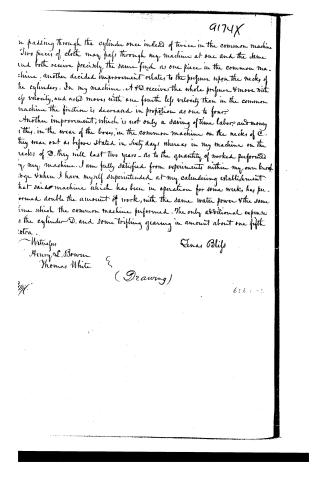
in passing through the cylinder once instead of twice in the common machine. Two pieces of cloth may pass through my machine at one and the same end both receive precisely the same finish as one piece in the common machine. Another decided improvement relates to the pressure upon the necks of the cylinders. In my machine, A & D receive the whole pressure & move with equal velocity, and as D moves with one fourth less velocity than in the common machine the friction is decreased in proportion as one to four.
Another improvement, which is not only a saving of time, labor, and money, but this, in the wear of the boxes, in the common machine on the necks of C. They wear out as before stated in sixty days, whereas, in my machine on the necks of D, they will last two years — as to the quantity of work performed by my machine. I am fully satisfied from experiments within my own knowledge when I have myself superintended at my calendering establishment that said machine which has been in operation for some weeks, has performed double the amount of work, with the same water power & the same time which the common machine performed. The only additional expense is the cylinder D, and some trifling gearing in amount about one fifth extra.
Witnesses
Henry L. Bowen
Thomas White
(Texas, Blifs)
(Drawing)
655 : 5.
Published accounts: journal notice
Notice in the monthly list of patents, with remarks
Journal of the Franklin Institute, new ser., vol. 17 (1836), p. 339 · View the page
53. For an improvement in Calendering Cloth; Zenas Bliss Johnston, Providence county, Rhode Island, October 17.
Remarks. The improvement here patented consists in the addition of a roller above the three ordinarily used in calenders, by the aid of which additional roller the cloth is twice glazed in its passage between the rollers, thereby preventing the necessity of performing the operation a second time. In the ordinary calender, it is said that the boxes in which the gudgeons of the top roller run, last generally but sixty days, the weight having to be applied on them, whilst by the new arrangement, in which a large roller with a slow motion receives the weight, the boxes will last for two years.
About this record
- Patentee
- the Journal of the Franklin Institute, Journal
- Date
- the Name and Date index of patents, USPTO records, Jim Shaw's X-patent list
- Invention
- the Name and Date index of patents
- Listed in
- the Name and Date index of patents, USPTO records, Jim Shaw's X-patent list, the Journal of the Franklin Institute
- The patentee's full name comes from the Franklin Institute's journal.