

Drawings and documents
National Archives restored drawings: drawing
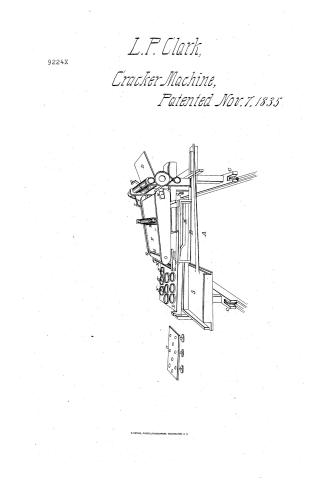
L.P. Clark's Patent Drawing for a Craker Machine

National Archives, Restored Patent Drawings (Record Group 241) · Full-size scan at the National Archives · Catalog record
Show the text on the drawing Hide (34 words)
Words on the drawing as machine-read by the National Archives; not checked. Useful mainly for searching.
KITCHEN UTENSILS. / 65) KITCHEN UTENSILS. / Cracker Mach's / Bread and Cracker Machines. / Stampus / 6150 / Vol23 1331 / 92.24.4 / DIVISION. / Crokier Machine / 9224 / Patented / db
USPTO scan
The patent as scanned by the USPTO
-
 Page 1
-
 Page 2
-
 Page 3


U.S. Patent and Trademark Office · Google Patents
Show the transcription Hide (803 words)
Machine transcription (LightOnOCR) of the pages as scanned by the USPTO, most of them the handwritten copies made when the records were restored after the 1836 fire. Not checked; it can misread handwriting, so compare it with the scan.
Page 1.
9224X
L.P. Clark,
Cracker Machine,
Patented Nov. 7, 1835.

Page 2.
Nov 7, 1835
Levin P. Black
9224X Letters Patent
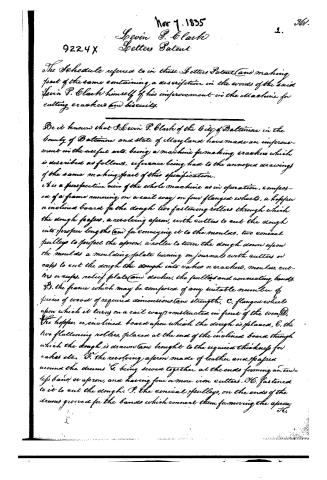
The Schedule referred to in these Letters Patent (and making part of the same containing a description in the words of the said Levin P. Black himself of his improvement in the machine for cutting crackers and biscuits.
Be it known that Levin P. Black of the City of Baltimore in the County of Baltimore and State of Maryland have made an improvement in the useful arts, being a machine for making crackers which is described as follows, reference being had to the annexed drawings of the same making part of this specification.
It is a perspective view of the whole machine as in operation, consisting of a frame running on a rail way on four flanged wheels, a hopper or inclined board for the dough, two flattening rollers through which the dough passes, a revolving apron, with cutters to cut the dough into proper lengths (and for conveying it to the moulds), two conical pulleys to propel the apron, a roller to turn the dough down upon the moulds, a moulding plate turning on journals with cutters or caps to cut the dough into cakes or crackers, moulds, cutters or caps, relief plate (and docket), the pulleys and connecting bands.
B. the frame which may be composed of any suitable number of pieces of wood of required dimensions (and strength), C. flanged wheels upon which it turns on a rail way constructed in front of the oven, D. the hopper or inclined board upon which the dough is placed, E. the two flattening rollers, placed at the end of the inclined board through which the dough is drawn (and brought to the required thickness for cakes etc.), F. the revolving apron made of leather and spaced around the drums G. being sewed together at the ends forming an endless band or apron, and having four or more iron cutters, H. fastened to it to cut the dough, I. the conical pulleys, on the ends of the drums grooved for the bands which connect them for moving the apron, H.
Page 3.
362. 9224 X 2.
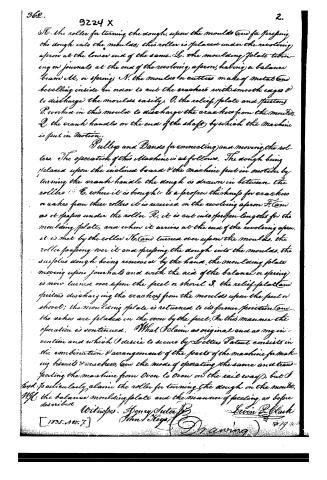
R. the roller for turning the dough, upon the moulds and for pressing the dough into the moulds; this roller is placed under the revolving apron at the lower end of the same. L. the moulding plate turning on journals at the end of the revolving apron, having a balance beam M, or spring. N. the moulds or cutters made of metal and bevelling inside in order to cut the crackers with smooth edges and to discharge the moulds easily. O. the relief plate and pistons P. worked in this mould to discharge the crackers from the moulds. Q. the crank handle on the end of the shaft by which the machine is put in motion.
Pulleys and Bands for connecting and moving the rollers. The operation of this machine is as follows. The dough being placed upon the inclined board and the machine put in motion by turning the crank handle the dough is drawn in between the rollers C. where it is brought to a proper thickness for crackers or cakes from there rollers it is received on the revolving apron F. and as it passes under the roller R, it is cut into proper lengths for the moulding plate, and when it arrives at the end of the revolving apron, it is met by the roller R, and turned over upon the moulds, the roller passing over it and pressing the dough into the moulds, the surplus dough being removed by the hand, the moulding plate moving upon journals and with the aid of the balance or spring is now turned over upon the peel or shovel S. the relief plate and pistons discharging the crackers from the moulds upon the peel or shovel; the moulding plate is returned to its former position and the cakes are placed in the oven by the peel. In this manner the operation is continued. What I claim as original and as my invention and which I desire to secure by Letters Patent consists in the combination and arrangement of the parts of the machine for making biscuits and crackers, and the mode of operating the same and transporting the machine from oven to oven on the rail way, but I particularly claim the roller for turning the dough on the moulds, M, the balance moulding plate and the manner of peeling as before described.
Witnesses. Henry Suter John Hays Levin P. Clark
[1835. Nov. 7.]
Published accounts: journal notice
Notice in the monthly list of patents
Journal of the Franklin Institute, new ser., vol. 17 (1836), p. 144 · View the page
686. Crackers, cutting.-L. P. Clarke, Baltimore, Maryland,
Published accounts: journal notice
Notice in the monthly list of patents
Journal of the Franklin Institute, new ser., vol. 17 (1836), p. 404 · View the page
5. For a Machine for Making Crackers; Levin P. Clark, Baltimore, Maryland, November 7.
About this record
- Patentee
- Jim Shaw's X-patent list
- Date
- the Name and Date index of patents, USPTO records, Jim Shaw's X-patent list
- Invention
- the Name and Date index of patents
- Listed in
- the Name and Date index of patents, USPTO records, Jim Shaw's X-patent list, the Journal of the Franklin Institute
- The Franklin Institute's journal spells the name differently.
- The residence comes from the Franklin Institute's journal.