

Drawings and documents
National Archives restored drawings: drawing
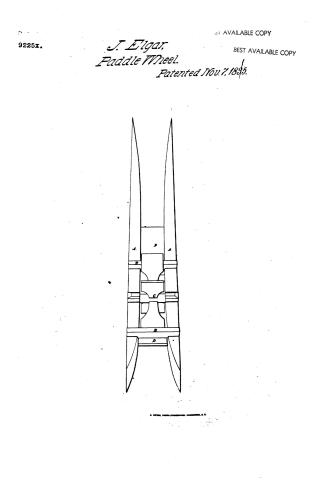
John Elgar's Patent Drawing for a Canal Steam Boat

National Archives, Restored Patent Drawings (Record Group 241) · Full-size scan at the National Archives · Catalog record
Show the text on the drawing Hide (70 words)
Words on the drawing as machine-read by the National Archives; not checked. Useful mainly for searching.
114-SHIPS, / 115. SBJPS. / Form. / 2 POPULSION. / [N9] Paddle Wheels / CLASSIFICA TION / 97254 / ELGAH, > / DIVISION. / 9225X / CANAL STEAM BOAT. / PAr: Nov. 7: J835, / References / A Boats / a connecting timbers / c. Paddle wheel / D. Sheeting / Patent office May 12" 1598 - / Made under direction of the commission of patents / w county by with act 73d March 153y / commission of patents
USPTO scan
The patent as scanned by the USPTO
-
 Page 1
-
 Page 2
-
 Page 3


U.S. Patent and Trademark Office · Google Patents
Show the transcription Hide (506 words)
Machine transcription (LightOnOCR) of the pages as scanned by the USPTO, most of them the handwritten copies made when the records were restored after the 1836 fire. Not checked; it can misread handwriting, so compare it with the scan.
Page 1.
92251.
J. Elgar,
Paddle Wheel.
Patented Nov. 7, 1835.
BEST AVAILABLE COPY

Page 2.
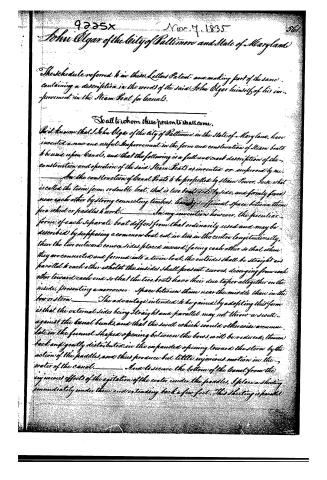
John Olgar of the City of Baltimore and State of Maryland
The schedule referred to in these Letters Patent, and making part of the same, containing a description in the words of the said John Olgar himself of his improvement in the Steam Boat for canals.
To all to whom these presents shall come,
Be it known that I John Olgar of the City of Baltimore in the State of Maryland, have invented a new and useful improvement in the form and construction of Steam boats to be used upon canals, and that the following is a full and exact description of the construction and operation of the said Steam Boats as invented or improved by me.
In the construction of Canal Boats to be propelled by Steam Power, such as is called the twin form, or double boat, that is two boats side by side, and firmly fixed near each other by strong connecting timbers, leaving sufficient space between them for a wheel or paddles to work. In my invention however, the peculiar form of each separate boat differs from that ordinarily used and may be described by supposing a common boat cut in two in the centre longitudinally, then the two outward convex sides placed inward, facing each other so that when they are connected and formed into a twin boat, the outsides shall be straight and parallel to each other whilst the insides shall present curves, diverging from each other toward each end so that the two boats have their due taper altogether on the inside, presenting a narrower space between them near the middle than in the bow or stern. The advantage intended to be gained by adopting this form is that the external sides being straight and parallel may not throw a swell against the canal banks, and that the swell which would otherwise accumulate in the funnel shaped opening between the bows will be reduced, thrown back and gently distributed in the expanded opening toward the stern by the action of the paddles, and thus produce but little injurious motion in the water of the canal. In order to secure the bottom of the canal from the injurious effect of the agitation of the water under the paddles, I place a sheeting immediately under them and extending back a few feet. This sheeting is parallel
Page 3.
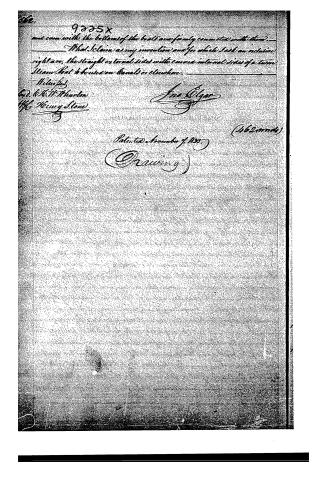
and connect with the bottoms of the boats and firmly connected with them.
What I claim as my invention and for which I ask an exclusive right are, the straight external sides with curved internal sides of a turn Steam Boat to be used on canals or elsewhere.
Witnesses
Geo. W. W. Harlow
Wm. Henry Stone
Jno. Elgar
(460 words)
Patented November 7, 1855.
(Drawing)
Published accounts: journal notice
Notice in the monthly list of patents, with remarks
Journal of the Franklin Institute, new ser., vol. 17 (1836), p. 405 · View the page
11. For Canal Boats, to be propelled by steam; John Elgar, Civil Engineer, Baltimore, Maryland, November 7.
Remarks. A twin boat is to be made, the outer sides of each being vertical planes, parallel to each other. If an ordinary keel boat be supposed to be cut through the middle vertically and longitudinally, and the convex sides be then placed opposite to each other, leaving a space between them for a paddle wheel, the proposed form will be understood. It is supposed that such a construction will prevent the washing of canal banks. The claim is to "the straight external sides, with curved internal sides, of a twin steamboat, to be used on canals, and elsewhere." There have been propositions and patents for similar boats, but we do not know of any now in use, nor do we believe that they will present the anticipated advantage. The water way between the boats becomes less and less as the greatest convexity of the two parts is approached, which causes the water to pack, and rise in front, which will occasion, we apprehend, nearly, or quite, as much swell as a boat of the ordinary form, and, at the same time, create a resistance which will consume a part of the power applied.
About this record
- Patentee
- the Journal of the Franklin Institute, Journal
- Date
- the Name and Date index of patents, USPTO records, Jim Shaw's X-patent list
- Invention
- the Name and Date index of patents
- Listed in
- the Name and Date index of patents, USPTO records, Jim Shaw's X-patent list, the Journal of the Franklin Institute, Burke's List of Patents (1847)
- The patentee's full name comes from the Franklin Institute's journal.
- Burke's 1847 Patent Office list gives the same patent.