

Drawings and documents
National Archives restored drawings: drawing
F. Fossard's Patent Drawing for an Apparatus for Drying Clothes

National Archives, Restored Patent Drawings (Record Group 241) · Full-size scan at the National Archives · Catalog record
Show the text on the drawing Hide (18 words)
Words on the drawing as machine-read by the National Archives; not checked. Useful mainly for searching.
is / old
USPTO scan
The patent as scanned by the USPTO
-
 Page 1
-
 Page 2
-
 Page 3
-
 Page 4
-
 Page 5
-
 Page 6
-
 Page 7
-
 Page 8


U.S. Patent and Trademark Office · Google Patents
Show the transcription Hide (2,590 words)
Machine transcription (LightOnOCR) of the pages as scanned by the USPTO, most of them the handwritten copies made when the records were restored after the 1836 fire. Not checked; it can misread handwriting, so compare it with the scan.
Page 1.
No Printed Specification Available
9227X
F. FOSSARD.
Dyeing Vat.
Patented Nov. 7, 1835.

Page 2.
9227X
Nov 7, 1835
Selin Forward, Philadelphia
Letters Patent
The Schedule referred to in the Letter Patent, and making part of the same containing a description in the words of the said Selin Forward himself of his improvement in the process of dyeing and in manufacturing the properties of Potash and Soda.
To all whom it may concern. Be it known that I, Selin Forward, of the City of Philadelphia in the State of Pennsylvania have invented or discovered certain improvements in the mode of manufacturing the Properties of Potash and Soda and of dyeing therewith and with certain other materials herein named, the processes described and claimed being improvements on those specifically described by me in the two several patents heretofore granted to me by the government of the United States, to wit, one on the fourteenth day of December 1832, and one on the 23rd day of April 1834, and I do hereby declare that although there are certain processes and machinery hereinof be described which have been used and known before, I do not intend to claim them as my invention in the patent which I am hereby obtaining but have introduced them with a view to render the process that I do claim perfectly plain and intelligible to those skillful in the art to which they appertain. Referring therefore not only to the description herein given but also to the complications contained in my former patents for a full understanding of the subject I limit the claims now made to the following items. I claim the improved process of dyeing blue by the double decomposition of a soluble ferricyanide and a salt of iron or other metal by the means hereafter described.
Process of Dyeing in Blue Acid Bath, No. 1.
This Bath is prepared with 100 parts of water in weight to one part of sulphuric or other suitable acid, and is to be employed at 80 to 100 degrees Fahrenheit. It should always contain from acid to alkali.
Page 3.
after the woolen material has passed through it. Washing bath No. 2, consists of water to be used either at the ordinary temperature or warmer and its use is only recommended for economy's sake to wash off the excess of acid which may remain on the woolen material on being withdrawn from Bath No. 1. — Alkaline Bath No. 3, prepared with water and a small quantity of alkali, but in preference to others with the carbonate of soda viz. one part and a quarter of alkali in weight to 100 parts of water heated to 75 or 80 degrees Fahr.
Irrigate Bath No. 4. To be prepared with the feruginous precipitate of Potash (any other feruginous precipitate will answer the same purpose) and should be 3 degrees stronger. Becomes saturated for salts and employed at about 90 to 100 degrees Fahr. as this Bath should always be kept in an acid state in preference to an alkaline one, one pound of sulphuric acid may be added to any 300 gallons of water. Feruginous Bath No. 5. To be formed with a protosalt of iron and water (any other salt of iron, Molybdenum etc. may be used with more or less success) and to make about 11 ounces of Bismuth acetate and should be employed at about 100 or 70 Fahr. This Bath may be neutralized like No. 4 or be used in its neutral state. Bath No. 6. Composed of water heated to about 100 or 110 degrees Fahr. to which should be added a small quantity of acid, say as in No. 4.
Bath No. 7. Composed of water heated to about 100 degrees Fahr. to which should be added 1/2 part acid in weight to 100 parts of water. The liquid which drains from the material treated upon on being withdrawn from this Bath should always be of an acid taste.
Stove Bath No. 8. To be employed without immersing the dyed material in a liquid. It is simply a stove made clean and heated to about 210 degrees Fahr. in which the dyed material is to be placed and the floor should be covered with a woollen cloth at the top in order that the steam may pass off. — Ammoniacal Bath No. 9. To be prepared and employed as follows. A close pan being prepared as for No. 8, the dyed stuff is to be hung up and some highly concentrated liquid ammonia is to be placed in a crock on the ground. Ammoniacal gas may also be used.
Page 4.
9227X
203.
to descend in any other convenient way. The vapour arising from the ammonia will have an instantaneous effect and produce a darker colour. The liquid ammonia may also be used in another form mainly but as much of it in water as may be necessary to produce the desired colour and pass the material regularly through it. But the alone can dictate the quantity and the quality of the ammonia both as that of the water employed may differ. This bath is to be used at the ordinary temperature or heated to 60 or 70 degrees F.H.
Bath No. 1 will be useful for about 20 operations. No 2 for 5. No 3 for 10. No 4 for 100. No 5 for 50. No 6 for 4. No 7 for 7. No 9 for as long as any of the ammoniacal gas remains. The Baths No 1, 2, 3, 4, 5, 7, 4, 9, require being kept in the order indicated by adding from time to time the various things with which they are formed. When the baths No 4 and 5 are no longer fit for use they may be mixed together in equal volume and prepared blue be made with the deposit. The vessels containing the Baths intended for dyeing in the pieces should be an oblong glass form and then for dyeing use of a round form furnished with a strainer worked by means of a crane and with a frame to hold the strainer on the heat while the wool is draining. Strains are worked in the ordinary way. The Baths No 4 & 5 should be heated by steam in contact and not condensed. For woolens in the piece the cloth or stuff being freed from grease and fulled when the last operation is necessary it should be passed through the baths No 1, 2, and 3, in any ordinary sort of order and by the means ordinarily employed by dyers, after the Bath No 3, should be washed and cleaned with fuller earth and be well washed in plenty of cold water. The cloth being well drained (or dried in preference) pass it slowly through Baths No 4, 5, 6 and 7, by means of the apparatus represented in the plate accompanying these specifications and described below. The stuff should be passed No 5 times alternately from Bath No 6 to Bath No 7, and vice versa for the purpose of raising the colour or fixing the shade of iron; after this if the intensity of colour desired is not obtained it must be recharged through the Baths 4, 5, 6 & 7, as recommended until the desired colour is obtained.
Page 5.
204. 9227X
after which the cloth should be stirred and cleaned with fuller's earth, then washed and be washed with cold water, then dry the cloth on tenter hooks and place it on tenter hooks in the Stone Bath No 8. for about 3 hours and if desired let it afterwards be submitted to the action of ammonia in the bath No 9 or be passed through a liquid ammonia bath. The application of ammonia is only asserted to in certain cases when particular colours are wanted, but more so when a species of Modesty is desired.
The operation may be shortened by passing the wool by means of the dusters No 1. and 3. washing it and working it into cloth. This cloth having been wound upon a roller in the finishing room is carried to the dye house and passed through the baths 4, 5, 6 and 7. then it is to be soaked and cleaned with a mixture of fuller's earth and of white soap water cold and concentrated as experience will dictate — it will be necessary to take care that the soap employed is not too caustic and that it is perfectly dissolved before it is applied, and that the cloth (if it has been dried after the dyeing) is rendered a little humid before the soap is added. If however it should happen that the soap renders the colour less brilliant let the cloth be submitted to the action or contact of steam and it will become quite fresh again then dry and finish the cloth — When light blues are wanted Baths No 4 & 5 should be made weaker in the Bath No. 9 as well as its substitute the white soap water should be dispensed with.
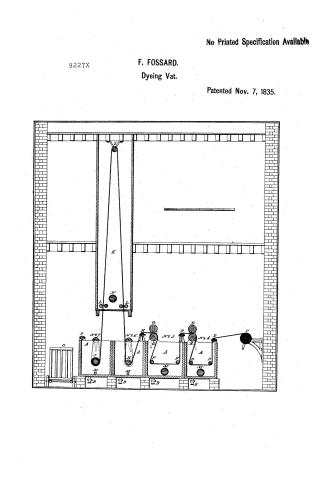
Description of the apparatus. A. A rack on which the Baths are formed. B. Licks to draw off the contents of the Baths. C. Roller on which the cloth is wound before entering the baths. D. roller on and under which the cloth passes in Bath No 4. E. Drying Rollers for equalizing and pressing the liquid out of the cloth. These rollers should be covered with coarse cloth &c. F. Rolling. G. Pressing Rollers down as E. — H. Rollers, the first one to guide the cloth into the bath and the other one to pass it regularly through the liquid in the cloth may be wound on the last one previously to winding into the air. I. Roller, J. roller on which the cloth may be wound or it may be delivered into the bath at liberty. K. enclosure which should be heated. L. M. N. O. P. Q. R. S. T. U. V. W. X. Y. Z.
Page 6.
to the same temperature as the Baths No 6 & 7. This is not absolutely necessary but it is recommended. A guiding Roller. M Tubes introduced into the bath for heating them by steam. N Tube for heating and cleaning the Carriage to raise the cloth after it is dyed. O Guiding Rollers to conduct the cloth into the carriage. O The system of Rollers represented in the plate are recommended and particularly the pressing Roller which should be made very firm and flexible but they are not absolutely necessary. Any other means may be resorted to by which the distribution of the liquid on and through the tissue in an even and regular way shall be obtained. I would also have it understood that I lay no claim to any part of the apparatus above described. The operation for wool is as follows: Take wool which has been well cleaned by the ordinary process, put it into Bath No 1 for about 10 minutes, then raise it out of the liquid, let it drain for 10 minutes, lower it again and let it remain 10 minutes, then raise it and allow to drain 10 or 15 minutes and place it into bath No 2 and 3 cleaning the same out and following the same plan for each of these baths as for No 1. Then turn the wool washed the usual way, when it is well drained (or dried would be preferable) place it again into a strainer and convey it to bath No 4. When it should be treated in the manner as in bath No 1 and after the last immersion it should be allowed to drain for 10 minutes, suspended to the frame, then it should be lowered on the frame, placed across the bath and a false cover pierced with holes should be placed on. Then turn the strainer and wool upside down and allow them to remain in that position for 10 minutes. This operation being intended to distribute the liquor as equally as possible over every part of the wool. Then turn the strainer into into its original position and pass it promptly to bath No 5, when it should occasionally be raised and lowered for about 1/4 of an hour. Then raise it just clear of the bath and allow it to drain for about 20 minutes then pass it into bath No 6, when the immersions should be made similar to those in regard to bath No 1, after which pass it into bath No 7, when the immersion at intervals of 10 minutes will be sufficient. Wash in plenty of cold water.
Page 7.
dry by the ordinary way and then place the wool into the Iron Bath No 8. for about 3/4 of an hour. This will complete the operation of drying and the wool may be treated as though dyed by any other process. The observations relating to the dyeing in the piece inserted above apply also to the dyeing also in the wool. Another method for dyeing wool for Broadcloths by this new process is to pass it into bath No 1 and then to scour it in the ordinary way and wash in plenty of water. When drained press it into a bath of carbonate of Soda, making about 2 degrees of the aometer of Beaumes for salts and 120 degrees Fte for about 10 minutes, when drained carry it to bath 5. for about 20 minutes, wash immediately in plenty of water or rather lower the strainer when the wool will have been draining for but a few minutes into a vat full of lukewarm water so that the liquid draining from the wool be not allowed to become acid again by absorption of oxygen for in that state it combines anew with the iron and carries it off from the wool. Then dry. The advantage of this method is that at the stage of the process the material may be dyed in many colours (and especially in blacks) by means of dye woods without addition of metallic salts to the baths and with a great saving of dye stuffs. For thus the yellow wool is washed into cloth full of dyed &c. then the piece is passed into baths No 4, 6 and 7 by means of the apparatus described above. If the dyes leading to are of a dye solid to acids they will be faithfully preserved and the cloth will bear the appearance of having been dyed altogether in the wool. carry to the stock for cleansing &c. — There are several other modifications of this process which will occur to the dyer and be useful to him in various cases. Cloths stuffs &c. dyed in profusion of iron blue may be dyed in many colours by the ordinary process and dye stuffs as when dyed in indigo blue for when it is necessary in order to obtain evenness and uniformity of colour to distribute the liquid equally after bath No 4, 5 by agitating them with sticks, and if suspended by changing their position that is to say by turning the upper part down and vice versa as long as thought proper. Any other sort of tissue cloths or shrouds than woolen ones do not require baths No 1 2 3 only silks require to be freed from the gum they contain by any of the ordinary
Page 8.
922.77
purposes. The object of this improved process for which a Patent has been granted to me by the government of the United States on the 23rd of April 1834 is to enable the manufacturer to produce a much finer species of Cotton than those generally found in the market and therefore more available in the buying for all business, and also to produce it in much larger quantities at the same time with comparatively much less expense and trouble to himself and inconvenience to the neighborhood.
Witness
Rich. Davis
Oliver Clarke
F. Fossard.
(Drawing)
(2800 Words)
207
Cord.
1836
Published accounts: journal notice
Notice in the monthly list of patents
Journal of the Franklin Institute, new ser., vol. 17 (1836), p. 144 · View the page
682. Prussiates, making and dying with. -Felix Fossard, City of Philadelphia,
Published accounts: journal notice
Notice in the monthly list of patents, with remarks
Journal of the Franklin Institute, new ser., vol. 17 (1836), p. 403 · View the page
1. For improvements in Manufacturing the Prussiates of Potash and Soda, and in dying therewith, and with certain other materials; Felix Fossard, city of Philadelphia; an alien, who has resided two years in the United States; November 7.
Remarks. Mr. Fossard obtained a patent for a purpose similar to the foregoing, on the 14th of December, 1832, and a second on the 3d of April, 1834; and in his present specification he has recapitulated parts of the former for the purpose of making more fully known the improvements which he has since made, which consist, mainly, in the "process of dying blue by the double decomposition of a soluble ferro-cyanate, or prussiate, and a salt of iron, or other metal," by processes which he sets forth, but which are not of a nature to admit of being epitomized, or presented at all in a form which would interest any one not immediately concerned in, and chemically acquainted with, dying processes.
About this record
- Patentee
- Jim Shaw's X-patent list
- Date
- the Name and Date index of patents, USPTO records, Jim Shaw's X-patent list
- Invention
- the Name and Date index of patents
- Listed in
- the Name and Date index of patents, USPTO records, Jim Shaw's X-patent list, the Journal of the Franklin Institute, Burke's List of Patents (1847)
- Burke's 1847 Patent Office list gives the same patent.
- Residence from Burke's 1847 Patent Office list; the standard lists give none.