

Drawings and documents
National Archives restored drawings: drawing
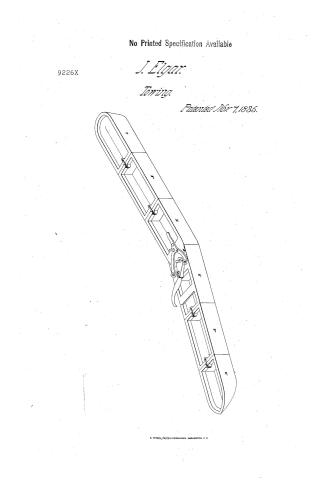
John Elgar's Patent Drawing for and Apparatus for the Transportation of Goods on Canals and Rail Roads

National Archives, Restored Patent Drawings (Record Group 241) · Full-size scan at the National Archives · Catalog record
Show the text on the drawing Hide (92 words)
Words on the drawing as machine-read by the National Archives; not checked. Useful mainly for searching.
ohn / you ratus for the Transportation of goods en Canuls and . Rail / retented Nov.7th 1135 / 9226-X / 114-SHIPS / 92267 / CLASSIFICATION / DIVISION: / References / 4 Cases, which terve on rail roads carbodies and / on canals as boats / B spaped cave / c Sterm shaped / case / D Case with one concave / forming the rule joint / Es Case / 7° Rule joint / a Connecting bar / H Lever / I Fastening / NB. There may be added any required number / cases.A. / Patent offe / Made under direction / in componenty
USPTO scan
The patent as scanned by the USPTO
-
 Page 1
-
 Page 2
-
 Page 3
-
 Page 4


U.S. Patent and Trademark Office · Google Patents
Show the transcription Hide (1,224 words)
Machine transcription (LightOnOCR) of the pages as scanned by the USPTO, most of them the handwritten copies made when the records were restored after the 1836 fire. Not checked; it can misread handwriting, so compare it with the scan.
Page 1.
No Printed Specification Available
9226X
J. Elgar.
Towing.
Patented Nov. 7, 1835.
Page 2.
926x C (Extended for 7 years from 7 November 1829.)
Re-issued 25 December 1835.
John Elgar of the City of Baltimore and State of Maryland.
This schedule referred to in the Letters Patent and making part of the same, containing a description in the words of the said John Elgar himself of his Improvement in the Art of, and apparatus for, the transportation of goods on canals and rail roads.
To all whom it may concern,
Be it known that I John Elgar of the City of Baltimore in the State of Maryland, have invented certain improvements in the art of, and in the apparatus for the conveyance or transportation of goods on a line where canals and Rail Roads form alternate links in the chain of communication, as for example on the great Pennsylvania line from Philadelphia to Pittsburg, a part of which invention or improvement may be applied to the construction of and transportation in Canal Boats on those lines in which the mode of conveyance is by water alone, and I do hereby declare that the following is a full and exact description of my said improvement or invention.
The object which I have in view in the first instance is to prevent the necessity of removing the goods from the vehicle within which they are first loaded, by constructing cases which serve on Rail Roads as car bodies and on canals as boats. This I effect by making such vehicles, or car bodies, of sheet iron in the manner of iron tanks, riveting them up water tight in the same way. The dimensions of these bodies must be determined by that of the Canal locks through which they are to pass when used as boats. If for example the lock will admit a boat of fourteen feet in width and eighty in length, the bodies may be made seven feet wide and twenty feet long so that eight bodies lie abreast and four in length may pass at the same time. I intend sometimes to make the bodies wholly of sheet iron, but they may be made of that material to the height of about three feet only with an additional height say of three feet made of wood. The bodies when made of this length are to be carried upon eight wheeled cars. If your wheeled cars are preferred the bodies must be made of a length suitable.
Page 3.
suitable thrusts, and a greater number of them will then of course be connected together when in the water. As these bodies are by their combination to form canal boats, the requisite number of them are to be so formed at one end as to constitute a well-shaped bow, and the same number are to be so shaped as to constitute a stern, the other ends are to be made square so that when connected by proper fastenings they will be in one continuous inflexible line to the length of the lock through which they are to pass. It is a well-known fact that the resistance to a boat moving through the water is nearly as the cross section of the part immersed, without regard to length, and I contemplate the obtaining a great advantage from the application of this principle in the conversion of our bodies into canal boats, as they are to be made but half the width of an ordinary boat, their draught being the same their cross section will be but one half. I contemplate therefore the coupling of these bodies together in one continuous line, without placing them side by side excepting when they are passing through locks by which means but one half the power of traction ordinarily required will be found necessary the foremost and hindmost bodies constituting a stem and stern.
The great length given to the combined boat in this case, will render it necessary to make provision for passing along those parts of the canal where there is any considerable curvature. For this purpose I construct a certain number of the bodies in such a manner as that when coupled so as to constitute a canal boat they will form a rule joint, which will allow of the requisite lateral motion to conform to the curvature of the canal. To make such a joint the end of one of the bodies composing it must terminate in the concave arc of a semicircle, and that of the corresponding one in a convex semicircle adapted to each other. The distance apart of these flexible joints should be equal to that of an ordinary canal boat, so that when detached they will pass side by side through locks. These rule joint sections are to be constructed by a connecting bar which falls in a plane, on a strong upright pin, fixed in the centre of the circumference of the joint or on any other convenient
Page 4.
9226x
novice mode — To cause the boats so connected to conform to the curvature of the canal, and to steer them by making one act as a rudder to the other, (for a wheel and rudder), or adopt a lever, or other power of each only joint so as to communicate the requisite degree of flexure. A compound boat of any desired length may thus be formed and managed, the first of the series of boats only being bow forward and the last only stern forward. — The bodies may be transferred from the cars to the water, and from the water to the cars by means of powerful cranes, but the mode which I intend in general, to adopt is to extend the rail way down into the canal bottom in the manner practiced in marine railway ways, the bodies may thus be made to float from and on to the cars with the utmost facility. — The rule joint and mode of steering I also intend to apply to canal boats of the ordinary construction and length but reduced in breadth one half, so that in passing through locks the boats may be disconnected at the joints and pass through in pairs side by side, thus obtaining the advantage before alluded to as resulting from the diminution of the cross section and admitting of an increased velocity with a decreased injury to the banks of the canals. — What I claim as my invention is the within described Art of, and apparatus for the conveyance or transportation of goods on lines of canal and rail road, is the constructing of car bodies in the manner set forth, so that they may be converted into canal boats upon the principle and for the purposes herein fully described and specified. I also claim the connecting of such, or other canal boats by rule joints, for the purpose of adapting them to the curvature of the banks, and of steering them by their action upon each other, upon the same principle with that by which a rudder is made to steer an ordinary boat.
Witnesses
C. R. H. Harton
Henry Stone
Jno. Elgar
Patented November 11, 1855
Drawing
Published accounts: journal notice
Notice in the monthly list of patents
Journal of the Franklin Institute, new ser., vol. 17 (1836), p. 144 · View the page
692. Rail road and Canal Transportation. John Elgar, Baltimore, Maryland,
About this record
- Patentee
- the Journal of the Franklin Institute, Journal
- Date
- the Name and Date index of patents, USPTO records, Jim Shaw's X-patent list
- Invention
- the Name and Date index of patents
- Listed in
- the Name and Date index of patents, USPTO records, Jim Shaw's X-patent list, the Journal of the Franklin Institute, Burke's List of Patents (1847)
- The patentee's full name comes from the Franklin Institute's journal.
- Burke's 1847 Patent Office list gives the same patent.