

Drawings and documents
USPTO scan
The patent as scanned by the USPTO
-
 Page 1
-
 Page 2
-
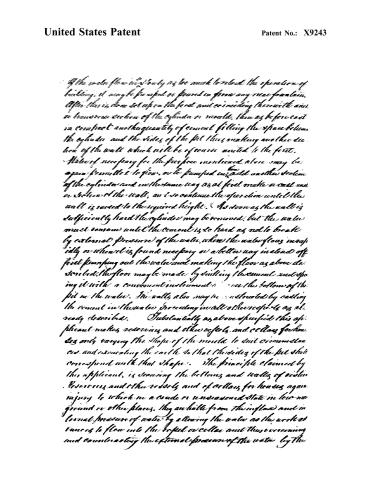 Page 3
-
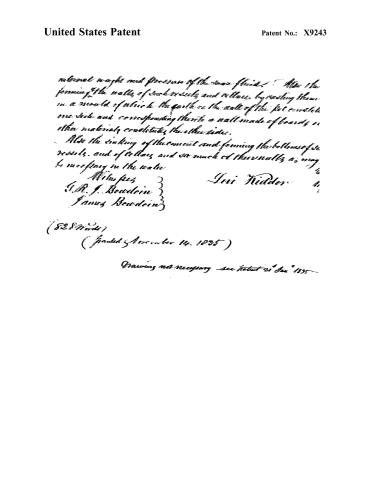 Page 4


U.S. Patent and Trademark Office · Google Patents
Show the transcription Hide (898 words)
Machine transcription (LightOnOCR) of the pages as scanned by the USPTO, most of them the handwritten copies made when the records were restored after the 1836 fire. Not checked; it can misread handwriting, so compare it with the scan.
Page 2.
United States Patent
Patent No.: X9243
See Wiedler
Letters Patent
The Wiedler referred to in these Letters Patent is a machine plant of the same containing a steam piston and the wheels of the said See Wiedler himself of the same invention and nothing more than brief description, etc.
In the case of a certain thin cylindrical pressure as follows: Wiedler the first places a number of sections in a hollow cylinder made in several transverse sections about two feet long and each transverse section in three or more longitudinal sections, fastened together by hooks, pins, or other convenient means, and capable of being taken apart and removed at pleasure from the place in which they are used. These cylinders would maybe of any length and diameter desired. Next a circular pit of sufficient depth is excavated in the earth, in diameter greater than the cylinder or would by twice the required thickness of the cylinder wall to be built. If during the operation of excavating much water has flowed into the pit it may be removed by pumping or other means, then a thick floor of cement mortar is laid all over the bottom of the pit and six inches thick upon this floor which should be level is set one of the transverse sections of the cylinder or would at equal distance all around from the sides or surface of the pit and being set it firmly with the sides of the pit a mould in which to cast the first section of the cylinder wall. If during this last operation the water has again flowed in it is to be removed. It may be again pumped out, a little dense or strong mortar nearly fluid made of cement and the best sand is cast compact between the cylinder and the sides of the pit filling the space between them and thus forming the first section of the cylinder wall. The water is now permitted to flow over this section of the wall into the cylinder thus by its pressure it may prevent the floor or bottom while in an unseasoned state from being injured from the opposed pressure of the water in the walls.
Page 3.
United States Patent
Patent No.: X9243
If the water flows in too slowly or too much to retard the operation of building, it may be fine mixed or poured in from any convenient fountain. Often, then, it is done set up in the first and encircling the earth and in transverse sections of the cylinder or mould, then as before cast in compact another quantity of cement filling the space between the cylinder and the sides of the pit thus making another section of the wall which will be of course united to the first.
Water if necessary for the purpose mentioned above may be again from the 1 to 2 ft. or be pumped in and another section of the cylinder cast in the same way as at first made or cast in a section of the wall, and so continue the operation until the wall is raised to the required height. As soon as the wall is sufficiently hard the cylinder may be removed; but the water must remain until the cement is so hard as not to break by external pressure of the water when the water flows inwardly or when it is found necessary in a better way instead of first pumping out the water and making the floor as above described, the floor may be made by sinking the cement and spiking it with a convenient instrument in the bottom of the pit or the water. The walls also may be constructed by casting the cement in the water proceeding in all other respects as already described. Substantially as above specified this application makes reservoirs and other vessels and cisterns for houses only varying the shape of the mould to suit circumstances and excavating the earth so that the sides of the pit shall correspond with that shape. The principle claimed by this applicant, is storing the bottom and walls of cisterns, reservoirs and other vessels and of cisterns for houses against injury to which in a sudden or unseasoned state in low ground or other places, they are liable from the influx and internal pressure of water by allowing the water as the water at times to flow into the bottom or cistern and thus increasing and counteracting the external pressure of the water by the
Page 4.
United States Patent
Patent No.: X9243
natural weight and pressure of the same fluid. Also the forming of the walls of such vessels and cellars, by casting them in a mold of which the walls are the walls of the pot and the one side and corresponding thereto a wall made of boards or other materials constitutes the other side.
Also the sinking of the cement and forming the bottom of the vessels, and of cellars and so much of their walls as may be necessary in the water.
Inventors:
- Louis Riddler
- A. J. Bourdin
- James Bourdin
(828 words)
(Granted November 14, 1895)
Drawing not necessary — see patent as “Jan” 1895
Published accounts: journal notice
Notice in the monthly list of patents
Journal of the Franklin Institute, new ser., vol. 17 (1836), p. 144 · View the page
699. Cisterns, &c., water proof.-Levi Kidder, city of New York,
Published accounts: journal notice
Notice in the monthly list of patents, with remarks
Journal of the Franklin Institute, new ser., vol. 17 (1836), p. 407 · View the page
18. For Cisterns, Reservoirs, &c. of Hydraulic Cement; Levi Kidder, city of New York, November 14.
Remarks. A pit is to be dug, of a circular form, and the bottom of it is to be covered with hydraulic cement, say to the depth of six inches; upon this floor is to be laid a cylindrical mould, allowing sufficient space between it and the earth for the thickness of the intended side wall, which space is to be filled in with hydraulic cement; another cylindrical section is then to be placed on the former, and the process repeated until the wall is of the required height. To counteract the external pressure from water in the soil, the cistern may be supplied with water from any convenient source, as the work proceeds.
About this record
- Patentee
- the Journal of the Franklin Institute, Journal
- Date
- the Name and Date index of patents, USPTO records, Jim Shaw's X-patent list
- Invention
- the Name and Date index of patents
- Listed in
- the Name and Date index of patents, USPTO records, Jim Shaw's X-patent list, the Journal of the Franklin Institute, Burke's List of Patents (1847)
- The patentee's full name comes from the Franklin Institute's journal.
- The residence comes from the Franklin Institute's journal.
- Burke's 1847 Patent Office list gives the same patent.