

Drawings and documents
USPTO scan
The patent as scanned by the USPTO
-
 Page 1
-
 Page 2
-
 Page 3
-
 Page 4


U.S. Patent and Trademark Office · Google Patents
Show the transcription Hide (1,276 words)
Machine transcription (LightOnOCR) of the pages as scanned by the USPTO, most of them the handwritten copies made when the records were restored after the 1836 fire. Not checked; it can misread handwriting, so compare it with the scan.
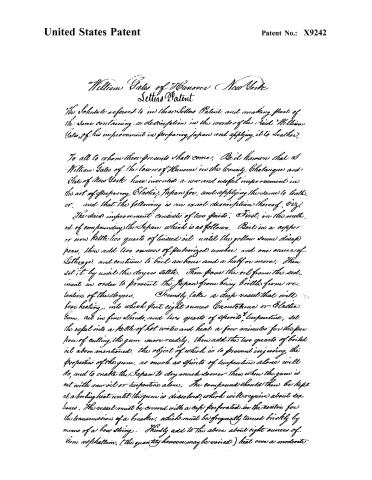
Page 2.
United States Patent
Patent No.: X9242
William Gates of Hanover New York
Letters Patent
The Schedule referred to in these Letters Patent and making part of the same containing a description in the words of the said William Gates of his improvement in preparing Japan and applying it to Leather.
To all to whom these presents shall come, Be it known that I William Gates of the town of Hanover in the County of Ulster and State of New York have invented a new and useful improvement in the art of preparing Elastic Japan for, and applying the same to leather, and that the following is an exact description thereof, viz:
The said improvement consists of two parts. First, in the method of compounding the Japan which is as follows. Boil in a copper or iron kettle two quarts of linseed oil until the yellow scum disappears, then add two ounces of pulverized amber, and one ounce of Litharge, and continue to boil an hour and a half or more; then set it by until the driers settle. Then pour the oil from the sediment in order to prevent the Japan from being brittle from retention of the driers. Secondly, take a deep vessel that will bear heating, into which put eight ounces Casein or Elastic Gum, cut in fine shreds, and two quarts of Spirits of Turpentine, set the vessel into a kettle of hot water and heat a few minutes for the purpose of cutting the gum more readily, then add the two quarts of boiled oil above mentioned, the object of which is to prevent injuring the properties of the gum, as much as Spirits of Turpentine alone will do, and to enable the Japan to dry much sooner than when the gum is cut with raw oil or turpentine alone. The compound should then be kept at a boiling heat until the gum is dissolved, which will require about six hours. The vessel must be covered with a cap perforated in the centre for the transmission of a breaker, which must be frequently turned briskly by means of a bow string. Thirdly add to the above about eight ounces of Gum asphaltum, (the quantity however may be varied) heat over a moderate
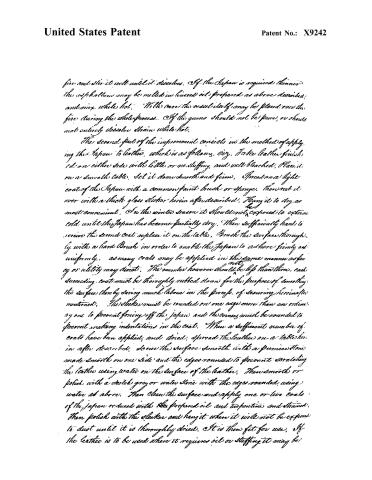
Page 3.
United States Patent
Patent No.: X9242
fire and stir it well until it dissolves. If the Japan is required thinner the asphaltum may be melted in linseed oil prepared as above described and mix while hot. With care the vessel itself may be placed over the fire during the whole process. If the gums should not be pure, or should not entirely dissolve strain while hot.
The second part of the improvement consists in the method of applying this Japan to leather, which is as follows. viz. Take leather finished on either side with little or no stuffing, and well bleached. Place it on a smooth table, set it down smooth and firm. Spread on a light coat of the Japan with a common paint brush or sponge. Then rub it over with a thick glass slicker herein after described. Hang it to dry as most convenient. In the winter season it should not be exposed to extreme cold until the Japan has become partially dry. When sufficiently hard to receive the second coat replace it on the table. Brush the surface thoroughly with a hard brush in order to enable the Japan to adhere firmly and uniformly. As many coats may be applied in the same manner as fancy or utility may direct. The number however should be less than three, each succeeding coat must be thoroughly rubbed down for the purpose of smoothing the surface thereby saving much labour in the process of securing hereinafter mentioned. The slicker must be rounded on one edge more than an ordinary one to prevent forcing off the Japan and the corners must be rounded to prevent making indentations in the coat. When a sufficient number of coats have been applied and dried, spread the leather on a table herein after described. Leave the surface smooth with a pumice stone made smooth on one side and the edges rounded to prevent scratching the leather using water on the surface of the leather. Then smooth or polish with a steel grey or water stone with the edge rounded, using water as above. Then clean the surface and apply one or two coats of the Japan reduced with the prepared oil and turpentine and strained. Then polish with the slicker and hang it where it will not be exposed to dust until it is thoroughly dried. It is then fit for use. If the leather is to be used where it requires oil or stuffing it may be
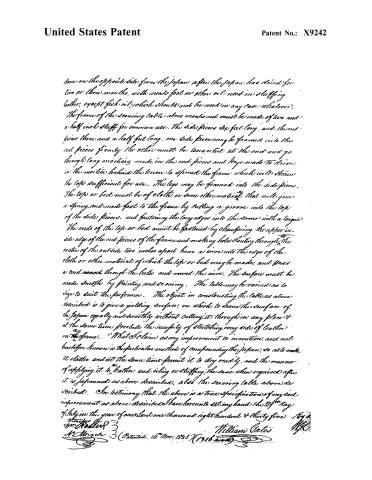
Page 4.
United States Patent
Patent No.: X9242
done on the opposite side from the japan after the japan has dried for two or three months, with meats foot or other oil used in stuffing leather; except fish oil, which should not be used in any case whatever.
The frame of the sewing table above mentioned must be made of two and a half inch stuff for common use. The side pieces six feet long, and the end pieces three and a half feet long. One side piece may be framed into the end pieces firmly; the other must be tenanted at the end and go through long mortises made in the end pieces and keys made to drive in the mortises behind the tenon to spread the frame which will strain the top sufficient for use. The legs may be framed into the side pieces. The top or bed must be of cloth or some other material that will give a spring and made fast to the frame by cutting a groove into the top of the side pieces, and fastening the long edges into the same with a tongue. The ends of the top or bed must be fastened by chamfering the upper inside edge of the end pieces of the frame and making holes slanting through the centre of the outside two inches apart here a wire into the edge of the cloth or other material of which the top or bed may be made, and passes a cord round through the holes and round the wire. The surface must be made smooth by printing and sewing. The table may be varied as to size to suit the performer. The object in constructing the table as above described is to give a yielding surface, on which to sew the surface of the japan equally and smoothly without cutting it through in any place, and at the same time preclude the necessity of stretching every side of leather on the frame.
What I claim as my improvement or invention, and not heretofore known is the particular method of compounding the japan, so as to make it elastic and at the same time permit it to dry readily, and the manner of applying it to leather and oiling or stuffing the same when required after it is japanned as above described, also the sewing table above described.
In testimony that the above is a true specification of my said improvement as above described I have hereunto set my hand the 29th day of July in the year of our Lord one thousand eight hundred & thirty five.
Witness:
Wm. Moirer 3
William Gates
(Patented 14th Nov. 1835) (1316 words)
Published accounts: journal notice
Notice in the monthly list of patents
Journal of the Franklin Institute, new ser., vol. 17 (1836), p. 144 · View the page
703. Japan for leather. William Gates, Hanover, New York,
Published accounts: journal notice
Notice in the monthly list of patents, with remarks
Journal of the Franklin Institute, new ser., vol. 17 (1836), p. 408 · View the page
22. For Preparing and Using Elastic Japan for Leather; William Gates, Hanover, Chatauque county, New York, November 14.
Remarks. The japan is to be prepared by boiling two quarts of linseed oil until the yellow scum disappears, then adding two ounces of umber, and one of litharge, and boiling again for an hour and a half; after this the dryers are to be allowed to settle, and the clear liquor poured off. Eight ounces of India rubber, in shreds, are to be heated in a vessel with two quarts of spirits of turpentine; to these are to be added the two quarts of boiled oil and the compound is to be kept at a boiling heat until the gum is is completely dissolved, which may be six hours. Eight ounces of asphaltum are then to be added and dissolved. This constitutes the japan. The second part of the process consists in laying the varnish on the leather, which is to be done by a brush or sponge, and in the rubbing down and slicking, which are minutely described. The claims made are to "the particular method of compounding the japan so as to make it elastic, and at the same time permit it to dry readily; and the manner of affixing it to the leather." We do not see any thing in the manner of compounding the japan, which is new to us, either as respects the materials employed, or the mode of treating them; nor is the manipulation of laying it on, rubbing it down, slicking, &c. generally distinguished from the plans heretofore followed.
About this record
- Patentee
- the Journal of the Franklin Institute, Journal
- Date
- the Name and Date index of patents, USPTO records, Jim Shaw's X-patent list
- Invention
- the Name and Date index of patents
- Listed in
- the Name and Date index of patents, USPTO records, Jim Shaw's X-patent list, the Journal of the Franklin Institute, Burke's List of Patents (1847)
- The patentee's full name comes from the Franklin Institute's journal.
- The residence comes from the Franklin Institute's journal.
- Burke's 1847 Patent Office list gives the same patent.