

Drawings and documents
National Archives restored drawings: drawing
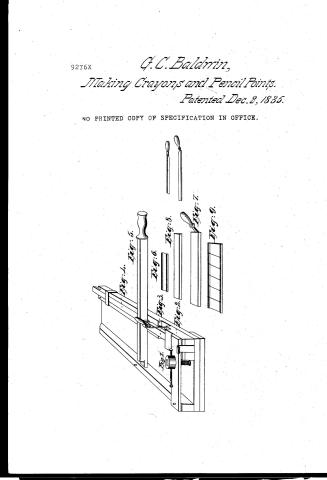
G.C. Baldwin's Patent Drawing for a Machine for Manufacturing Crayons and Pencil Points

National Archives, Restored Patent Drawings (Record Group 241) · Full-size scan at the National Archives · Catalog record
Show the text on the drawing Hide (39 words)
Words on the drawing as machine-read by the National Archives; not checked. Useful mainly for searching.
#1 - / ONLER / Pencils, / Machine for manufacturing (eayous points / classification / 9276 / Patentea Dec 2nd 1835. / DIVIST DIV. / to mentus / office burht is / 9276 / Fig:8 / Fig.y / rig.9.
USPTO scan
The patent as scanned by the USPTO
-
 Page 1
-
 Page 2
-
 Page 3
-
 Page 4


U.S. Patent and Trademark Office · Google Patents
Show the transcription Hide (691 words)
Machine transcription (LightOnOCR) of the pages as scanned by the USPTO, most of them the handwritten copies made when the records were restored after the 1836 fire. Not checked; it can misread handwriting, so compare it with the scan.
Page 1.
9276X
G. C. Baldrin,
Making Crayons and Pencil Points.
Patented Dec. 2, 1835.
NO PRINTED COPY OF SPECIFICATION IN OFFICE.

Page 2.
9276X
Dec 2, 1835
Guy C. Baldwin
Letters Patent
739
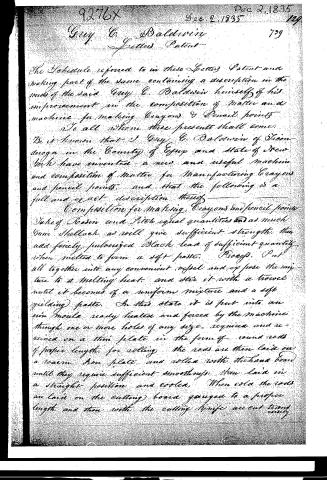
The Schedule referred to in these Letters Patent and making part of the same containing a description in the words of the said Guy C. Baldwin himself of his improvement in the composition of matter and machine for making Crayons & Pencil points.
To all whom these presents shall come:
Be it known that I Guy C. Baldwin of Tioga county in the County of Essex and State of New York have invented a new and useful machine and composition of matter for Manufacturing Crayons and pencil points, and that the following is a full and exact description thereof.
Composition for making Crayons and pencil points
Take of Rosin and Pitch equal quantities and as much Gum Shellack as will give sufficient strength. Then add finely pulverized Black lead of sufficient quantity when melted to form a soft paste.
Process. Put all together into any convenient vessel and expose the mixture to a melting heat, and stir it with a trowel until it becomes of a uniform mixture and a soft yielding paste. In this state it is put into an iron mould ready heated and forced by the machine through one or more holes of any size, acquired and received on a thin plate in the form of round rods of proper length for rolling. The rods are then laid on a rosin iron plate and rolled with the hand board until they acquire sufficient smoothness. Then laid in a straight position and cooled. When cold the rods are laid on the cutting board gauged to a proper length and then with the cutting knife are cut transverse.
Page 3.
124 92767
nearly, and ready for use. Description of the Machine.
Figure 1st A vice attached horizontally to a platform with the screw perpendicular. Figure 2nd A cast iron mould, six inches long, four wide and two deep, with a wooden handle and has a groove or hollow to receive the paste and one or more holes through the end to discharge it. The mould is placed in the vice and made fast. Figure 3rd A follower about eight inches long, suited to the groove in the mould and forces the paste through it. Figure 4th A slide confined by a groove in the platform with a notch to receive the lever and serve to keep the follower in a right direction. Figure 5th A lever three feet in length, worked by hand and acts on a pivot eight inches from the fulcrum or notch in the slide when moved forward carries the follower into the groove in the mould and forces the paste through the hole in the end on to the receiver. Figure 6th A receiver of wood or tin of any length required to receive the rods from the mould and on which they are laid ready for rolling. Figure 7th A rolling plate of cast iron sixteen inches long, four wide and one thick with a wooden handle and polished on one side very smooth for rolling. Figure 8th A hand board of wood of the same dimensions of the rolling plate and held in the hand when rolling the rods on the rolling plate. Figure 9th A cutting board sixteen inches long and three wide both sides and one end are raised one fourth of an inch above the face of the board. The sides are spaced into equal distances of proper lengths and sawed or cut down to the board to receive the cutting knife and on which the rods are laid while cutting. Figure 10th
Page 4.
9276x
A knife with a thin blade six inches long and to be used with a sharp and keen edge. Figure 11th.
A narrow towel used to fill and clean the mouth.
Published accounts: journal notice
Notice in the monthly list of patents
Journal of the Franklin Institute, new ser., vol. 17 (1836), p. 144 · View the page
736. Pencil and crayon points. George C. Baldwin, Ticonderoga, N. Y.
Published accounts: journal notice
Notice in the monthly list of patents, with remarks
Journal of the Franklin Institute, new ser., vol. 18 (1836), p. 35 · View the page
2. For an improvement in the Composition of matter, and a Machine for Manufacturing Crayon and Pencil Points; Guy C. Baldwin, Ticonderoga, Essex county, New York, December 2.
Remarks. For this composition we are told to take equal quantities of rosin and pitch, with as much shellac as is necessary for strength, and to add to them "finely pulverized black lead, of sufficient quantity, when melted, to form a soft paste;" then to expose the mixture to a melting heat, and to stir it with a trowel until it becomes soft and yielding. The composition is then to be put into a heated iron mould, and forced through one or more holes of any size required, when it is in a proper form for rolling, by which it acquires a polished surface. The rolls are then to be laid in a straight position, cooled, gauged, and cut into the required lengths. The foregoing information is succeeded by a "description of the machine," which includes the trowel, the knife, the rubbing board, &c. &c. all of which, of course, are patented, as there is no discrimination between them, nor any thing which can be construed into a claim.
About this record
- Patentee
- Jim Shaw's X-patent list
- Date
- the Name and Date index of patents, USPTO records, Jim Shaw's X-patent list
- Invention
- the Name and Date index of patents
- Listed in
- the Name and Date index of patents, USPTO records, Jim Shaw's X-patent list, the Journal of the Franklin Institute, Burke's List of Patents (1847)
- Burke's 1847 Patent Office list gives the same patent.