

Drawings and documents
USPTO scan
The patent as scanned by the USPTO
-
 Page 1
-
 Page 2


U.S. Patent and Trademark Office · Google Patents
Show the transcription Hide (311 words)
Machine transcription (LightOnOCR) of the pages as scanned by the USPTO, most of them the handwritten copies made when the records were restored after the 1836 fire. Not checked; it can misread handwriting, so compare it with the scan.
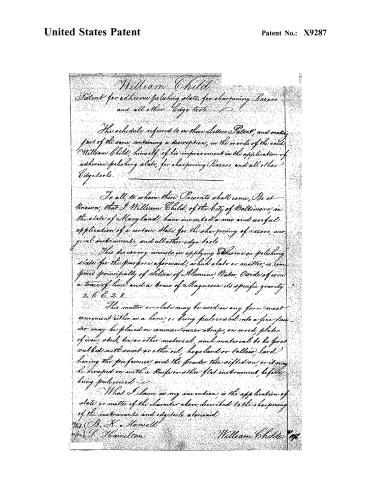
Page 2.
United States Patent
Patent No.: X9287
William Child
Patent for adhesive polishing slate, for sharpening Razors and all other Edge tools
This schedule referred to in these Letters Patent, and making part of the same, containing a description, in the words of the said William Child, himself, of his improvement in the application of adhesive polishing slate, for sharpening Razors and all other Edge tools.
To all, to whom these Presents shall come, Be it Known, that I William Child, of the city of Baltimore, in the state of Maryland, have invented a new and useful application of a certain slate for the sharpening of razors, surgical instruments, and all other edge tools.
This discovery consists in applying adhesive or polishing slate for the purpose aforesaid, which slate or matter, is composed principally of Silica of Alumina, Water, Oxide of iron, a trace of lime and a trace of Magnesia its specific gravity 2.6828.
This matter or slate may be used in any form most convenient either as a hone, or being pulverized into a fine powder may be placed on common razor straps, on wood, plates of iron, steel, tin or other material, such material to be first rubbed with sweet or other oil, hog’s lard or tallow, lard having the preference, and the powder then sifted on, or it may be scraped on with a knife or other flat instrument, before being pulverized.
What I claim as my invention, is the application of slate or matter of the character above described to the sharpening of the instruments and edge tools aforesaid.
Wm. B. K. Mansell
Wm. J. Hamilton
William Child
Published accounts: journal notice
Notice in the monthly list of patents
Journal of the Franklin Institute, new ser., vol. 17 (1836), p. 144 · View the page
757. Sharpening razors, &c.-William Child, Baltimore, Md.
Published accounts: journal notice
Notice in the monthly list of patents, with remarks
Journal of the Franklin Institute, new ser., vol. 18 (1836), p. 41 · View the page
23. For Sharpening Razors, Surgical Instruments, &c.; William Child, city of Baltimore, December 15.
Remarks. Nothing can be more vague than the, so called, specification of this patent, which, we suppose, is taken for the application of some kind of hone, or slate, which the patentee has found in a quarry or bed, somewhere; even this, however, is mere conjecture, as will be seen by quoting his own words, which are, that "this discovery consists in applying adhesive or polishing slate for the purpose aforesaid, which slate or matter is composed principally of silica, of alumi alumine, water, oxide of iron, a trace of lime, and a trace of magnesia, its specific gravity 2.6 to 2.8. * This matter or slate may be used in any form most convenient, either as a hone, or being pulverized into a fine powder, may be placed on common razor straps, &c." 4 " What I claim as my invention is the application of slate or matter of the character above described, to the sharpening of the instruments and edge tools above described." This NEW composition of matter was undoubtedly put together a few thousand, and possibly a few million of years, prior to the period when the serpent beguiled eve, and even prior to the ages in which the Saurian monsters were the lords of the land and of the ocean. "Whetstone, slate, or hone," we are told by Bakewell, " is a variety of talcy slate, containing particles of quartz; when these particles are extremely minute, and the slate has a uniform consistence and requisite degrees of hardness, it forms hones of the best quality." If the patentee has discovered any hones still better, he ought at least to have told us where he had found them, that after the expiration of his exclusive right to the sharpening of his razor upon a transition rock, we might enjoy the same privilege in the same degree.
About this record
- Patentee
- the Journal of the Franklin Institute, Journal
- Date
- the Name and Date index of patents, USPTO records, Jim Shaw's X-patent list
- Invention
- the Name and Date index of patents
- Listed in
- the Name and Date index of patents, USPTO records, Jim Shaw's X-patent list, the Journal of the Franklin Institute, Burke's List of Patents (1847)
- The patentee's full name comes from the Franklin Institute's journal.
- Burke's 1847 Patent Office list gives the same patent.