

Drawings and documents
National Archives restored drawings: drawing
Charles Lane's Patent Drawing for an Improved Fire Place and Grate

National Archives, Restored Patent Drawings (Record Group 241) · Full-size scan at the National Archives · Catalog record
Show the text on the drawing Hide (45 words)
Words on the drawing as machine-read by the National Archives; not checked. Useful mainly for searching.
yes STOVES & PORNACES / Sana / 137 / Fire Places. / 120 / Improval Tin. Place & Fran / $200 / 9288t / IIV / 9288 X / Patenteer 15 Dec 4835 / EXTERNAL VIEW. / Fig: / 1191 / Internal Section / Fig% / B/ / OR / Horizontal Section / (A / / migs.
USPTO scan
The patent as scanned by the USPTO
-
 Page 1
-
 Page 2
-
 Page 3


U.S. Patent and Trademark Office · Google Patents
Show the transcription Hide (791 words)
Machine transcription (LightOnOCR) of the pages as scanned by the USPTO, most of them the handwritten copies made when the records were restored after the 1836 fire. Not checked; it can misread handwriting, so compare it with the scan.
Page 1.
9288X
C. Lane,
Fire Place Grate
Patented Dec. 15, 1835.
No Printed Specification Available
Fig. 1.
Fig. 2.
Horizontal Section
Fig. 3.
Page 2.
12887
Dec. 15, 1855
87
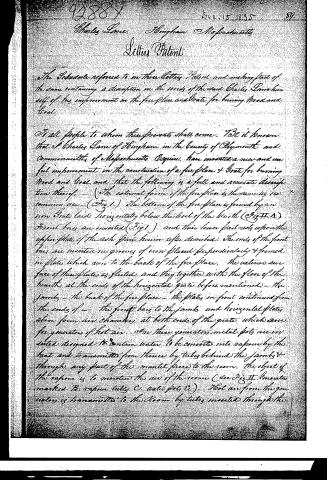
Charles Lane Hingham Massachusetts
Letters Patent
The Schedule referred to in these Letters Patent and making part of the same containing a description in the words of the said Charles Lane himself of his improvement in the fire place and Grate for burning Wood and Coal.
To all people to whom these presents shall come. To be it known that I Charles Lane of Hingham in the County of Plymouth and Commonwealth of Massachusetts Citizen, have invented a new and useful improvement in the construction of a fire place & Grate for burning Wood and Coal, and that the following is a full and accurate description thereof. — (The external form of the fire place is the same as in common use — (Fig 1.) The bottom of the fire place is formed by an iron Grate laid horizontally below the level of the hearth (Fig II. A) Iron bars are inserted (Fig 1) and their lower part rests upon the upper plate of the ash pan herein after described. The ends of the front bars are inserted in grooves of iron placed perpendicularly & formed in plates which are to the back of the fire place. The exterior surface of these plates is fluted and they together with the floor of the hearth at the ends of the horizontal grate before mentioned: — the jambs — the back of the fire place — the plates in front continued from the ends of — the front bars to the jambs and horizontal plates above form air chambers at both ends of the grate which serve for generators of hot air. On these generators metal pots are inserted designed to contain water to be converted into vapour by the heat and transmitted from thence by tubes behind the jambs & through any part of the mantel piece to the room. The object of the vapour is to moisten the air of the room (see Fig II. Generators marked B, vapour tubes C, water pots E). Hot air from the generators is transmitted to the room by tubes inserted through the
Page 3.
sides thereof into the fanks and thence through solid beds of clay to the Room in such place as may be most convenient (Fig. I. D.) the pots containing water may be covered and surmounted by ornamental vases with tops containing a lateral aperture in each movable as to regulate the transmission of vapour (Fig. I. A.) The draft of air to keep the wood or coal ignited is received from below the hearth through a horizontal tube closed at the inner end and opened by a register or air valve at the outer end. With this main tube other tubes are connected which are placed horizontally & at right angles thereto to conduct and distribute the air beneath & to the back part of the grate. The draft may be increased or diminished by a movable register or air valve before mentioned which can be raised or lowered by a metal chain attached to a wheel with a hook (valve & tube Fig. II. A. & wheel and hook Fig. II. B.) A stationary ash pan covered with a fine grate is placed on the hearth the top of which is level therewith to receive all the ashes which falls from the grate. This fine grate is movable & when taken up the ashes in the pan may be emptied therefrom into a pit beneath through an aperture in the side of the pan (Fig. II. ash pan Hb. side aperture I.)
What I claim as my own invention and not previously known in the above described improvement is, First. The sinking of the grate below the level of the hearth, by which means ignition sooner takes place and combustion is increased by excluding the coal from the external air from the Room & the convenience resulting by the deposit of ashes in the bottom of the grate — Second. The generators of hot air & the mode of transmitting it to the room — Third. The production of vapour from the pots of water aforesaid & the transmission of the vapour to the Room to moisten the air — 4th. The valve beneath the hearth and the pipes connected therewith, by which the draft of air may be increased or diminished & distributed — Fifth. The ash pan upon the plan described as before mentioned.
Witnesses Theodore Cushing Charles Lane, Solomon Cushing 17/8 1837 (Drawing)
Published accounts: journal notice
Notice in the monthly list of patents
Journal of the Franklin Institute, new ser., vol. 17 (1836), p. 144 · View the page
751. Fire place. -Charles Lane, Hingham, Mass.
Published accounts: journal notice
Notice in the monthly list of patents, with remarks
Journal of the Franklin Institute, new ser., vol. 18 (1836), p. 39 · View the page
17. For a Fire-place and Grate for burning wood or coal; Charles Lane, Hingham, Plymouth county, Massachusetts, December 15.
Remarks. The lower bars of this grate are to be set below the level of the hearth, and the air to feed it is to be admitted from without, through an opening regulated by a valve, or dampers. The jambs and back are to form hot air chambers, from which the heated air is to be distributed through tubes; vessels for water are also to be contained within the jambs, the vapour from which is to pass into the room through tubes. There are five distinct claims made, which we do not think it necessary to copy, as they contain little if any thing that is new; let one serve as a sample, "the generators of hot air, and the mode of transmitting it to the room." The whole description is of that general character which does not fulfil the requirements of the patent law; and were this defect cured, most of the things claimed would be found untenable.
About this record
- Patentee
- the Journal of the Franklin Institute, Journal
- Date
- the Name and Date index of patents, USPTO records, Jim Shaw's X-patent list
- Invention
- the Name and Date index of patents
- Listed in
- the Name and Date index of patents, USPTO records, Jim Shaw's X-patent list, the Journal of the Franklin Institute, Burke's List of Patents (1847)
- The patentee's full name comes from the Franklin Institute's journal.
- Burke's 1847 Patent Office list gives the same patent.