

Drawings and documents
National Archives restored drawings: drawing
Henry Mellish's Patent Drawing for an Improvement in Hanging Wagons and Other Carriages

National Archives, Restored Patent Drawings (Record Group 241) · Full-size scan at the National Archives · Catalog record
Show the text on the drawing Hide (41 words)
Words on the drawing as machine-read by the National Archives; not checked. Useful mainly for searching.
CARRIAGES & WAGORS / [31] Springs. / Springs = Carriagon / classipication / 9315.4 / DIVISION. / 9315 X / Hecarry Heellish' / Improvement / in hunging Magers & other Carriages. / Patented. Lan: 11th 1836. / Fig 1. / 24 / th / a F
USPTO scan
The patent as scanned by the USPTO
-
 Page 1
-
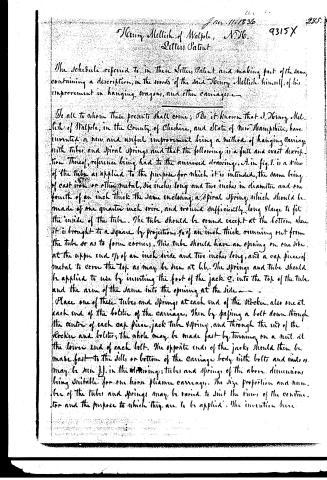 Page 2
-
 Page 3


U.S. Patent and Trademark Office · Google Patents
Show the transcription Hide (528 words)
Machine transcription (LightOnOCR) of the pages as scanned by the USPTO, most of them the handwritten copies made when the records were restored after the 1836 fire. Not checked; it can misread handwriting, so compare it with the scan.
Page 1.
9315X
H. MELLISH.
Carriage-Spring.
Patented Jan. 11, 1836.
Fig. 1.
<!-- Image: Diagram of a carriage spring with labeled parts A, B, C, D -->
Page 2.
Jan. 11/1836 285.
Henry Mellish, of Walpole, N.H. 9315X
Letters Patent
The schedule referred to in these Letters Patent and making part of the same, containing a description, in the words of the said Henry Mellish himself, of his improvement in hanging wagons, and other carriages.
To all to whom these presents shall come; Be it known that I, Henry Mellish, of Walpole, in the County of Cheshire, and State of New Hampshire, have invented a new and useful improvement being a method of hanging carriages with tubes and spiral springs and that the following is a full and exact description thereof, reference being had to the annexed drawing. A in fig. 1 is a view of the tube as applied to the purpose for which it is intended, the same being of cast iron or other metal, six inches long and two inches in diameter and one fourth of an inch thick the same enclosing a spiral spring which should be made of one quarter inch wire, and wound sufficiently long to fit the inside of the tube. The tube should be round except at the bottom when it is brought to a square by projections 9 of an inch thick running out from the tube so as to form corners. This tube should have an opening on one side at the upper end 5/8 of an inch wide and two inches long, and a cap piece of metal to cover the top as may be seen at b.b. The springs and tube should be applied to use by inserting the foot of the jack c, into the top of the tube and the arm of the same into the opening at the side.
Place one of these tubes and springs at each end of the rocker, also one at each end of the bottom of the carriage. Then by passing a bolt down through the centre of each cap piece, jack tube & spring, and through the end of the rocker and bolster, the whole may be made fast by turning on a nut at the lower end of each bolt. The opposite ends of the jacks should then be made fast to the sills or bottom of the carriage body with bolts and nuts as may be seen f.f. in the drawing; tubes and springs of the above dimensions being suitable for one horse pleasure carriages. The size proportion and number of the tubes and springs may be varied to suit the views of the constructor and the purpose to which they are to be applied. The invention here
Page 3.
claimed, and for which a Patent is desired to be secured is the combined application of the springs and tube to the above named purpose.
Witnesses:
David Fisher
Joseph Fisher
Henry Aldrich
Drawing
Published accounts: journal notice
Notice in the monthly list of patents, with remarks
Journal of the Franklin Institute, new ser., vol. 18 (1836), p. 115 · View the page
13. For Hanging Carriages by means of tubes and spiral springs; Henry Mellish, Walpole, Cheshire county, New Hampshire, January 11.
Remarks. "The invention here claimed is the combined application of the springs and tubes to the above named purpose." The contrivance consists simply of a spiral spring of wire enclosed in a tube, with such appendages as are necessary to attach it to the carriage, and to cause the weight of the body to rest upon the springs. There is no novelty whatever in the employ. ment of spiral springs, contained within tubes, for hanging carriage bodies, but they have been found so much less to be depended upon than springs of the more ordinary kind, that they have uniformly, after trial, been thrown aside.
About this record
- Patentee
- DATAMP
- Date
- the Name and Date index of patents, DATAMP, USPTO records
- Invention
- DATAMP
- Listed in
- the Name and Date index of patents, DATAMP, USPTO records, Jim Shaw's X-patent list, the Journal of the Franklin Institute, Burke's List of Patents (1847)
- Burke's 1847 Patent Office list gives the same patent.