

Drawings and documents
National Archives restored drawings: drawing
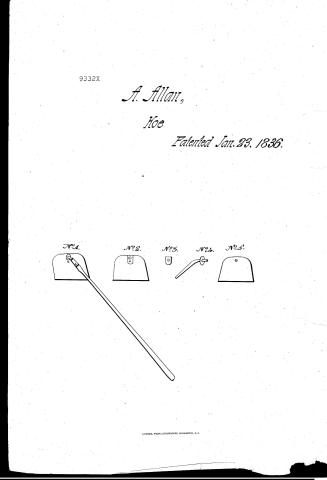
Adna Allan's Patent Drawing for a Hoe

National Archives, Restored Patent Drawings (Record Group 241) · Full-size scan at the National Archives · Catalog record
Show the text on the drawing Hide (37 words)
Words on the drawing as machine-read by the National Archives; not checked. Useful mainly for searching.
classipication / 9332-X / BIVISION / 9332X / 1/1 / 55 HARROWS AND DIGGERS. / Hoes. / wgo / Adna Allan's Hoe. / Patentia Jany 23? 1836. / Not / n°2 No No. N°S
USPTO scan
The patent as scanned by the USPTO
-
 Page 1
-
 Page 2


U.S. Patent and Trademark Office · Google Patents
Show the transcription Hide (351 words)
Machine transcription (LightOnOCR) of the pages as scanned by the USPTO, most of them the handwritten copies made when the records were restored after the 1836 fire. Not checked; it can misread handwriting, so compare it with the scan.
Page 1.
9332X
A. Allan,
Hoe
Patented Jan. 23, 1836.

Page 2.
UNITED STATES PATENT OFFICE.
ADNA ALLEN, OF RAMAPO, NEW YORK.
GARDEN OR FIELD HOE.
Specification forming part of Letters Patent dated January 23, 1836.
To all whom it may concern:
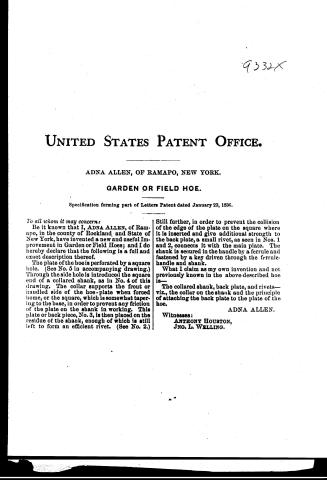
Be it known that I, ADNA ALLEN, of Ramapo, in the county of Rockland and State of New York, have invented a new and useful Improvement in Garden or Field Hoes; and I do hereby declare that the following is a full and exact description thereof.
The plate of the hoe is perforated by a square hole. (See No. 5 in accompanying drawing.) Through the side hole is introduced the square end of a collared shank, as in No. 4 of this drawing. The collar supports the front or handled side of the hoe-plate when forced home, or the square, which is somewhat tapering to the base, in order to prevent any friction of the plate on the shank in working. This plate or back piece, No. 3, is then placed on the residue of the shank, enough of which is still left to form an efficient rivet. (See No. 2.)
Still further, in order to prevent the collision of the edge of the plate on the square where it is inserted and give additional strength to the back plate, a small rivet, as seen in Nos. 1 and 2, connects it with the main plate. The shank is secured in the handle by a ferrule and fastened by a key driven through the ferrule-handle and shank.
What I claim as my own invention and not previously known in the above-described hoe is—
The collared shank, back plate, and rivets—viz., the collar on the shank and the principle of attaching the back plate to the plate of the hoe.
ADNA ALLEN.
Witnesses:
ANTHONY HOUSTON,
JNO. L. WELLING.
Published accounts: journal notice
Notice in the monthly list of patents, with remarks
Journal of the Franklin Institute, new ser., vol. 18 (1836), p. 121 · View the page
37. For an improvement in the Garden Hoe; Adna Allen, Ramapo, Rockland county, New York, January 23.
Remarks. This patent is taken for the manner of attaching the shank to the plate of the hoe, so as to render it secure from working loose. The plate or blade of the hoe, is perforated with a square hole; the shank is made to fit this hole, and has a collar formed on it which comes up against the plate; a second plate, like a washer, passes over the shank on the face of the hoe, and the whole is secured together by riveting; the shank is secured in the handle by a ferule, and fastened by a key driven through both. The claim is to "the collared shank, back plate, and rivets, viz: the collar on the shank, and the principle of attaching the back plate to the plate of the hoe."
About this record
- Patentee
- DATAMP
- Date
- the Name and Date index of patents, DATAMP, USPTO records
- Invention
- DATAMP
- Listed in
- the Name and Date index of patents, DATAMP, USPTO records, Jim Shaw's X-patent list, the Journal of the Franklin Institute, Burke's List of Patents (1847)
- Burke's 1847 Patent Office list gives the same patent.