

Drawings and documents
National Archives restored drawings: drawing
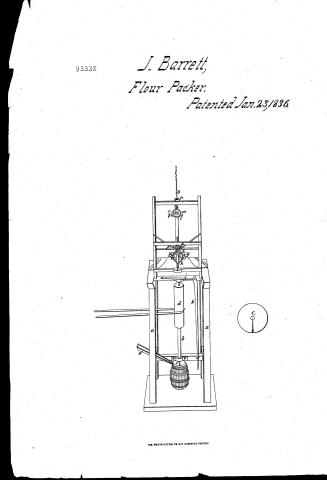
Jonathan Barrett's Patent Drawing for a Flour Press

National Archives, Restored Patent Drawings (Record Group 241) · Full-size scan at the National Archives · Catalog record
Show the text on the drawing Hide (33 words)
Words on the drawing as machine-read by the National Archives; not checked. Useful mainly for searching.
give 100. [67] PRESSES. Flour Packere Packing / $1. / Contin Comf / J O NATHAY BARBETT / CLASSINICATION / FLOUR / S. / 9333X / DIVISION / Pulented / 9333
USPTO scan
The patent as scanned by the USPTO
-
 Page 1
-
 Page 2
-
 Page 3
-
 Page 4


U.S. Patent and Trademark Office · Google Patents
Show the transcription Hide (1,012 words)
Machine transcription (LightOnOCR) of the pages as scanned by the USPTO, most of them the handwritten copies made when the records were restored after the 1836 fire. Not checked; it can misread handwriting, so compare it with the scan.
Page 1.
9333X
J. Barrett,
Flour Packer.
Patented Jan. 23, 1836.

AM. PHOTO-LITHO. CO. N.Y. (OSBORNE'S PROCESS)
Page 2.
Jan. 23, 1836
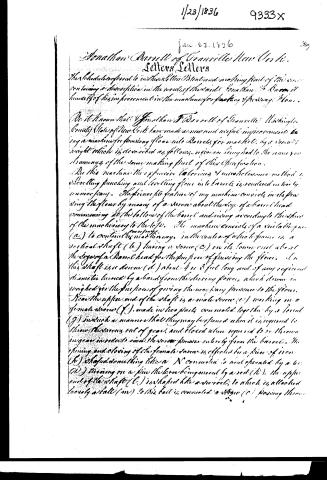
Jonathan Burrall of Granville New York.
Letters Letters
The Schedule referred to in the Patent Statement making part of this specification a description in the words of the said Jonathan Burrall himself of his improvement in the machine for packing & pressing flour.
It is known that Jonathan Burrall of Granville Washington County State of New York have made some and useful improvements being a machine for pressing flour into Barrels for market, by a certain weight which is described as follows, reference being had to the annexed drawings of the same making part of this Specification.
In this machine the expensive laborious & unwholesome method of rolling punching and leveling flour into barrels is rendered entirely unnecessary. The principal feature of my machine consists in the pressing the flour by means of a screw about the size of a barrel head commencing at the bottom of the barrel and rising according to the form of the machinery to the top. The machine consists of a suitable press (a) to contain the machinery in the center of which frame is a vertical shaft (b) having a screw (c) on its lower end about the size of a barrel head for the purpose of pressing the flour. On this shaft is a drum (d) about 4 or 5 feet long and of any required diameter turned by a band from the driving power, which drum is weighed for the purpose of giving the necessary pressure to the flour. Near the upper end of the shaft is a male screw (e) working in a female screw (f) made in two parts connected together by a joint (g) in such a manner that they may be opened when it is required to throw the screws out of gear, and closed when required to be thrown in gear in order to save the screw power entirely from the barrel. The opening and closing of the female screw is effected by a piece of iron (h) shaped something like a N connected to and operated by a lever (i) turning on a pin the lever being moved by a rod (k). The upper end of the shaft (b) is shaped like a screw, to which is attached loosely a ball (m) to this ball is connected a finger (o) passing through
Page 3.
370.
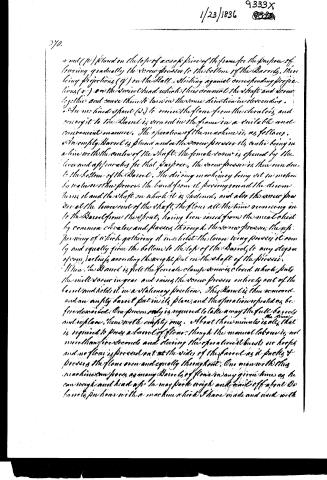
a nut (p) placed on the top of a cone of pieces of the frame for the purpose of forcing gradually the screw pressor to the bottom of the Barrel, there being projections (q) on the Wall, striking against corresponding projections (r) on the screw head which thus connect the shaft and screw together and cause them to turn in the same direction in descending.
An inverted spout (s) to receive the flour from the elevator, and convey it to the Barrel is secured in the frame in a suitable and convenient manner. The operation of the machine is as follows.
An empty Barrel is placed under the screw pressor its axis being in a line with the centre of the shaft. The female screw is opened by the lever and adjusted as for that purpose, the screw pressor is then run down to the bottom of the Barrel. The driving machinery being set in motion by water or other power, the band from it having round the drum turns it and the shaft on which it is fastened, and also the screw pressor at the lower end of the shaft, the flour all the time running in to the Barrel from the spout, having been raised from the meal chest by common elevator and passed through the screw pressor, the efficiency of which gathering it in whilst the screw pressor is evenly and equally from the bottom to the top of the Barrel, to any degree of firm packing, according to the weight put on the shaft of the pressor.
When the Barrel is full the female clamp screw is closed which puts the male screw in gear and raises the screw pressor entirely out of the barrel and holds it in a stationary position. The Barrel is then removed and an empty Barrel put in its place, and the operation repeated as before described. One person only is required to take away the full barrels and replace them with empty ones. About three minutes is all that is required to press a barrel of flour, though the manual labour is not more than five seconds and during the operation it busts no hoops and no flour is pressed out at the sides of the barrel as it packs & presses the flour even and equally throughout. One man with this machine can press as many Barrels of flour in any given time as he can weigh and load after he may pack weigh and haul off about 20 barrels per hour with a machine which I have made and used with
Page 4.
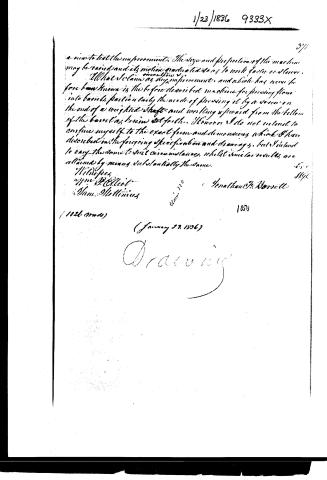
a view to test the improvement. The size and proportions of the machine may be varied and its motion graduated so as to work faster or slower.
What I claim as my improvement, and which has never before been known in the before described machine for pouring flour into barrels, particularly the mode of pouring it by a reservoir on the end of a weighted shaft and working upward from the bottom of the barrel as herein set forth. However I do not intend to confine myself to the exact form and dimensions which I have described in the foregoing specification and drawings, but I intend to say the same to such circumstances, which similar results are attained by means substantially the same.
Witness
Wm. P. Elliot
Sam. Mettinius
Jonathan H. Norvell
(1026 words)
(January 23, 1836)
Drawing
Published accounts: journal notice
Notice in the monthly list of patents, with remarks
Journal of the Franklin Institute, new ser., vol. 18 (1836), p. 120 · View the page
35. For a Machine for Packing Flour in Barrels; Jonathan F. Barrett, Granville, Washington county, New York, January 23.
Remarks. This is certainly a new, and, we think, a good machine. The flour to be pressed, runs into the barrel in a continuous stream, and the pressing commences at the bottom, and goes on until the barrel is filled. The barrel is placed on the bed of the press, and above it there is a vertical shaft, which is made to revolve by a drum and band, and is capable of rising and falling through the height of the barrel At the lower end of this shaft there is what is called a screw, but this essential part is very imperfectly described; it is nearly of the diameter of the interior of the barrel, and appears to be a transverse section, containing a single thread of a screw, and it has, of course, an opening from its upper to its lower side, through which flour may pass. The shaft, we suppose, must revolve in a direction tending to raise this section of a screw, and the bottom of it, forming a spiral inclined plane, presses upon the flour as it passes through the opening, having to operate upon thin successive strata only, and thus gradually rising to the top, when the packing is completed. The shaft is loaded with any amount of weight which may be found necessary, and there is appended to it the apparatus necessary for raising and lowering the shaft rapidly, when requisite. The claim made is to the employment of "a screw on the end of a weighted shaft," in the manner described. The patentee says that about three minutes completes the pressing of a barrel of flour; the manual labour, however, not exceeding five seconds; that during the operation there is not any bursting of hoops, or pressing of flour out of the sides; that with a machine made to test the improvement, one man can readily pack, weigh, and nail off, about twenty barrels per hour.
About this record
- Patentee
- DATAMP
- Date
- the Name and Date index of patents, DATAMP, USPTO records
- Invention
- DATAMP
- Listed in
- the Name and Date index of patents, DATAMP, USPTO records, Jim Shaw's X-patent list, the Journal of the Franklin Institute, Burke's List of Patents (1847)
- Burke's 1847 Patent Office list gives the same patent.