

Drawings and documents
National Archives restored drawings: drawing
Unknown and Eli. W. Blake's Patent Drawing for an Improvement in Mortice and Other Locks

National Archives, Restored Patent Drawings (Record Group 241) · Full-size scan at the National Archives · Catalog record
Show the text on the drawing Hide (22 words)
Words on the drawing as machine-read by the National Archives; not checked. Useful mainly for searching.
ideis Hardware / Locks / thinking / XYESE / of
USPTO scan
The patent as scanned by the USPTO
-
 Page 1
-
 Page 2
-
 Page 3
-
 Page 4
-
 Page 5


U.S. Patent and Trademark Office · Google Patents
Show the transcription Hide (1,416 words)
Machine transcription (LightOnOCR) of the pages as scanned by the USPTO, most of them the handwritten copies made when the records were restored after the 1836 fire. Not checked; it can misread handwriting, so compare it with the scan.
Page 1.
Classification 9353 X
Division 9353 X
Improvement in Letter-Press Locks. 2-5-1836
Patented Feb 6, 1836
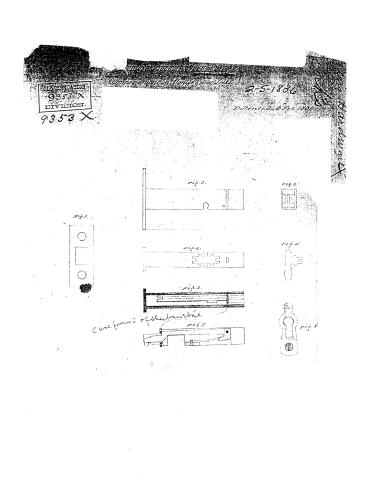
Fig. 1.
Fig. 2.
Fig. 3.
Fig. 4.
Fig. 5.
Fig. 6.
Fig. 7.
Fig. 8.
Case formed of the material
Page 2.
9353X Feb 6, 1836 Feb 5, 1836 425
Philip Blake & Eli Whiting Blake, Ohio, Harro. Co.
Letters Patent
The defendants referred to in their Letters Patent and making part of the same containing a description of the art of the said Philip Blake & Eli Whiting Blake, both of Ohio, Harro. Co., in the county of Harro, in the state of Connecticut, citizens of said state of the United States, have invented and constructed several new and useful improvements in locks and other locks consisting in certain modifications of the structure of locks as heretofore made whereby the manufacture is facilitated and the expense diminished. In which the mortise lock may be reduced to such a compact size that it may be fast with but injury to doors, the time to receive the mortise locks heretofore in use. The following is a full and accurate description of the said lock as modified by the introduction of our improvements.
The Case or part which contains or includes the moving parts of the lock. It has a piece of flat iron or other metal whose length is equal to the distance that the lock is to reach in from the edge of the door and whose width is equal to the width inside of the two sides and one edge of the case being but three or right angles forms the two sides and bottom of the case. One end of this piece then forms a secured by holding, riveting, bracing, or otherwise, to the edge plate or flat through which the bolt protrudes when thrown out. The end of the key hole or that part which receives the axis of the key is made to the two sides close to the bottom of the case so that it cuts across the bottom of the case, one edge then leads to the other to allow of the passage of the bit of the key which bit when the key is introduced passes chiefly or wholly below the bottom of the case to permit the key to rotate in its axis and to bring its bit within the case. In the moving parts of the lock the bottom of the case is the just place to carry the cutting edge in a form corresponding to whole or in part to the joining the key. The constituting means to the lock.
The Bolt—This has a square head and thin shank and in the common locks the form and position of the shank may be varied to make variety in the locks and with the motion that may be chosen to guide its motion and direction.
Page 4.
9353X 427.
place and in due degree subverting the purpose of the little or tiny hole in the lock. In this case a great force will be produced incapable of being opposed to the lock unless it keeps within the limits of the thickness of the keyhole or the other or both of the notches in the key hole which are respectively fast.
The Tumbler Spring one spring may act on several tumblers, or which is preferable each tumbler may have its appropriate spring. The springs may be secured to the tumbler keys either to the case bolt or tumbler. When the tumblers are attached to the bolt we prefer to attach their springs to the bolt also by riveting them to an arm projecting from one side of it. Should the arm or key be missing, the case alone is limited to describe a piece enough to cross its upper edge or interior arc. It does not properly because we consider the lock complete without it. It adds nothing either to the cleansing, security, utility or durability of the lock and may therefore be dispensed with. When economy is desired, if however, we are unable to manufacture it, we shall be deemed more valuable with a key. This may be made in various ways. A cheap and good method would be to press the interior of the lock from the upper edge while in a thin piece of sheet iron or other metal, having it and turned down to cover the end of the case. The key, however, must not be so made as to differ in any respect from the key before it was except in the form of the key as already described which must of course conform to the peculiar construction, arrangement and position of the interior mechanism of the lock.
The Catch Bolt. This does not necessarily differ from the corresponding part of a common surface lock. The key hole is situated and drops the key. But we will here differ from those keys, for we are using a key for a lock from the door by projecting backwards to set a lever from behind the door. When the drop is being behind it either on a piece projecting back from the door or the catchhole or one of the doors or catchholes, which it is desired to the door by means of this catchhole, the drop may be made with a hole or a thin sheet iron or brass which should be slightly too insufficient to pass through the outside of the catchhole. The drop should have a small hole or pin reaching beyond the edge of the catchhole either at the top or near the bottom by means of which it may be withdrawn from the key hole.
Page 5.
9353x
The above is submitted. The Mortise lock thereabove described is new or is by its features to be new in the following particulars which we deem important as mainly contributing to the compactness of its form & the facility of its construction & which generally are collectively & collectively combined to which or in them & which as our invention that I am combining a case whose two sides or edges are of one piece with the Mortise or frame described & having the Mortise side by attaching thereon the bolt, the upper edge of the case or box is that toward which the bit of the key is turned when it acts on the bolt & the other edge is the lower edge or bottom & by constructing the case as to have it open or capable of being opened to the purpose of receiving & adjusting the internal machinery of the lock on its upper edge & not on either side or bottom or edge & by so locating the key hole, that when the key is introduced it be always just in the hole or in part below the bottom of the case & by using the edge or bottom of the case in the moving the lock by cutting it to correspond to the or in part to the form of the key & by combining a bolt moved by the action of the key & a notch or between cheeks on the side of its head & with the falling into slot or recess the bit of the key & by so locating the Mortise so as to prevent that it may fall into the same hole or recess in the bit of the key whether the key be introduced from one side or the other of the Door & by combining the Mortise as herein described of having the Mortise by attaching same to the bolt with the inserted & herein described of giving same direct security to the lock & by having several screws falling into corresponding notches or holes of different depths in the bit of the key & by placing the drop behind the key hole & in them & by so placing the foregoing eight innermost particulars are all applicable to frame described & the Mortise lock or so before claim there all in their application to Mortise locks & the same with the exception of the frame & second they are equally applicable to all other known & other locks & to the same claim there & with the exception of the frame & second & their application to other locks.
Patentee Feb 6, 1856
Drawing
2045 a 82
Published accounts: journal notice
Notice in the monthly list of patents, with remarks
Journal of the Franklin Institute, new ser., vol. 18 (1836), p. 188 · View the page
26. For an improvement in Mortise and other Locks; Philos and Eli W. Blake, New Haven, Connecticut, February 5.
Remarks. This lock exhibits much ingenuity and skill in its construction, but the description and drawing would both be necessary to make the plan adequately known. There are eight specific claims, which if given alone, would not afford an idea of the structure; we must therefore pass it over, as requiring more space for illustration than can be afforded.
About this record
- Patentee
- DATAMP
- Date
- the Name and Date index of patents, DATAMP, USPTO records
- Invention
- DATAMP
- Listed in
- the Name and Date index of patents, DATAMP, USPTO records, Jim Shaw's X-patent list, the Journal of the Franklin Institute, Burke's List of Patents (1847)
- Burke's 1847 Patent Office list gives the same patent.