

Drawings and documents
National Archives restored drawings: drawing
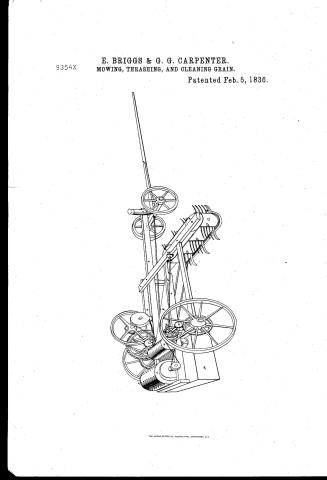
Eliakim Briggs and George C. Carpenter's Patent Drawing for a Machine for Mowing, Thrashing, and Cleaning Grain

National Archives, Restored Patent Drawings (Record Group 241) · Full-size scan at the National Archives · Catalog record
Show the text on the drawing Hide (69 words)
Words on the drawing as machine-read by the National Archives; not checked. Useful mainly for searching.
ELIAKIM . C. = CARPENTER. / 56. / Mouring Minashing & cleaning Grains / 1.2 20 / 9354-4 / PIVISION. / Patented 5th fel 1836. / new / 9354 X / 14 Essen pingers / according thrasher / giving motion luttie unriplet Cylinders / H. iced-Roller / Her stran somether Grain. / Patrick Office whing 183 8 / Made under the direction of the legal / f Patentain comformity with acts haves / Gen Striemandary / Mymph Elemonth / for imponse of
USPTO scan
The patent as scanned by the USPTO
-
 Page 1
-
 Page 2
-
 Page 3
-
 Page 4


U.S. Patent and Trademark Office · Google Patents
Show the transcription Hide (1,050 words)
Machine transcription (LightOnOCR) of the pages as scanned by the USPTO, most of them the handwritten copies made when the records were restored after the 1836 fire. Not checked; it can misread handwriting, so compare it with the scan.
Page 1.
E. BRIGGS & G. G. CARPENTER.
MOWING, THRASHING, AND CLEANING GRAIN.
Patented Feb. 5, 1836.

THE NORRIS PETERS CO., PHOTO-LITHO., WASHINGTON, D.C.
Page 2.
9354X
Feb 5, 1836
William Briggs and George S. Carpenter of Franklin Co. N.Y.
Letters Patent
The Schedule referred to in these Letters Patent and making part of the same, containing a description on the records of the said William Briggs and George S. Carpenter themselves of their improvement in the machine for Mowing, Threshing and cleaning Grain.
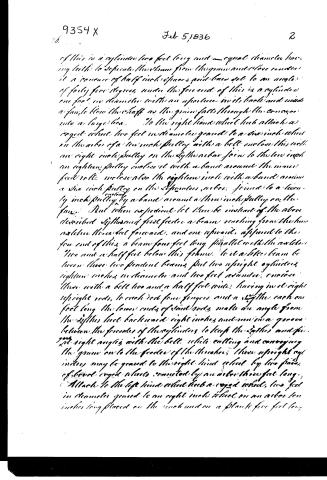
To all to whom these Presents shall come: Be it known that We William Briggs and George S. Carpenter, of Fort Livingston in the County of Franklin and State of New York, have invented a new and useful improvement in harvesting, Threshing and cleaning Grain, and that the following is a full and exact description of the construction and operation of said machine as invented by us. The machine may be erected upon four wheels, like the four wheels of a wagon, and the team harness to it as to a Wagon. The four side bars are four, and the hind axle bar ten feet long. They are nine feet apart and connected by a reach one foot wide and fourteen feet long, with a parallel reach framed to its right ten feet from it, but eleven feet long. The thighs are two tythes six feet long, and four feet apart attached to an arbor parallel with, and six feet from end of the hind axlebar, by arms joining them thirty two and a half degrees as they rotate to end. A crank connected to the tythes arm will meet a quadrant on the parallel reach and force the wire screen between the tythes forward of their edges to let the cut grain slide down from it on to the first feed or, enclosing two arbor, three feet long and six inches deep, joined with the tythes above by timbers framed to the reach and hind axlebar. Said first feeder will run parallel with the tythes, and at right angles and convey the grain on to a second feeder of like fashion, but running backwards, via first conveys the grain up between the cheeks into the thresh or which is two feet long, and one in diameter. Directly back.
Page 3.
of this is a cylinder two feet long and equal diameter having teeth to separate the straw from the grain and close under it a groove of half inch space, point bars set to an angle of forty five degrees, under the fore end of this is a cylinder one foot in diameter with an aperture in its back and made a fan, to blow the staff as the grain falls through the groove into a large box. To the right hand wheel hub attach a cogged wheel two feet in diameter geared to a six inch wheel on the axis of a ten inch pulley with a belt enclose this with an eight inch pulley on the sifter bar join to the ten inch an eighteen pulley enclose it with a band around the inner feet roll, enclose also the eighteen inch with a band around a six inch pulley on the separator, wheel, joined to a twenty inch pulley by a band around a three inch pulley on the fan. But when expedient let there be instead of the above described sifter and first feeder a beam reaching from the hammer three feet forward, and one upward, affixed to the fore end of this, a beam four feet long, parallel with the axle two and a half feet below this frame, to it a like beam be hewn there two pendent beams, put two upright cylinders eighteen inches in diameter and two feet asunder, enclose them with a belt two and a half feet wide, having in it eight upright rods, to each rod four fingers and a sifter each one foot long, the lower ends of said rods make an angle from the sifter back eight inches and run in a groove between the faces of the cylinders to keep the sifter and fingers right angles with the belt while cutting and conveying the grain on to the feeder of the thresher. These upright cylinders may be geared to the right hand wheel by two pairs of bevel cogged wheels connected by an axle three feet long. Attach to the left hand wheel hub a cogged wheel, two feet in diameter geared to an eight inch wheel on an axle ten inches long placed on the rack and on a plank five feet long.
Page 4.
9354 X Feb 5, 1836 3
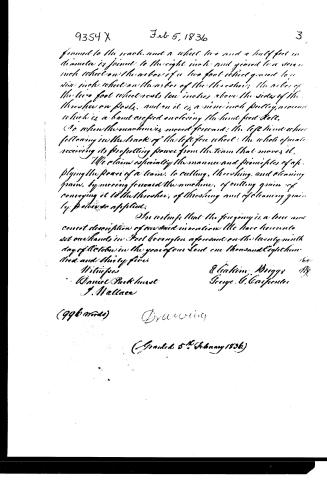
fitted to the racks, and a wheel two and a half feet in diameter is joined to the eight inch and geared to a seven inch wheel on the arbor of a two foot wheel geared to a six inch wheel on the arbor of the threshing; the sides of the two foot wheel rests ten inches above the sides of the threshing on posts, and on it is a nine inch pulley, around which is a band crossed enclosing the head feed Roll.
So when the machine is moved forward, the left hand wheel following in the track of the left fore wheel, the whole of grain receiving its propelling power from the team that moves it.
We claim especially the manner and principles of applying the power of a team, to cutting, threshing, and cleaning grain, by moving forward the machine, of cutting grain, of conveying it to the threshing, of threshing and of cleaning grain by power so applied.
In witness that the foregoing is a true and correct description of our said invention, We have hereunto set our hands in Pat. Covington aforesaid on the twenty ninth day of October in the year of our Lord one thousand Eight hundred and thirty five.
Witnesses
Daniel Burkhurst
J. Wallace
Eliakin Briggs
George S. Carpenter
(996 words) Drawing
(Granted 5th February 1836)
Published accounts: journal notice
Notice in the monthly list of patents, with remarks
Journal of the Franklin Institute, new ser., vol. 18 (1836), p. 184 · View the page
10. For a Machine for Harvesting, Thrashing, and Cleaning Grain; Eliakim Briggs and George W. Carpenter, Covington, Franklin county, New York, February 5.
Remarks. This machine is to run on four wheels, like wagon wheels, the adhesion of the hind wheels to the ground carrying revolving scythes, a cylinder thrashing machine, and other appurtenances. The apparatus is not fully described, and we are very apprehensive that it had not been fairly tried before being patented, as we are of opinion that its promise upon paper would not be realized in the wheat field. Its power to cut, convey, thrash, and clean grain, and the satisfactory concurrent action of all its parts, would not, we think, have given it a passport to the Patent Office. The claim is to "the manner and principles of applying the power of a team to cutting, thrashing, and cleaning grain, by moving forward the machine; of cutting grain, of carrying it to the thrasher, of thrashing, and of cleaning grain, by power so applied." This claim does not, with sufficient distinctness, state the particular machinery for effecting the object, refers to no individual part of it, but appears to relate more to the end than to the means, whilst the latter is the only thing patentable.
About this record
- Patentee
- DATAMP
- Date
- the Name and Date index of patents, DATAMP, USPTO records
- Invention
- DATAMP
- Listed in
- the Name and Date index of patents, DATAMP, USPTO records, Jim Shaw's X-patent list, the Journal of the Franklin Institute, Burke's List of Patents (1847)
- Burke's 1847 Patent Office list gives the same patent.