

Drawings and documents
National Archives restored drawings: drawing
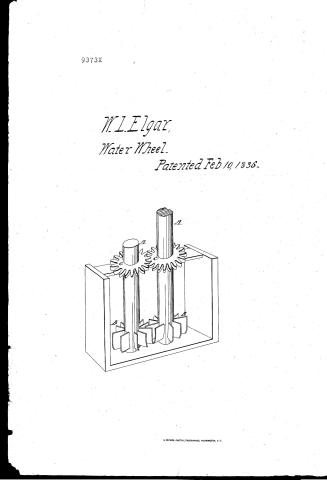
W.L. Elgar's Patent Drawing for a Twain Water-wheel

National Archives, Restored Patent Drawings (Record Group 241) · Full-size scan at the National Archives · Catalog record
Show the text on the drawing Hide (37 words)
Words on the drawing as machine-read by the National Archives; not checked. Useful mainly for searching.
188, MOTORS / Botary, / [168 / 95734 / 8373X / W. IIs. o HITH GARIS / I wain Water-Wheel / Palented / A Strafts / B. Flonts / C. cogrew / a Sirickland Dei
USPTO scan
The patent as scanned by the USPTO
-
 Page 1
-
 Page 2


U.S. Patent and Trademark Office · Google Patents
Show the transcription Hide (315 words)
Machine transcription (LightOnOCR) of the pages as scanned by the USPTO, most of them the handwritten copies made when the records were restored after the 1836 fire. Not checked; it can misread handwriting, so compare it with the scan.
Page 1.
9373X
W. L. Elgar,
Water Wheel.
Patented Feb 10, 1836.
Page 2.
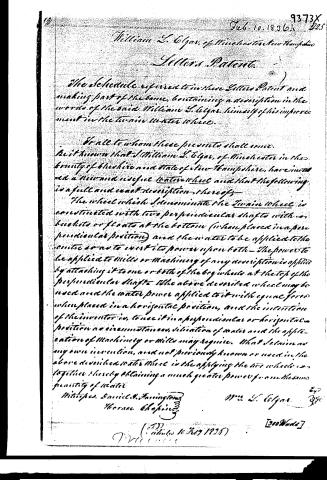
William L. Elgar, of Winchester, Northamptonshire
Letters Patent.
The schedule referred to in these Letters Patent and making part of the same, containing a description in the words of the said William L. Elgar, himself of his improvement in the turbine water wheel.
To all to whom these presents shall come.
Be it known that I William L. Elgar, of Winchester in the county of Berkshire and state of New Hampshire, have invented a new and useful water wheel and that the following is a full and exact description thereof.
The wheel which I denominate the Turbine wheel is constructed with two perpendicular shafts with buckets or floats at the bottom (when placed in a perpendicular position) and the water to be applied to the center so as to exert its power upon both. The power to be applied to mills or machinery of any description is applied by attaching it to one or both of the big wheels at the top of the perpendicular shafts. The above described wheel may be used and the water power applied to it with equal force when placed in a horizontal position, and the intention of the inventor is to use it in a perpendicular or horizontal position as circumstances, situation of water and the application of machinery or mills may require. What I claim as my own invention, and not previously known or used in the above described water wheel is the applying the two wheels together thereby obtaining a much greater power from the same quantity of water.
Witnesses, Daniel R. Harrington
Herman Chapin
Wm L. Elgar
[300 Words]
Published accounts: journal notice
Notice in the monthly list of patents, with remarks
Journal of the Franklin Institute, new ser., vol. 18 (1836), p. 188 · View the page
31. For a Twain Water Wheel; William L. Elgar, Chester county, New Hampshire, February 10.
Remarks. Here are to be two shafts each having buckets, or floats, at one end, and geared together at the other by cog wheels. The water is to be "applied at the centre, so as to exert its power on both," and the claim made is to "the applying the two wheels together, thereby obtaining a much greater power from the same quantity of water." We are not instructed in the manner of causing the water to act upon the floats in the centre only, and we really cannot tell how it is to be effected; the thing, however, is altogether unworthy of thought. 32. For a machine for Planing and Dressing Boards; Melzer Twells, Milo, Yates county, New York, February 10, A fare wheel is to revolve vertically, carrying four, or any other number of, plane irons, and close to the periphery are to be cutting bits, or hooks, to precede the double or single irons in their operation. The boards are to be held edgewise, resting against standards upon a suitable carriage, and held against the vertical standards by dogs. The plane wheel is to be driven by one band and whirl, and the carriage to be moved by another. This comprises all the information given, and there is not any claim. The plan has nothing in it having the remotest alliance to novelty, nor does it bear those features of maturity which would lead to the conclusion that it had been tried. The fact, is that as presented in the specification, it will not work well, and if it would, a patent could not be sustained for it.
About this record
- Patentee
- DATAMP
- Date
- the Name and Date index of patents, DATAMP, USPTO records
- Invention
- DATAMP
- Listed in
- the Name and Date index of patents, DATAMP, USPTO records, Jim Shaw's X-patent list, the Journal of the Franklin Institute, Burke's List of Patents (1847)
- Burke's 1847 Patent Office list gives the same patent.