

Drawings and documents
National Archives restored drawings: drawing
William Gerrish's Patent Drawing for a Boot Crimp

National Archives, Restored Patent Drawings (Record Group 241) · Full-size scan at the National Archives · Catalog record
Show the text on the drawing Hide (18 words)
Words on the drawing as machine-read by the National Archives; not checked. Useful mainly for searching.
with / OR
USPTO scan
The patent as scanned by the USPTO
-
 Page 1
-
 Page 2
-
 Page 3


U.S. Patent and Trademark Office · Google Patents
Show the transcription Hide (724 words)
Machine transcription (LightOnOCR) of the pages as scanned by the USPTO, most of them the handwritten copies made when the records were restored after the 1836 fire. Not checked; it can misread handwriting, so compare it with the scan.
Page 1.
9375X
W. Gerrish,
Boot Crimp,
Patented Feb. 10, 1836.
Page 2.
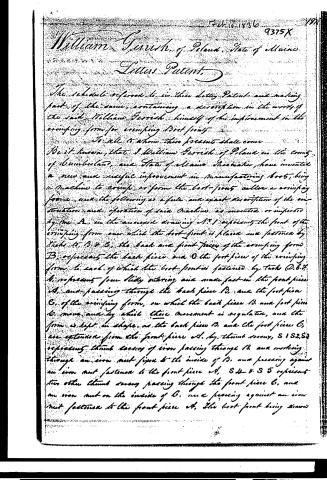
William Gerrish, of Poland, State of Maine
Letters Patent.
The schedule referred to in these Letters Patent and making part of the same, containing a description in the words of the said William Gerrish himself of his improvement in the crimping form for crimping boot fronts.
To all to whom these presents shall come
Be it known, that I William Gerrish of Poland in the county of Cumberland, and State of Maine aforesaid, have invented a new and useful improvement in manufacturing boots, being a machine to crimp or form the boot-fronts called a crimping form, and the following is a full and exact description of the construction and operation of said machine as invented or improved by me. A, in the annexed drawing at 1.1 represents the front of the crimping form over which the boot-front is placed and fastened by tacks to B & C, the back and front pieces of the crimping form. B, represents the back piece and C the front piece of the crimping form to each of which the boot-front is fastened by tacks D, E, F, G. H, represents four slides entering and made fast on the front piece A, and passing through the back piece B, and the front piece C, of the crimping form, on which the back piece B, and front piece C, move, and by which their movement is regulated, and the form is kept in shape, as the back piece B, and the front piece C, are extended from the front piece A, by thumb screws, S 1 S 2, S 3, representing thumb screws of iron passing through B, and working through an iron nut fixed to the inside of B, and pressing against an iron nut fastened to the front piece A, S 4 & S 5 represent two other thumb screws passing through the front piece C, and an iron nut on the inside of C, and pressing against an iron nut fastened to the front piece A. The boot-front being drawn
Page 3.
82
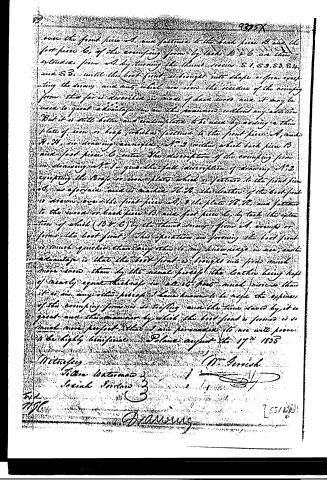
use the front piece A, and fasten to the back piece B, and the foot piece C, of the crimping form by tabs D & E are then extended from A by turning the thumb screws S1, S2, S3, S4, and S5, until the boot front is brought into shape or form excepting the seams and cuts which are iron the residue of the crimping form thus far is described is made of hard wood and it may be used to great advantage in this manner without any alteration. But it is still better and contemplated to be used by adding a thin plate of iron or hoop, which is fastened to the front piece A, marks H, H, in drawing annexed, No. 2 within which back piece B and foot piece C enter. The description of the crimping form in drawing No. 1 gives the full description of drawing No. 2 excepting the brass or iron plate which is fastened to the front piece A, as aforesaid and is marked H, H. The leather of the boot front is drawn over the front piece A, & the plate H, H, and fastened to the wood or back piece B, and foot piece C, by tabs, the extension of which (B & C) by the thumb screws, from A, crimps or forms the boot front, this operation in forming the boot front is much quicker than any other to my knowledge in use, and the advantage is that the boot front is brought into form much more even than by the usual process, the leather being kept of nearly equal thickness in all its parts much more so than it is in any other process. I have known to be made the soles of the crimping form are so trifling and the time saved by it is great and the manner by which the boot front is formed is so much more perfect that I am persuaded its use will prove to be highly beneficial.
Poland August the 17th 1835
Witness
Tilton Waterman
Sarah Perkins
M. Gerrish
[Signature]
Drawing
[557489]
Published accounts: journal notice
Notice in the monthly list of patents, with remarks
Journal of the Franklin Institute, new ser., vol. 18 (1836), p. 188 · View the page
28. For Preventing malt liquors from becoming sour; Josiah Stowell, Manchester, Hillsborough county, New Hampshire. (See specification.) 29. For a Crimping Form, for crimping boots; William Gerrish, Poland, Cumberland county, Maine, February 10.
Remarks. The form, with the screws and nuts by which the leather is to be drawn on to it, are fully described, but there is no claim made, or any attempt to discriminate between this and the numerous other contrivances for the same purpose.
About this record
- Patentee
- DATAMP
- Date
- the Name and Date index of patents, DATAMP, USPTO records
- Invention
- DATAMP
- Listed in
- the Name and Date index of patents, DATAMP, USPTO records, Jim Shaw's X-patent list, the Journal of the Franklin Institute, Burke's List of Patents (1847)
- Burke's 1847 Patent Office list gives the same patent.