

Drawings and documents
National Archives restored drawings: drawing
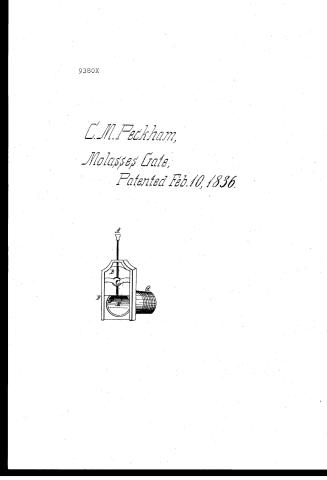
Charles M. Peckham's Patent Drawing for a Molasses Gate

National Archives, Restored Patent Drawings (Record Group 241) · Full-size scan at the National Archives · Catalog record
Show the text on the drawing Hide (89 words)
Words on the drawing as machine-read by the National Archives; not checked. Useful mainly for searching.
37 WATER DISTRIBUTIO / Cocks & / Sales / Sliding Gates HARLES M. IP CKHAS / (10) RIGHTED DISTRIBUTION / MOLASSES GATE. / (10) have Ture / 500 / CLASSIFICATION / E G. / 9380x / Paiented 1836. / #9380x / DIVISION. / References, / 4, / A.the knob at the lop of the rod / B.sliding gate or valve / C. elliptical brass spring / Difront rim of the head or ledge for the / E.orifice in the pipe for dischargeing / F packing of leather in the head / G. serew on the pipe or barrel,
USPTO scan
The patent as scanned by the USPTO
-
 Page 1
-
 Page 2
-
 Page 3


U.S. Patent and Trademark Office · Google Patents
Show the transcription Hide (854 words)
Machine transcription (LightOnOCR) of the pages as scanned by the USPTO, most of them the handwritten copies made when the records were restored after the 1836 fire. Not checked; it can misread handwriting, so compare it with the scan.
Page 1.
9380X
C.M. Peckham,
Molasses Gate,
Patented Feb. 10, 1836.

Page 2.
9380X Feb. 10, 1836. 261
Charles W. Beckham, of New Haven. Conn.
Letters Patent.
The Schedule referred to in these Letters Patent and making part of the same, containing a description in the words of the said Charles W. Beckham himself of his improvement in the Fount for drawing molasses and other liquids.
To all to whom these presents shall come: Be it known that I, Charles W. Beckham, of New Haven, in the County of New Haven in the State of Connecticut, have invented a new and useful improvement in molasses gates, which I call "Beckham's improved molasses gates" and that the following is a full and exact description thereof.
My improved molasses gate is made of block tin or other composition of metal and consists of a tapering pipe or tube, armed with the thread of a screw, about half of its length on the smallest end, by which it may be screwed in and made fast in a hole made for that purpose in the head of the vessel or cask to which it is applied. This pipe or tube for hogheads is about four inches long and one and a quarter inch in diameter, and may be proportionally less for smaller casks.
This pipe or tube is in common use and I claim no improvement therein, but my improvement consists in the gate attached to the pipe. This gate consists of four parts viz. the head, the slide, the spring and the piston and knob. These parts except the spring are cast separately in suitable moulds. The head for hoghead gates is a plate of metal about one eighth of an inch thick, about two inches broad, four or five inches in height the sides and top being turned up or over so as to form a lip or ledge to guide and hold the spring and piston described, near the lower end of this head an orifice is made to receive the mouth of the pipe or tube. This orifice is larger than the mouth of the pipe and the head plate rests on a ring or ledge on the tube, to which it is firmly soldered on the back side, bringing the mouth of the tube exactly even with the front face of the head leaving in front a hollow space between the end of the pipe and the front face of the head to be filled with a ring of pliable leather as a valve to press on the slide and prevent leaking.
The slide is a flat piece or plate of metal, broad enough to fill the space
Page 3.
between the lips or side ledges of the head varying half the height of the head, so as fully to cover when shut, the mouth of the pipe & the leather ring around it. When raised, will leave the mouth of the pipe open. The back side of this plate or slide is made quite smooth. On the front side of it, are ledges to receive & hold the spring. The spring I make of brass, iron or steel, & is a flat piece about half an inch broad & long enough to reach to and play freely between the lips or ledges on the sides of the head piece. It is bent elliptically so that when in place the ends will press upon the lips & ledges of the head, while the bowing centre of the spring will press the sliding plate against the leather ring around the mouth of the pipe & prevent all leaking.
From the top of the sliding plate or gate a piston or rod rises, passing through a hole in the top ledge of the head to guide & keep it steady & terminates in a knob, by which the slide or gate is moved up or down, so as to open or close the mouth of the pipe at pleasure.
These several parts being put together and the leather ring or valve inserted in the manner above described, form a faucet peculiarly adapted to the draft of molasses or any similar liquors & may be used for water or other liquids. It is preferable to all others in use, in this, that it is simple in its construction & its several parts are visible & accessible. For a further illustration of my invention, I refer to the model and drawings of the same deposited in the Patent office. What I claim as my invention & not previously known in the above described machine, is the application of the spring and the manner of its application as above specified. Therefore I solicit Letters Patent according to the law, in such case provided. Dated at New Haven August 26th 1855.
Witnesses
Simon Baldwin
W. S. Peterson
Charles W. Hookham
Expt.
Patent
[Signature]
Published accounts: journal notice
Notice in the monthly list of patents, with remarks
Journal of the Franklin Institute, new ser., vol. 18 (1836), p. 190 · View the page
39. For an improved Molasses Gate; Charles W. Perkham, New Haven, Connecticut, February 10.
Remarks. This gate is constructed like those in general use, but a spring is used to press the gate, or sliding plate, against the orifice of the instrument, and the employment of the spring, exclusively, is the subject of the claim.
About this record
- Patentee
- DATAMP
- Date
- the Name and Date index of patents, DATAMP, USPTO records
- Invention
- DATAMP
- Listed in
- the Name and Date index of patents, DATAMP, USPTO records, Jim Shaw's X-patent list, the Journal of the Franklin Institute, Burke's List of Patents (1847)
- The Franklin Institute's journal spells the name differently.
- Burke's 1847 Patent Office list gives the same patent.