

Drawings and documents
USPTO scan
The patent as scanned by the USPTO
-
 Page 1
-
 Page 2
-
 Page 3
-
 Page 4
-
 Page 5


U.S. Patent and Trademark Office · Google Patents
Show the transcription Hide (1,285 words)
Machine transcription (LightOnOCR) of the pages as scanned by the USPTO, most of them the handwritten copies made when the records were restored after the 1836 fire. Not checked; it can misread handwriting, so compare it with the scan.
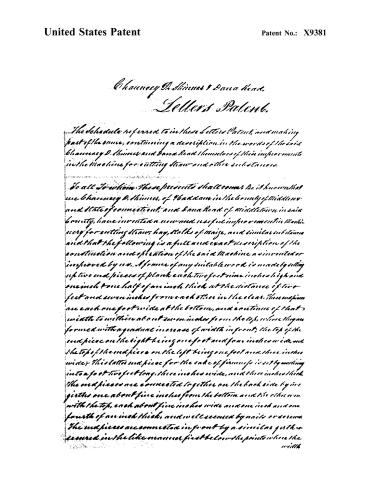
Page 2.
United States Patent
Patent No.: X9381
Chamney D. Shimer & Dana Read,
Letters Patent.
The schedule referred to in these Letters Patent, and making part of the same, containing a description in the words of the said Chamney D. Shimer and Dana Read themselves of their improvement in the machine for cutting straw and other substances.
To all to whom these presents shall come: Be it known that we Chamney D. Shimer, of Middletown in the county of Middlesex and state of Connecticut, and Dana Read of Middletown in said county, have invented a new and useful improvement in Machine for cutting straw, hay, stalks of maize, and similar substances and that the following is a full and exact description of the construction and operation of the said Machine as invented or improved by us. A frame of any suitable wood is made by setting up two end pieces of plank each two feet nine inches high and one inch and one half of an inch thick at the distance of two feet and seven inches from each other in the clear. These end pieces are each one foot wide at the bottom, and continue of that width to within about seven inches from the top, where they are formed with a gradual increase of width in front, the top of the end piece on the right being one foot and four inches wide, and the top of the end piece on the left being one foot and three inches wide. This latter end piece for the sake of firmness is set by mortising into a foot two feet long, three inches wide, and three inches thick. The end pieces are connected together on the back side by five girths one about five inches from the bottom and the other with the top, each about five inches wide and one inch and one fourth of an inch thick, and well secured by nails or screws. The end pieces are connected in front by a similar girth secured in the like manner just below the point where the width
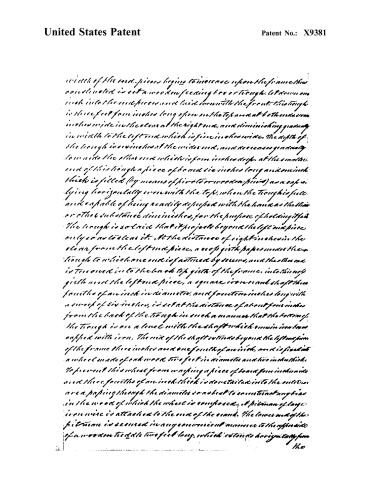
Page 3.
United States Patent
Patent No.: X9381
width of the end-pieces begins to increase upon the frame thus constructed is set a wooden feeding box or trough, let down one inch into the end pieces and laid even with the front. This trough is three feet from inches long upon the top and at both ends an inch wide in the clear at the right end, and diminishing gradually in width to the left end which is five inches wide. The depth of the trough increases at the wider end, and decreases gradually towards the other end which is four inches deep. At the smaller end of this trough a piece of board six inches long and one inch thick is fitted (by means of pivots or wooden pins) as a cap, lying horizontally even with the top, when the trough is full and capable of being readily adjusted with the hand as the hair or other substance diminishes, for the purpose of holding it fast. The trough is so made that it projects beyond the left end piece only so as to clear it. At the distance of eight inches in the clear from the left end piece, a roof girth passes under the trough to which one end is fastened by screws, and the other is introduced into the back top girth of the frame, into which girth and the left end piece, a square iron and shaft three fourths of an inch in diameter, and fourteen inches long with a screw of six inches, is set at the distance of about four inches from the back of the trough in such a manner that the bottom of the trough is on a level with the shaft which remains in the cap with iron. The end of the shaft extends beyond the left end piece of the frame three inches and one fourth of an inch, and is fixed at a wheel made of oak wood two feet in diameter and two inches thick. To prevent this wheel from warping a piece of board four inches wide and three fourths of an inch thick is dovetailed into the outside area passing through the diameter so as best to counteract any bias in the wood of which the wheel is composed. A pitman of large iron wire is attached to the end of the crank. The lower end of the pitman is secured in any convenient manner to the opposite of a wooden trolley two feet long, which extends horizontally from the
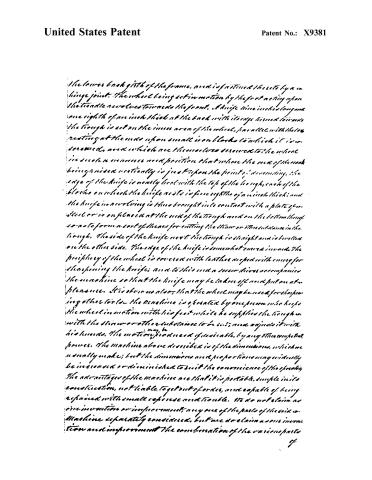
Page 4.
United States Patent
Patent No.: X9381
The lower back girth of the frame, and is fastened thereto by a hinge joint. The wheel being set in motion by the foot acting upon the treadle revolves towards the front. A knife nine inches long and one eighth of an inch thick at the back with its edge turned towards the trough is set on the inner area of the wheel, parallel with the rim, resting at the ends upon small iron blocks to which it is screwed, and which are themselves screwed to the wheel in such a manner and position that when the end of the work being raised vertically is just upon the point of descending, the edge of the knife is nearly level with the top of the trough, each of the blocks on which the knife rests is five eighths of an inch thick and the knife in revolving is thus brought into contact with a plate of steel or is on placed at the end of the trough and on the bottom thereof so as to form a sort of shears for cutting the straw or other substance in the trough. The side of the knife next the trough is straight and is bevelled on the other side. The edge of the knife is somewhat more inward. The periphery of the wheel is covered with leather adapted with energy for sharpening the knife; and to this end a screw driver accompanies the machine so that the knife may be taken off and put on at pleasure. It is obvious also, that the wheel may be used for sharpening other tools. The machine is operated by one person who keeps the wheel in motion with his foot while he supplies the trough with the straw or other substance to be cut; and adjusts it with his hands. The motion may be produced if desirable, by any other suitable power. The machine above described is of the dimensions, which are usually made; but the dimensions and proportions may evidently be increased or diminished to suit the convenience of the operator. The advantages of the machine are that it is portable, simple in its construction, not liable to get out of order, and capable of being repaired with small expense and trouble. We do not claim as our invention or improvement, any one of the parts of the said machine separately considered, but we do claim as our invention and improvement the combination of the various parts of
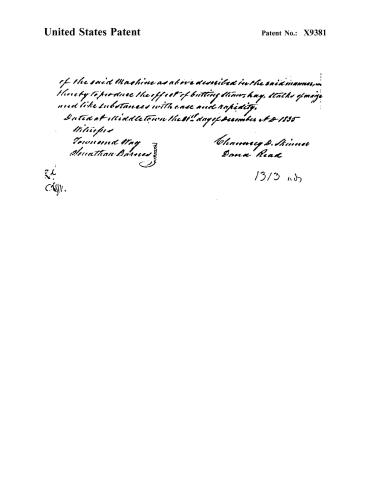
Page 5.
United States Patent
Patent No.: X9381
of the said Machine as above described in the said manner,
thereby to produce the effect of cutting flax, hay, stalks of maize
and like substances with ease and rapidity.
Dated at Middletown the 8th day of December A.D. 1835
Witnesses
Thomas D. Skinner
Donna Read
13/3 w.d.
Published accounts: journal notice
Notice in the monthly list of patents, with remarks
Journal of the Franklin Institute, new ser., vol. 18 (1836), p. 189 · View the page
34. For a Machine for cutting Straw, Hay, &c. &c.; Chauncy D. Skinner and Dana Reed, Haddam, Middlesex county, Connecticut, February 10.
Remarks. The specification of this patent gives a verbose description of the dimensions of the different parts of the machine, and ends by claiming "the combination of the various parts as described." The material to be cut is placed in a trough in the usual way, and the knife is fixed upon the face of a wheel revolving vertically; the shaft of this wheel has a crank on it, and is to be driven by the aid of a treadle, in the manner of a foot lathe. There is no feeding apparatus, or any thing of moment not pointed out by us.
About this record
- Patentee
- DATAMP
- Date
- the Name and Date index of patents, DATAMP, USPTO records
- Invention
- DATAMP
- Listed in
- the Name and Date index of patents, DATAMP, USPTO records, Jim Shaw's X-patent list, the Journal of the Franklin Institute, Burke's List of Patents (1847)
- Burke's 1847 Patent Office list gives the same patent.