

Drawings and documents
National Archives restored drawings: drawing
J. E. Thomas' Patent Drawing for a Churn

National Archives, Restored Patent Drawings (Record Group 241) · Full-size scan at the National Archives · Catalog record
Show the text on the drawing Hide (46 words)
Words on the drawing as machine-read by the National Archives; not checked. Useful mainly for searching.
Brust / 31. DAIRY. / Rotary Churns. / Vertical Double Dasher. / nets / JENTHOMAS / Parallel Shafts. / of / CHURN. / Parence d 12th Feb. 1836 / 9394-+ / 8 : / DIV / 93947 / Top / Top / to / Section. / (tay mean only)6) / eg HI his / 70034 mystmay
USPTO scan
The patent as scanned by the USPTO
-
 Page 1
-
 Page 2
-
 Page 3


U.S. Patent and Trademark Office · Google Patents
Show the transcription Hide (469 words)
Machine transcription (LightOnOCR) of the pages as scanned by the USPTO, most of them the handwritten copies made when the records were restored after the 1836 fire. Not checked; it can misread handwriting, so compare it with the scan.
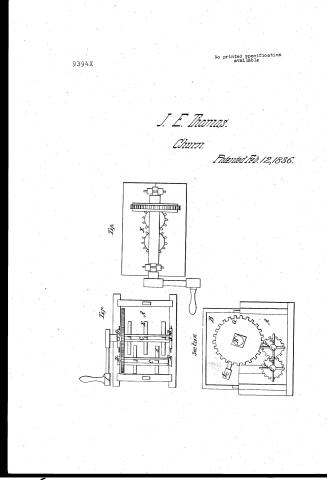
Page 1.
9394X
No printed specification available
J. E. Thomas.
Churn.
Patented Feb. 12, 1836.

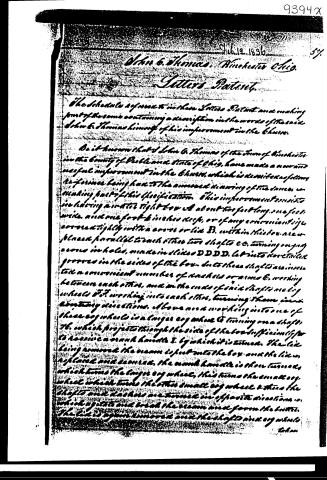
Page 2.
9394x
Jul. 12, 1896. 57.
John G. Thomas, Winchester Ohio.
Letters Patent.
The Schedule of use to in these Letters Patent and making part of the same containing a description in the words of the said John G. Thomas himself of his improvement in the churn.
Be it known that I John G. Thomas of the Town of Winchester in the County of Preble and State of Ohio, have made a new and useful improvement in the churn, which is described as follows reference being had to the annexed drawing of the same, on making part of this specification. This improvement consists in having a water tight box A about two feet long, one foot wide, and one foot & inches deep, or of any convenient size covered tightly with a cover or lid B, within this box are placed parallel to each other two shafts C C, turning on any axis in holes, made in slides D D D D, let into horizontal grooves in the sides of the box. Into these shafts are inserted a convenient number of racks or arms E, working between each other, and in the ends of said shafts are cog wheels F F working into each other, turning them in contrary directions. Above one is working into one of these cog wheels is a larger cog wheel G turning on a shaft H, which projects through the side of the box sufficiently far to receive a crank handle I, by which it is turned. The lid being removed the cream is put into the box and the lid is replaced and secured, the crank handle is then turned, which turns the larger cog wheel, this turns the small cog wheel which turns the other small cog wheel & thus the shafts and racks are turned in opposite directions, which agitate and break the cream and form the butter. The lid is again removed and the shaft D and cog wheel taken
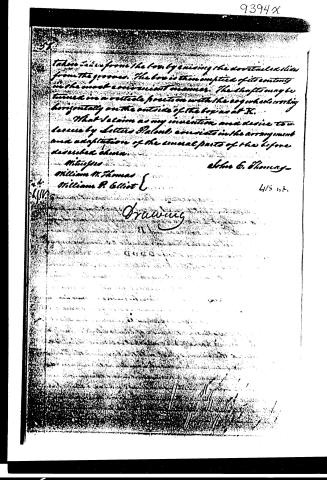
Page 3.
These lids from the box by raising the dovetailed sides from the grooves. The box is then emptied of its contents in the most convenient manner. The shafts may be turned in a vertical position with the cog wheels working horizontally on the outside of the box as at K.
What I claim as my invention and desire to secure by Letters Patent consists in the arrangement and adaptation of the several parts of the box before described.
Witnesses
William M. Thomas
William P. Elliot
John E. Thorney
4/5 1882
Drawing
Published accounts: journal notice
Notice in the monthly list of patents, with remarks
Journal of the Franklin Institute, new ser., vol. 18 (1836), p. 190 · View the page
37. For a Thrashing Machine; Thomas Beede, Sandwich, Stafford county, New Hampshire, February 10.
Remarks. This is a cylinder and concave machine, with some peculiarities about it upon which to found a claim, but not substantially different from numerous others of the same general construction.
Published accounts: journal notice
Notice in the monthly list of patents, with remarks
Journal of the Franklin Institute, new ser., vol. 18 (1836), p. 192 · View the page
45. For a Churn; John E. Thomas, Winchester, Preble county, Ohio, February 12.
Remarks. The body of the churn is to be a box, or case, through which two shafts are to run, furnished with slats, or dashers, passing between each other; on the outer end of each shaft there is to be a pinion, which is to be turned by a cog wheel; numerous examples of this churn exist in the patent office, and probably elsewhere.
Published accounts: journal notice
Notice in the monthly list of patents, with remarks
Journal of the Franklin Institute, new ser., vol. 18 (1836), p. 250 · View the page
67. For an improvement in the Manufacture of Starch; Walter and Thomas Leveredge, Dorchester, Norfolk county, Massachusetts, February 17.
Remarks. "We claim a patent for manufacturing starch from rice, or for the application of rice as a substitute for other substances heretofore used in the manufacture of starch." Whether so broad a claim as this can be sustained is a very doubtful point. Rice is the principal food of a very large portion of the human race, and is, by millions, eaten to the exclusion of nearly every thing else, and that among a people who use starch largely in their manufactures; we have not at hand, or in memory, any direct information on the subject, but the probabilities are much against the absolute novelty of the manufacture. The process followed by the patentees, but not claimed, is the following: fifty pounds chloride of lime are dissolved in one hundred gallons of water, and to the liquid when drawn off clear, eight pounds of sulphuric acid are added. Upon any quantity of rice as much of this liquor is to be poured as will just cover it, and it is to remain, with occasional stirring, for forty-eight hours. The liquid is then to be drawn off, and the rice ground, with water, to about the consistence of cream. To every one hundred gallons of this liquid, as much water is to be added, after which it is to be strained through a bolting cloth, to be allowed to settle for twenty-four hours, the clear liquid drawn off, and the starch dried. We do not understand the chemistry of this proceeding, the first step of which is to make, and to destroy, a solution of chloride of lime.
About this record
- Patentee
- DATAMP
- Date
- the Name and Date index of patents, DATAMP, USPTO records
- Invention
- DATAMP
- Listed in
- the Name and Date index of patents, DATAMP, USPTO records, Jim Shaw's X-patent list, the Journal of the Franklin Institute, Burke's List of Patents (1847)
- The Franklin Institute's journal gives a different date.
- Burke's 1847 Patent Office list gives the same patent.