

Drawings and documents
USPTO scan
The patent as scanned by the USPTO
-
 Page 1
-
 Page 2
-
 Page 3
-
 Page 4


U.S. Patent and Trademark Office · Google Patents
Show the transcription Hide (1,061 words)
Machine transcription (LightOnOCR) of the pages as scanned by the USPTO, most of them the handwritten copies made when the records were restored after the 1836 fire. Not checked; it can misread handwriting, so compare it with the scan.
Page 2.
United States Patent
Patent No.: X9395
David Wands and Calumet Waltham
Letters Patent
The invention relates to a new Series Plant and making part of the invention containing a description in the words of the said David Wands and Calumet Waltham themselves of their improvement in the machine for forming and cleaning all kinds of grain.
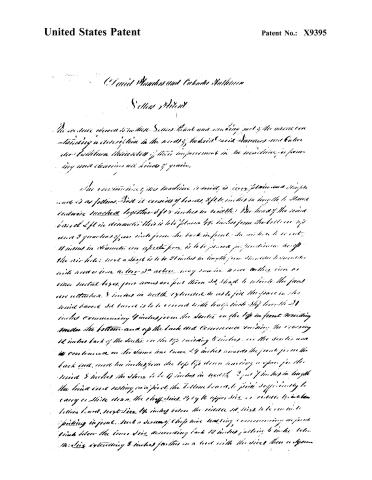
The construction of the machine in brief, is very plain and simple such as follows. First it consists of boards 3 ft 6 inches in length to stand endwise together 3 ft 5 inches in width. The head of the wind board 2 ft in diameter this is to be placed 4½ inches from the bottom up and 3 quarters of an inch from the back in front. The air hole to be cut 11 inches in diameter one square foot is to be placed perpendicular across the air hole. Next a shaft is to be 21 inches in length from the center to the center with a gear in a box 3½ inches may make a box with the iron or iron metal boxes. Four arms are put then 3d. Shaft to rotate the fan are attached 3 inches in width 4 inches wide as to fill the space in the wind board 3d board is to be covered with half inch 3½ length 21 inches commencing 4 inches from the center on the top in front running under the bottom and up the back and commence winding the covering 12 inches back of the center on the top raising 5 inches on the center and is continued on the same line 24 inches towards the front from the back end, next 10 inches from the top top down having a space for the wind 3 inches the space to be 4 inches in width 2 ft 7 inches in length the head end resting on a pivot, the bottom board to pivot sufficiently to carry or slide clean. The chop side 1½ to the upper side or middle 1½ inches bottom board, next side 1½ inches below the middle 3d. side to be covered picking in front. Next a screen of chop wire resting, commencing in front 1 inch below the lower side ascending back 12 inches falling 5 inches below the side extending 3 inches farther on a level with the side then a space
Page 3.
United States Patent
Patent No.: X9395
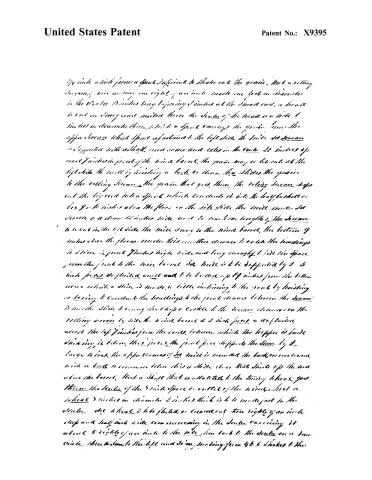
1/4 inch which forms a space sufficient to shake out the grain. Next a rolling screw, 1/4 inch in length, one right of an inch, made one foot in diameter, is the diameter 13 inches long tapering 3 inches at the small end, a head is cut in 1 inch and nailed there the center of the head is a hole 6 inches in diameter, then a hole a space over the grain. Now the upper screw which space is fastened to the left side the mill is driven by a shaft, and arms and rods in the center 20 inches up and 7 inches in front of the wind barrel, the grain may be let out at the left side the mill by hoisting a lock or down the sides the grain to the rolling screw. The grain that goes through the rolling screw drops out the big end into a space which conducts it into the hay basket or box 90 ft inches above the floor, on the side side the mill moves. A screw is a chain 12 inches wide and so much the length of the screw to be cut in the left side the mill strong to the wind barrel, the bottom 9 inches above the floor under this another drawer to cover the headings to drive a point 7 inches high wide and long enough to fill the space from the front to the wind barrel. The mill is to be supported by 2 3 inch posts, the front post must be to be raised up 29 inches from the bottom where a stile is made, a little inclining to the front by hoisting or lowering to connect to the headings to the front drawer between the screws is another stile between the chips cocked to the screw drawer on the rolling screw by side the wind barrel 2 3 inch posts a footboard across the top 7 inches from the end, between which the hopper is built. During it below, the posts, the front post supports the stile by 2 large wires, the upper corners of the mill is mounted the back corner corner with a box 11 inches on below this a stile door that shuts up the end above the barrel. Next a shape that is attached to the turning wheel goes through the center of the 3 inch space or outlet of the wind. Next a wheel 3 inches in diameter 2 inches thick is to be made fast in the stile. The wheel is to be flat or crowned out three eights of an inch deep and half inch wide commencing in the center carrying it about 5 eights of an inch to the side, then back to the center on a true circle, then the same to the left and so on, making from 4 to 6 spokes to the
Page 4.
United States Patent
Patent No.: X9395
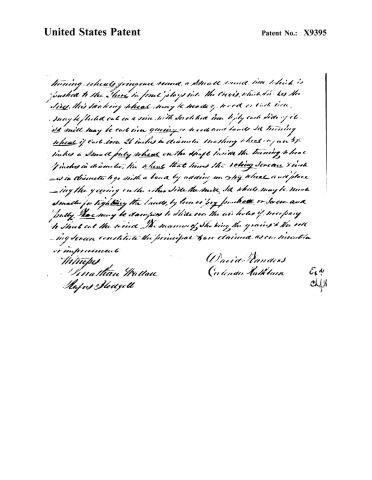
turning wheel going once round, a small round iron wheel is pushed to the other in front plays into the circle which has the size, this shaking wheel may be made of wood or cast iron, may be filed out on a vice with a tool then to ply each side of it the mill may be cast iron gearing or wood and bands to turning wheel if cast iron 26 inches in diameter making wheel or pan 54 inches a small pully wheel on the shaft inside the turning wheel 4 inches in diameter, the wheel that turns the rolling screen 8 inch = in diameter to go with a band by adding an extra wheel and placing the gearing on the other side the mill. 1st wheel may be much smaller for tightening the bands, by lever or by punch or screw and pully. The may be dampers to slide over the air holes if necessary to shut out the wind. The manner of shaking the grains & the rolling screen constitute the principal here claimed as our invention or improvement
Witnesses
Jonathan Wallace
Rufus Hougell
David Hamers
Calvin Halkburn
Ex. 4
24.11
Published accounts: journal notice
Notice in the monthly list of patents, with remarks
Journal of the Franklin Institute, new ser., vol. 18 (1836), p. 194 · View the page
56. For an improvement in the Wheat Fan; David Flanders and Calender Rathburn, Fort Covington, Franklin county, New York, February 13.
Remarks. The general construction of this wheat fan is the same as those in common use, and although much pains have been taken to describe its individual parts, we are not told, and are unable to discover, in what its special utility and novelty consist.
About this record
- Patentee
- DATAMP
- Date
- the Name and Date index of patents, DATAMP, USPTO records
- Invention
- DATAMP
- Listed in
- the Name and Date index of patents, DATAMP, USPTO records, Jim Shaw's X-patent list, the Journal of the Franklin Institute, Burke's List of Patents (1847)
- Burke's 1847 Patent Office list gives the same patent.