

Drawings and documents
National Archives restored drawings: drawing
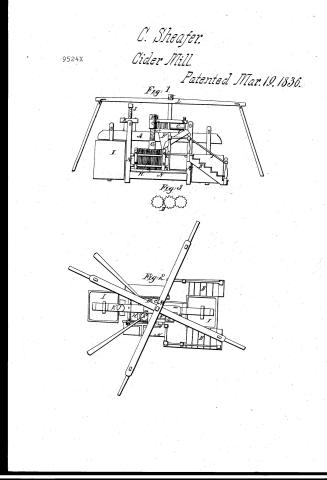
Christian Sheafer's Patent Drawing for a Cider Mill

National Archives, Restored Patent Drawings (Record Group 241) · Full-size scan at the National Archives · Catalog record
Show the text on the drawing Hide (45 words)
Words on the drawing as machine-read by the National Archives; not checked. Useful mainly for searching.
CLASSI ICATIONT / /2 / 9524X / 9524X / DIVISION / 100 / CHRISTLAN SHEJAFER'S / [19] Gider & ine / PRESSES / Gider Mill / Educating / Patented Mourch 19th 1850 / Please / Benad / Hig. I / Li / Fis / Fig: II. / BH / E' / Top.
USPTO scan
The patent as scanned by the USPTO
-
 Page 1
-
 Page 2
-
 Page 3
-
 Page 4


U.S. Patent and Trademark Office · Google Patents
Show the transcription Hide (1,117 words)
Machine transcription (LightOnOCR) of the pages as scanned by the USPTO, most of them the handwritten copies made when the records were restored after the 1836 fire. Not checked; it can misread handwriting, so compare it with the scan.
Page 1.
C. Sheaffer,
Cider Mill.
Patented Mar. 19, 1836.
9524X
Fig. 1.
Fig. 2.
Fig. 3.
Page 2.
15 9524X 153
Mar. 19, 1836
Christian Sheaffer
The Schedule referred to in this Letter Patent and making part of the same containing a description in the words of the said Christian Sheaffer himself of his improvement in the machine for making cider. To all to whom these presents shall come, But it known that I, Christian Sheaffer of the Township of Lebanon, in the County of Lebanon and State of Pennsylvania, have invented a new and very useful improvement in the machine for making cider, usually called, cider press, the following being a full and exact description of the construction and operation of the said machine as invented or improved by me. The machine consists of two pairs of stairs, a frame, one apple mill made of three cog wheels, cage or receiver, a press beam, two main screws, one assistant screw (with nut) and weights to do. A is the press beam. B is a pair of stairs of which there are two, viz one to correspond with it on the other side of the press beam. C is a hopper or right angle box wherein the apples are thrown, of which there are two, viz one on the other side of the mill (and placed at the contrary corner, a pair of the stairs and one of the hoppers or right angles) boxes are seen in the drawing accompanying this specification Fig II. D is the mill and consists as before said of three cog wheels, part of the one (and the whole of another) of which are seen in the drawing Fig III, being driven by the hopper or right angle box C - E is one of the main screws of which there are two, viz one to correspond with it on the other side of the press beam. F is a shaft or conductor. G is a piece of timber, in length the inside of the cage or receiver, and it makes from 3 yards or nearly so. H are the two weights lines which are fixed with strings, and so they are hung on the press beam by frames made of timber, one piece on each side of the press beam and one on top (at each box) the side pieces extend thus the boxes are are fastened at the bottom. I is an assistant screw. K is a piece of plank which has a hole fitted to the screw and may be cut to a nut, to correspond to the assistant screw, it is made from by two strong wires or lay of iron as seen in the drawing. L, M, N are keys to regulate the mill in case of friction. O is a piece of timber with two and pieces attached to it, at each of which a horse is attached, as M is another piece of timber
9
Page 3.
with and pieces, it is at right angles with the other and corresponds with it. The other pieces attached to the named timber, are not quite as long as those before named and are intended for the guiding of the horse screws. The horse pieces it is to have each of them one to correspond with it on the other side of the press beam. The machinery in different parts is strengthened with iron to prevent disorder in case of friction, wear &c. I omit to say that one of the main screws is seen in the drawing Fig 11. that there are two spouts or conduits, like T, viz one on the other side of the mill seen in the drawing Fig 11 and facing the main beam on that side, and under the hopper or right angled box in part—also omitted to say that the weight box at the stairs always rests on the ground. The operation is as follows. The apples are carried up the stairs on either side, thrown into either of the hoppers or right angled boxes viz on either side of the press beam, the horses are then driven round which sets the mill going and smashes the apples, the apples then tumble into the cage or receiver, then the cage or receiver is about one eighth full of smashed apples a layer of straw must then be put on (and so alternately until the cage or receiver is full). The cage or receiver which is in part, is then put on a beam is then laid one end on the platform of the stairs and the other end on the cage, this is done on both sides of the machinery, one man stands on one of them and another man stands on the other, they then by means of that pole, lighten the main screw, which as before hinted, passes thru the timber C and rests with their ends on the top of the cage or receiver, next long poles are put into the holes of the main screws, and screws are turned by means of the top part of the machinery viz that part to which the horses belong, but finally the main screws will cause the press beam and the weight box, near the assistant screw to rise, to prevent too much weight to rest on the main screws, the assistant screw is turned, which then bears part of the burden. The pressing process will cause the juice of the apples, or the cider to run on the side of the cage or receiver which is so constructed, as to drive the cider to run into a tub or something also at O. The machinery described by me
Page 4.
may be variously modified and arranged, while the same general principles or orders of action as those upon which my improvements are dependent may be substantially retained, in claiming certain things as my invention, therefore it is to be understood that I do not intend to limit myself to the precise modes and forms by me set forth, but to say the same in any way I may deem proper, while the same results are attained by analogous means. I claim as my invention the whole of the machinery, excepting what I have named the cage, or screen, the bed or base, belonging to the cage or screen, and the manner of mixing the straw with the ground apples, or rather the mashed apples.
Christian Schroffer.
Geo. Hein
Henry Dehoff & Peters
1155 w 55
Drawing
Spec. 1.15
Published accounts: journal notice
Notice in the monthly list of patents
Journal of the Franklin Institute, new ser., vol. 17 (1836), p. 439 · View the page
220. Cider mill. -Christian Shaeffer, Lebanon, Penn.
About this record
- Patentee
- DATAMP
- Date
- the Name and Date index of patents, DATAMP, USPTO records
- Invention
- DATAMP
- Listed in
- the Name and Date index of patents, DATAMP, USPTO records, Jim Shaw's X-patent list, the Journal of the Franklin Institute, Burke's List of Patents (1847)
- The Franklin Institute's journal spells the name differently.
- Burke's 1847 Patent Office list gives the same patent.