

Drawings and documents
USPTO scan
The patent as scanned by the USPTO
-
 Page 1
-
 Page 2
-
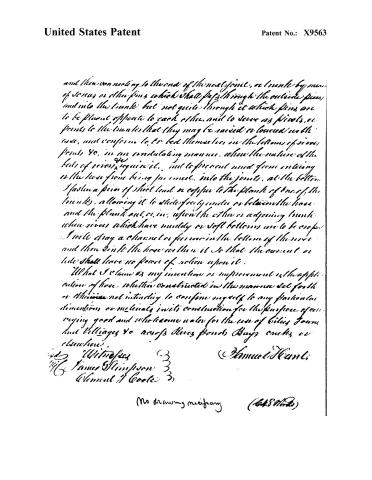 Page 3


U.S. Patent and Trademark Office · Google Patents
Show the transcription Hide (666 words)
Machine transcription (LightOnOCR) of the pages as scanned by the USPTO, most of them the handwritten copies made when the records were restored after the 1836 fire. Not checked; it can misread handwriting, so compare it with the scan.
Page 2.
United States Patent
Patent No.: X9563
Samuel H. Kent of Baltimore, Maryland
Letters Patent.
The Schedule referred to in these Letters Patent and making part of the same containing a description in the words of the said Samuel H. Kent himself of his improvement in the mode of conveying water, ores, ores, powders, bags, or else where by means of leather or India Rubber cloth Hose.
To all to whom these presents shall come, Be it known that I Samuel H. Kent of the City and County of Baltimore and State of Maryland have invented a new and useful improvement in the mode of conveying water, ores, powders, bags, or else where, by means of leather or India Rubber cloth Hose, and that the following is a full and exact description thereof that is to say, I form a hose in the usual way of making hose for fire engines, but with less frequent joints, and of suitable dimensions and strength, to answer the purpose desired; and to that end when more strength is required than the best quality of leather will afford, I wrap the leather hose around with canvas, ropes, bands of leather, wood, metal, or other substances, which are to be wound round it in a spiral or other manner in as many turns or thicknesses as may be deemed proper to secure sufficient strength for the particular purpose of water required. The said canvas, ropes, or other materials which surround it are to be in most cases well saturated or covered with coal-tar, or gum, or other suitable substance, and also the leather hose, and in some instances for a further security from bursting or external injury I enclose the hose in a sheath formed of plank, say from two to twenty feet in length, more or less, clamped together with joints, and the joint confined about it with lugs. Each of the lengths are to be connected by fastening pieces of plank upon the vertical sides of one end of each of the lengths and projecting so eighteen inches beyond the end of the lengths.
Page 3.
United States Patent
Patent No.: X9563
and then connecting to the end of the next joint, or trunk by means of screws or other pins which shall pass through the outside pieces and into the trunk but not quite through it which pins are to be placed opposite to each other and to serve as pivots, or points to the trunks that they may be raised or lowered with ease, and conform to, or bed themselves in the bottoms of rivers, ponds, &c. in an oscillating manner, where the nature of the beds of rivers require it, and to prevent mud from entering in the hose from being jammed into the joints, at the bottom. I fasten a piece of sheet lead or copper to the plank of one of the trunks, allowing it to slide freely under or between the hose and the plank and, or, in, upon the other or adjoining trunk when rivers which have muddy or soft bottoms are to be crossed. I will say a channel or furrow in the bottom of the hose and then sink the hose within it so that the current or tide shall have no power of action upon it.
What I claim as my invention or improvement is the application of hose, whether constructed in the manner set forth or otherwise not intending to confine myself to any particular dimensions or materials in its construction for the purpose of conveying good and wholesome water for the use of cities, towns, and villages &c. across rivers, ponds, bays, creeks, or elsewhere.
Witnesses
James Simpson 3
Clement J. Coote 3
Samuel Hunt
No drawing necessary (Patent Office)
About this record
- Patentee
- DATAMP, Burke's List of Patents (1847)
- Date
- the Name and Date index of patents, DATAMP, USPTO records
- Invention
- DATAMP
- Listed in
- the Name and Date index of patents, DATAMP, USPTO records, Jim Shaw's X-patent list, Burke's List of Patents (1847)
- The name conflict was settled by Burke's 1847 list.
- Burke's 1847 Patent Office list gives the same patent.