

Drawings and documents
USPTO scan
The patent as scanned by the USPTO
-
 Page 1
-
 Page 2
-
 Page 3
-
 Page 4


U.S. Patent and Trademark Office · Google Patents
Show the transcription Hide (956 words)
Machine transcription (LightOnOCR) of the pages as scanned by the USPTO, most of them the handwritten copies made when the records were restored after the 1836 fire. Not checked; it can misread handwriting, so compare it with the scan.
Page 2.
United States Patent
Patent No.: X9606
Alexander Williams, Washington D.C.
Letters Patent.
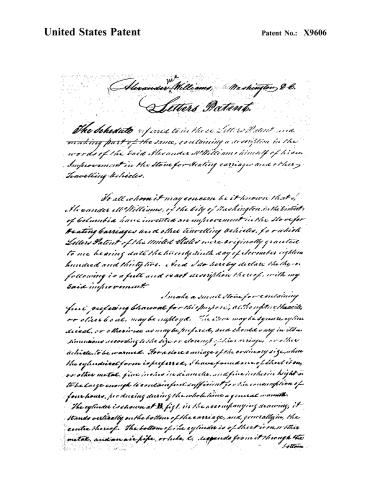
The Schedule referred to in these Letters Patent and making part of the same, containing a description in the words of the said Alexander Williams himself of his Improvement in the stove for heating carriages and other travelling vehicles.
To all whom it may concern be it known that I, Alexander Williams, of the City of Washington, in the District of Columbia have invented an improvement in the stove for heating carriages and other travelling vehicles, for which Letters Patent of the United States were originally granted to me bearing date the twenty-ninth day of December eighteen hundred and thirty-five. And I do hereby declare that the following is a full and exact description thereof, with my said improvement.
I make a small stove for containing fuel, preferring charcoal for this purpose, although coke, or other fuel, may be employed. The stove may be square cylindrical, or otherwise as may be preferred, and should vary in its dimensions according to the size or closeness of the carriage, or other vehicle, to be warmed. For a close carriage of the ordinary size, when the cylindrical form is preferred, I have found one of sheet iron, or other metal, five inches in diameter, and five inches in height, to be large enough to contain fuel sufficient for the consumption of four hours, producing during the whole time a general warmth.
The cylinder is shown at B, fig. 1, in the accompanying drawing, it stands vertically on the bottom of the carriage, and, generally in the centre thereof. The bottom of the cylinder is of sheet iron, or other metal, and an air pipe, or tube, C, ascends from it through the bottom.
Page 3.
United States Patent
Patent No.: X9606
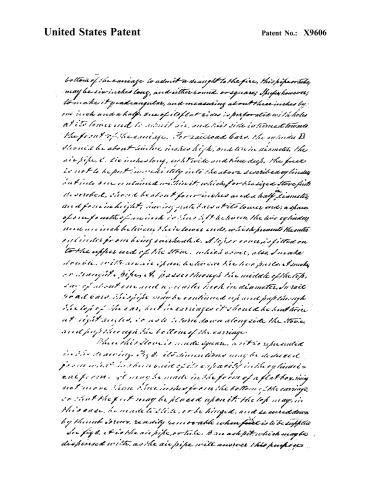
bottom of the carriage to admit a draught to the fire, this pipe or tube, may be six inches long, and either round, or square; I prefer, however, to make it quadrangular, and measuring about three inches by one inch and a half. One of its flat sides is perforated with holes at its lower end to admit air, and this side is turned towards the front of the carriage. For railroad cars, the cylinder B should be about twelve inches high, and ten in diameter. The air pipe, C, six inches long, eight wide and three deep. The fire is not to be put immediately into the above described cylinder, but into one contained within it, which, for the sized stove just described, should be about four inches and a half diameter, and four in height, having gate bars at its lower end; a space of one fourth of an inch is thus left between the two cylinders, and one inch between their lower ends, which prevents the outer cylinder from being overheated. A slip or cover is fitted on to the upper end of the stove, which cover, also, I make double, with an air space between the two parts. A smoke or draught pipe, D, passes through the middle of the top, say of about one and a quarter inch in diameter, in rail road cars. This pipe may be continued up and put through the top of the car, but in carriages it should be bent twice at right angles, or else to turn down alongside the stove, and put through the bottom of the carriage.
When this stove is made open, as it is represented in the drawing, Fig. 2, its dimensions may be deduced from what has been said of its capacity in the cylindrical form. It may be made in the form of a flat box, rising not more than three inches from the bottom of the carriage, so that the pot may be placed upon it. The top may, in this case, be made to slide, or be hinged, and secured down by thumb screws, readily removable when fuel is to be supplied. See fig. 2, it is the air pipe, or tube. B is a ash pit, which may be dispensed with, as the air pipe will answer this purpose.
Page 4.
United States Patent
Patent No.: X9606
C. the body of the stove. D. the door, or cover, & screws for lightening it, and F. The Smoke, or draught, pipe.
Instead of making the stove of double sheet iron, it may be made single, but then it should be lined with some imperfect conductor of heat, or instead of this the inner cylinder, or case, may be of cast iron instead of coal, lamps for burning oil, or any of the suitable ignitions compounds, may be employed, but I do not think them so convenient or so economical as charcoal. Having thus fully described my said invention and the improvement made thereon, I do hereby declare that although I have included in this instrument of writing a description of the machine as originally constructed by me, I have done so for the purpose merely of showing how my present improvement is connected therewith, and that all which I now claim as constituting the said improvement, is the addition to my carriage stove, of a tube, or pipe, for discharging the air which has passed through the fire, either under the body of the carriage by securing the said pipe, or by carrying it out through the top, or other part of the carriage, substantially in the manner herein set forth.
Witnesses
G. H. Keller
Thomas Stoney
J. Alex. McMillan
1008 1865
Ex:
CHJH
Published accounts: journal notice
Notice in the monthly list of patents
Journal of the Franklin Institute, new ser., vol. 18 (1836), p. 71 · View the page
303. Stove for carriages. Alexander McWilliams, Washington city,
About this record
- Patentee
- DATAMP
- Date
- the Name and Date index of patents, DATAMP, USPTO records
- Invention
- DATAMP
- Listed in
- the Name and Date index of patents, DATAMP, USPTO records, Jim Shaw's X-patent list, the Journal of the Franklin Institute, Burke's List of Patents (1847)
- Burke's 1847 Patent Office list gives the same patent.