

Drawings and documents
National Archives restored drawings: drawing
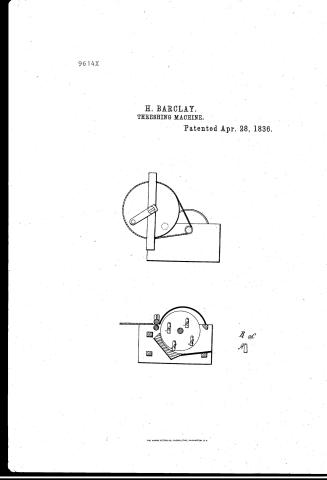
H. Barclay's Patent Drawing for a Thrashing Machine

National Archives, Restored Patent Drawings (Record Group 241) · Full-size scan at the National Archives · Catalog record
Show the text on the drawing Hide (32 words)
Words on the drawing as machine-read by the National Archives; not checked. Useful mainly for searching.
Entered. / 1: / 130. THRASHING. / [1 / Thrashing Machines. / A. Cylinder Machines. / A/1- / CLASSIFICATION / 9614-X / DIVISION / Thrushing Machine / Patented April 28
USPTO scan
The patent as scanned by the USPTO
-
 Page 1
-
 Page 2
-
 Page 3


U.S. Patent and Trademark Office · Google Patents
Show the transcription Hide (683 words)
Machine transcription (LightOnOCR) of the pages as scanned by the USPTO, most of them the handwritten copies made when the records were restored after the 1836 fire. Not checked; it can misread handwriting, so compare it with the scan.
Page 1.
9614X
H. BARCLAY.
THRESHING MACHINE.
Patented Apr. 28, 1836.

THE NORRIS PETERS CO., PHOTO-LITHO., WASHINGTON, D.C.
Page 2.
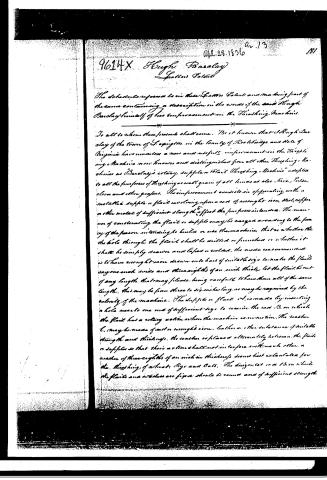
The Schenectady referred to in these Spatter Patent and making part of the same containing a description in the words of the said Hugh Barclay himself of his improvement on the Threshing Machine.
To all to whom these presents shall come. Be it known that I Hugh Barclay of the town of Lexington in the County of Rockbridge and State of Virginia have invented a new and useful improvement on the Threshing Machine now known and distinguished from all other Threshing Machines as "Barclay's rotary, supple or Flat Threshing Machine" adapted to all the purposes of threshing as well grain of all kinds as also Rice, Potatoes, clover and other grasses. The improvement consists in separating with a metallic supple or flat revolving upon a rod of wrought iron, steel, copper or other metal of sufficient strength to effect the purposes intended. The manner of constructing the flat or supple may be varied according to the fancy of the person intending to build or use the machine, that is whether the hole through the flat shall be drilled or punched or whether it shall be simply drawn and lapped or welded. The most recommended is to have wrought iron drawn into bars of suitable size to make the flats say one inch wide and three eighths of an inch thick, let the flat be cut of any length that may please, being careful to have them all of the same length. This may be from three to six inches long as may be required by the velocity of the machine. The supple or flat rod is made by inserting a hole near to one end of sufficient size to receive the rod 13, on which the flat has a rotary action when the machine is in motion. The washer C, may be made of cast or wrought iron, leather or other substance of suitable strength and thickness. The washer is placed alternately between the flats or supple so that their action shall not interfere with each other. A washer of three eighths of an inch in thickness seems best calculated for the threshing of oats, Rye and Corn. The bearings at 10 & 13 on which the flats and washers are fixed should be round and of sufficient strength.
Page 3.
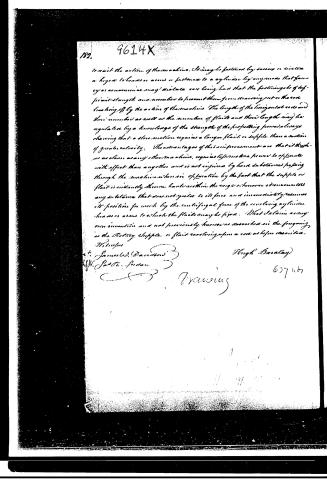
to resist the action of the machine. It may be fastened by screws or inserted a layer of leather or arms or fastened to a cylinder by any means that fancy or convenience may dictate care being had that the fastenings be of sufficient strength and number to prevent them from tearing out or the rods breaking off by the action of the machine. The length of the horizontal rods and their number as well as the number of flails and their length may be regulated by a knowledge of the strength of the projecting power, always observing that a slow motion requires a longer flail or sweeps than a motion of greater velocity. The advantages of this improvement are that it throws as a class as any other machine, requires less motive power to operate with effect than any other and is not injured by hard substances passing through the machine whether in operation by the fact that the sweeps or flail is instantly thrown back within the verge whereas it encounters any substance that does not yield to its force and immediately resumes its position for work by the centrifugal force of the revolving cylinder, hammers or arms to which the flails may be fixed. What I claim as my own invention and not previously known or described in the foregoing is the rotary sweeps or flail revolving upon a rod as before described.
Witnesses
James W. Davidson
Wm. J. Gordon
Hugh Barclay
637 11 67
Published accounts: journal notice
Notice in the monthly list of patents
Journal of the Franklin Institute, new ser., vol. 18 (1836), p. 71 · View the page
314. Thrashing machine.-Hugh Barclay, Lexington, Va.
About this record
- Patentee
- DATAMP
- Date
- the Name and Date index of patents, DATAMP, USPTO records
- Invention
- DATAMP
- Listed in
- the Name and Date index of patents, DATAMP, USPTO records, Jim Shaw's X-patent list, the Journal of the Franklin Institute, Burke's List of Patents (1847)
- Burke's 1847 Patent Office list gives the same patent.