

Drawings and documents
National Archives restored drawings: drawing
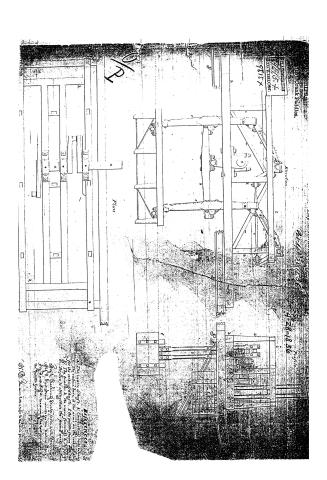
John Cochrane's Patent Drawing for an Improvement in Horizontal Paddles for Steam Boats

National Archives, Restored Patent Drawings (Record Group 241) · Full-size scan at the National Archives · Catalog record
Show the text on the drawing Hide (150 words)
Words on the drawing as machine-read by the National Archives; not checked. Useful mainly for searching.
COCHRANE as / 115. / 2. / Impt Horizonlal Paddles for Sleam Boats / Pater tax / [139] Crank Paddles, / Q3 / Par.Apr. 28.1836 / Profile / Big is / CLASSIFICATION / Elevation / 9615-+ / DIVISION / To) / 9615X / in / 7. / DF / 18 / to / 72 / mig 2. / IF / LF / Figst / n. / FO / Fight / Plan / Co / References. / a The Shaf h Connecting rod behween the ractuus bars, / The rachus bars, a the 072 rocking shafts e Connecting. rocts / for the Padales attached, / 3 the main ke. The Z upper / the The rocking shafts. guards n f the framing frame with uprights. framing / in Braces 20 s itrengthen the frame work. n Braces under the guards. / 50 / city Rocking Shaft arm and Braees / basteron wrists Radius Pars / and two the Castro piece to conneel the vadius Dars and / the paaale frame. / B. Bly The Jame letters refer to the same parls in each ofthe Drawing / of / Seale of Feet
USPTO scan
The patent as scanned by the USPTO
-
 Page 1
-
 Page 2
-
 Page 3


U.S. Patent and Trademark Office · Google Patents
Show the transcription Hide (843 words)
Machine transcription (LightOnOCR) of the pages as scanned by the USPTO, most of them the handwritten copies made when the records were restored after the 1836 fire. Not checked; it can misread handwriting, so compare it with the scan.
Page 1.
SHIPS: PADDLE
1881. Crank Paddles.
CLASSIFICATION:
7605+
DIVISION:
9615X
Projection:
Plan:
Profile:
References:
a. The inner Shaft, a Connecting Rod, a Wheel for the rocking Shaft, a the arms on the wheel, a the …
Page 2.
APR. 28. 1836
John Cochrane, of Baltimore, Md. 9615X
Letters Patent.
The Schedule referred to in the Letters patent and making part of the same, containing a description in the words of the said John Cochrane himself, of his improvement in Steam boat paddles.
To all to whom these presents shall come: Be it known that I, John Cochrane of Baltimore in the County of Baltimore, and State of Maryland; have invented a new and useful improvement in Steam boat paddles, and that the following is a full and exact description thereof.
Specification 1st. The paddle boards are attached by arms to strong frames, the arms having a slot or notch to admit the boards; the frames may contain any convenient number of paddles, say five or six which are to be of the usual dimensions in proportion to the size of the boat. 2nd. Two of these frames are on each side of the ship, and act alternately in the water; for inside navigation one paddle frame might be outside of this, but for outside or ocean navigation or twin boats it might be better for one to follow the other. 3rd. The paddle frames are hung by two radius bars at each end (framed together and strengthened by diagonal rods of iron to prevent lateral oscillation) from levers above on rocking shafts to strong iron pins bolted to the paddle frames. 4th. These levers lower the paddles into the water while they are acting and raise them, when they are going to fetch a stroke. 5th. The alternate motion of the paddles and levers are effected by cranks.
I claim the invention of the whole arrangement of the above described horizontal paddles and the model and drawings herewith deposited and referred to for further particulars, and are considered sufficient to enable any competent mechanic to construct them. This invention is the result of a thorough investigation of the principle upon which paddles act in propelling Steam boats; it is clear of all the acknowledged defects of the wheels and combines all the desideratum in paddles. In comparing the horizontal paddles with the wheels now in use, the following advantages are manifest: 1st. The Horizontal paddles act vertically in the water entering
Page 3.
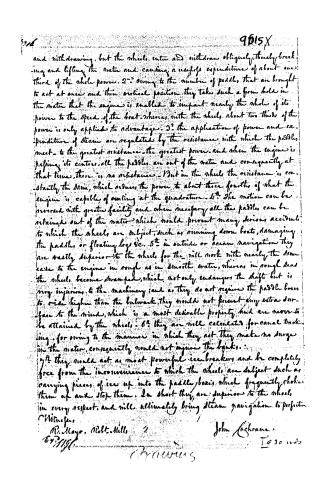
and withdrawing, but the wheels enter and withdraw obliquely, thereby breaking and lifting the water and causing a useless expenditure of about one third of the whole power. 2° Giving to the number of paddles that are brought to act at once and their vertical position, they take such a firm hold in the water that the engine is enabled to impart nearly the whole of its power to the speed of the boat, whereas, with the wheels, about two thirds of the power is only applied to advantage. 3° The application of power and expenditure of steam are regulated by the resistance with which the paddles meet—to the greatest resistance—the greatest power—and when the engine is pausing its centers, all the paddles are out of the water and consequently at that time, there is no resistance. But in the wheels the resistance is constantly the same, which reduces the power to about three fourths of what the engine is capable of exerting at the quadrature. 4° The motion can be reversed with greater facility and when necessary all the paddles can be withdrawn out of the water which would prevent many serious accidents to which the wheels are subject, such as running down boats, damaging the paddles, or floating log &c. 5° In outside or ocean navigation they are vastly superior to the wheels for they will work with nearly the same ease to the engine in rough as in smooth water, whereas in rough seas the wheels become swamped, which not only endangers the shafts but is very injurious to the machinery; and as they do not require the paddle boxes to ride higher than the bulwark, they would not present any extra surface to the wind, which is a most desirable property, and are never to be attained by the wheels. 6° They are well calculated for canal tracking, for owing to the manner in which they act they make no surges in the water, consequently would not injure the banks. 7° They would act as most powerful ice-breakers and be completely free from the inconvenience to which the wheels are subject such as carrying pieces of ice up into the paddle boxes which frequently choke them up and stop them. In short they are superior to the wheels in every respect, and will ultimately bring steam navigation to perfection.
Witness,
R. Mayo, Robt. Mills
John Coghane
To 30 11/12
Published accounts: journal notice
Notice in the monthly list of patents
Journal of the Franklin Institute, new ser., vol. 18 (1836), p. 71 · View the page
312. Paddles for boats. John Cochran, Baltimore, Md.
About this record
- Patentee
- DATAMP
- Date
- the Name and Date index of patents, DATAMP, USPTO records
- Invention
- DATAMP
- Listed in
- the Name and Date index of patents, DATAMP, USPTO records, Jim Shaw's X-patent list, the Journal of the Franklin Institute, Burke's List of Patents (1847)
- Burke's 1847 Patent Office list gives the same patent.