

Drawings and documents
National Archives restored drawings: drawing
G. Reynolds' Patent Drawing for a Feather-dressing Machine

National Archives, Restored Patent Drawings (Record Group 241) · Full-size scan at the National Archives · Catalog record
Show the text on the drawing Hide (141 words)
Words on the drawing as machine-read by the National Archives; not checked. Useful mainly for searching.
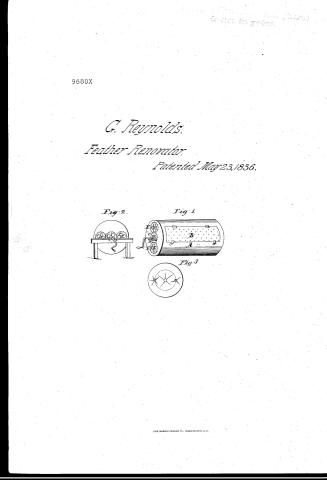
34. DRIERS. / Cylinder-Internal, / Sta. Horizontal. / Feather Dressing muchine. / CLASS IJATION / Patented May / 9.680. X / DIVIDION: / 9680 X / Fig.2. / Figs / * / mg.1. Represents the-Machine in perspective. / A The Cylinder / R The Door for putting in is entery out feathers / o Tooth wheel outhe yudgeon of the main shaft / D The two aling or rests to prevent the wheet from turning / E.F. The wheels 0 22 the gradgeo 20 8' of the aumiliary shafts / rig: / 2 the end of the cylinder with the yrest more plainly / Hig 3 Shows the of one end of the cylinder with the position of the / shafts and pins- the dotted describing the rerolution / which the auxitiary shafts make around the centre shaft. / The central chuff revolves with the cylinders in dure and the / me / anxilary shafts revolve me the other
USPTO scan
The patent as scanned by the USPTO
-
 Page 1
-
 Page 2
-
 Page 3
-
 Page 4
-
 Page 5


U.S. Patent and Trademark Office · Google Patents
Show the transcription Hide (1,462 words)
Machine transcription (LightOnOCR) of the pages as scanned by the USPTO, most of them the handwritten copies made when the records were restored after the 1836 fire. Not checked; it can misread handwriting, so compare it with the scan.
Page 1.
9680X
C. Reynolds.
Feather Renovator.
Patented May 23, 1836.
Fig. 2.
Fig. 1
Fig. 3
THE NORRIS PETERS CO., WASHINGTON, D.C.
Page 2.
May 23, 1836
George Reynolds, East Hartford, Ct.
Letters Patent
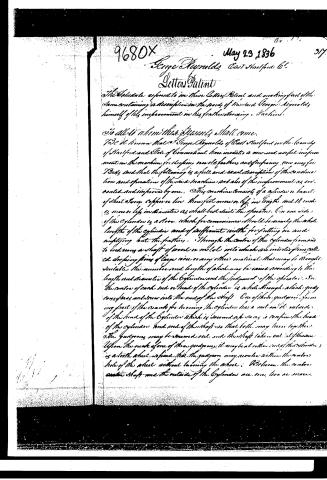
The Schedule referred to in these Letters Patent and making part of the same containing a description in the words of the said George Reynolds himself of his improvement in his feather dressing machine.
To all to whom these presents shall come.
We do know that George Reynolds of East Hartford in the County of Hartford and State of Connecticut have invented a new and useful improvement in the machine for dressing one side feathers and for dressing new ones for Beds and that the following is a full and exact description of the construction and operation of the said machine and also of the improvement as invented and improved by one. This machine consists of a cylinder or barrel of sheet iron, copper or tin, three feet more or less in length and 18 inches or more or less in diameter as shall best suit the operator. On one side of the cylinder is a door which for convenience should be nearly the whole length of the cylinder and of sufficient width for putting in and removing but the feathers. Through the centre of the cylinder from end to end runs a shaft of wood or metal into which are inserted pins called dressing pins of large iron or any other material that may be thought suitable, the number and length of which may be varied according to the length and diameter of the cylinder and the judgment of the operator. In the center of each end or head of the cylinder is a hole through which a gudgeon passes and turns into the end of the shaft. One of these gudgeons, forming part of the means for turning the cylinder has a nut and it surrounds the head of the cylinder which is screwed up so as to confine the head of the cylinder and end of the shaft so that both may turn together. The gudgeons may be screwed out and the shaft taken out at pleasure. Upon the neck of one of these gudgeons, it may be at either end of the cylinder, is a tooth wheel so fixed that the gudgeon may revolve within the center hole of the wheel without turning the wheel. Between the center shaft and the outside of the cylinder are one, two or more.
Page 3.
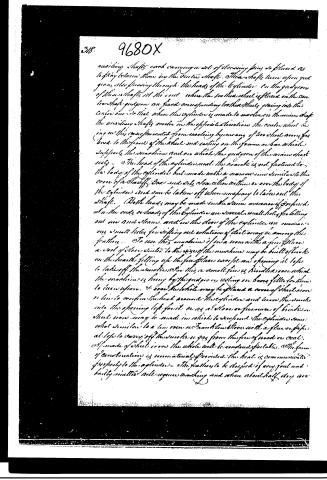
auxiliary shafts each carrying a set of dressing pins so placed as to fit between them in the centre shaft. These shafts turn upon gut gears also passing through the heads of the cylinders. In the gutgears of these shafts at the end, where the toothen wheel is placed on the centre shaft, gutgears are fixed corresponding to the wheels passing into the centre one, so that when the cylinder is made to revolve on the main shaft, the auxiliary shafts revolve in the opposite direction. The centre wheel being in this case prevented from revolving by means of two short arms fastened to the front of the wheel and resting on the frame or bar which supports the machine and on which the gutgear of the main shaft rests. The head of the cylinder, near the crank, is not fastened to the body of the cylinder but made with a narrow rim similar to the cover of a snuff-box, and set, also, either within or over the body of the cylinder and can be taken off when necessary to take out the shaft. Both heads may be made in the same manner if preferred. At the ends or heads of the cylinder are several small holes for letting out air and steam, and on the door of the cylinder are numerous small holes for letting out exhalations of dust, may be among the feathers. To use this machine in a room with a fire-place, a sort of house suited to the size of the machine may be built of bricks on the heads, filling up the fire-place except an opening at top to take off the smoke, or in this a small fire is kindled so as when the machine is heavy by the gutgear resting on bars fitted so as to turn upon it, and over the whole may be placed a cover of sheet iron or tin to confine the heat around the cylinder and have the smoke into the opening left for it, or as at stove or furnace of bricks or sheet iron, may be made in which to suspend the cylinder somewhat similar to a tea-cup or tea-kettle stove with a flue or pipe at top to carry off the smoke or gas from the fire of wood or coal. If made of sheet iron the whole will be more comfortable. The form of construction is immaterially provided the heat is communicated properly to the cylinder. The feathers to be dressed if any foul and badly matted will require washing and when about half dry are
Page 4.
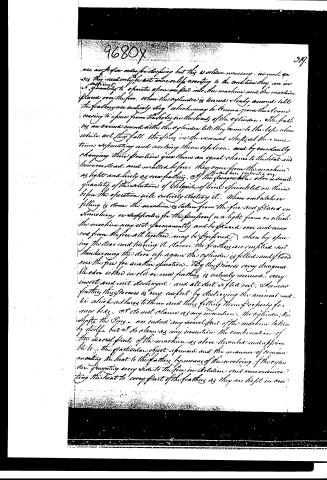
are in for use after be steeping but this is seldom necessary. In most cases they need only be wet once only according to the condition they are in. A sufficient quantity to operate upon must put into the machine and the machine placed over the fire. When the cylinder is turned slowly around till the feathers are entirely dry, which may be known from the sound ceasing to issue from the holes in the body of the cylinder. The feathers are carried round with the cylinder till they come to the top when while not they fall. The pins in the several shafts at the same time separating and working them up and by constantly changing their position give them an equal chance to the heat and however tired and matted before, they come from the machine as light and lively as new feathers. If the disagreeable odor of a small quantity of the solution of sulphide of zinc is sprinkled on them before the operation will entirely destroy it. When one batch or filling is done the machine is taken from the fire and placed on a stanchion, or scaffold for the purpose of a light from which the machine may not permanently and be turned over and turned from the fire all together, may be preferred. When by opening the door and turning it down the feathers are emptied out. Then turning the door up again the cylinder is filled and placed over the fire for another operation. By this process every disagreeable odor either in old or new feathers is entirely removed, every insect and dirt destroyed, and all dirt wiped out. I have no feather this process is very useful by destroying the animal matter which adheres to them and thus filling them properly for new beds. I do not claim as my invention the cylinder, its shafts, the pins, nor indeed any essential part of the machine taken by itself but I do claim as my invention the combination of the several parts of the machine as above described and applicable to the particular object aforesaid and the manner of communicating the heat to the feathers by means of the revolving of the cylinder preventing every access to the fire in operation and communicating the heat to every part of the feathers as they are kept in con-
Page 5.
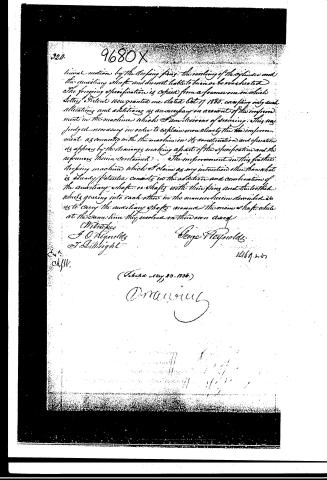
linear motion by the looping pins, the working of the cylinder and the auxiliary shaft and do not have to be recited. The foregoing specification is copied from a former one in which Letters Patent were granted me dated Oct 17, 1885, excepting only such alterations and additions as are necessary on account of the improvement in the machine which I am likewise of securing. This was judged necessary in order to explain more clearly the improvement as connected with the machine in its construction and operation as appears by the drawings making a part of the specification and the references therein contained. The improvement in the feather looping machine which I claim as my invention other than what is already patented consists in the addition and combination of the auxiliary shaft or shafts with their pins and the toothed wheels gearing into each other in the manner herein described so as to carry the auxiliary shafts around the main shaft while at the same time they revolve on their own axes.
Witnesses:
S O Reynolds
T L Wright
George Reynolds
1469 No 57
(Patented May 20, 1906)
D. M. W.
Published accounts: journal notice
Notice in the monthly list of patents
Journal of the Franklin Institute, new ser., vol. 18 (1836), p. 143 · View the page
374. Feather dresser. George Reynolds, East Hartford, Conn.
About this record
- Patentee
- DATAMP
- Date
- the Name and Date index of patents, DATAMP, USPTO records
- Invention
- DATAMP
- Listed in
- the Name and Date index of patents, DATAMP, USPTO records, Jim Shaw's X-patent list, the Journal of the Franklin Institute, Burke's List of Patents (1847)
- Burke's 1847 Patent Office list gives the same patent.