

Drawings and documents
National Archives restored drawings: drawing
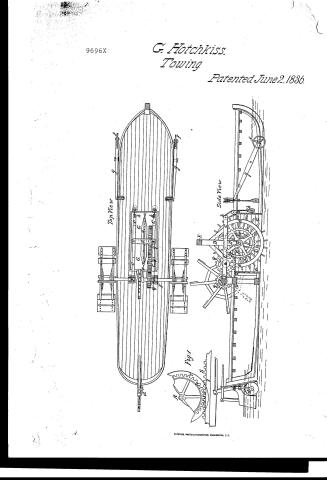
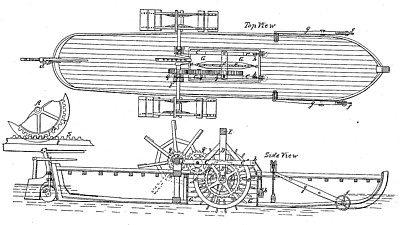
G. Hotchkiss' Patent Drawing for a Method of Propelling Boats


National Archives, Restored Patent Drawings (Record Group 241) · Full-size scan at the National Archives · Catalog record
Show the text on the drawing Hide (248 words)
Words on the drawing as machine-read by the National Archives; not checked. Useful mainly for searching.
Sheet 1. \BAMES / CLASS 115,-M/ RINE PROPULSION. / 64 / Ten / .RINE / PROPU!SION. / 2 \PROPULSIONI / 19 Internal Power / TOWING, / [139 Towing. / Internal Power / CLASSIFICATION / G o HIDI CHIISS / 26.76 / 9696x / DIV ISION. / 2011 / Propelling / Patented 2nd June 1836 / Refeience. / 1, / Anchor wheel / B, shaft or arear / the / cr arms / 2 posts, / Top / 14, Caps, / hinges / 's opening, thiough h the bottion of the beat / de the Anchor wheel to work through / rejection's or so / 3.6, pully and / 9.99 coz wheel gear / d,wheel in Ludder, 2 direction whul. / Bugy whuls with their leversly) / itty esents the / Fig. / ancher we beel with cogs / 1557 / 7°, / this to I flanged 7*/ forthe / of, unning in / ruser / my laid on canalitc. raits/t) / District of Colombia. bounty of mastington, In mit / an Huil December 1845 before The Subscriber / aquiting ofthe personally appeared Gideon / the Whise you New york / ma. de In lenn bath stratthe above drawing / ennable to them amal for / ab which was pa tented in the / with "unc/836 his which letters than granted / think Harks / Ileconn
Sheet 2. Mis. SEMPS. / 2. / CLASS 115, -MARINE PROPULSION, / TOWING, / [33] / 19. Internal Power / Gxo HILL CHIRISS / CLASSIFICATION / 9696x / DIV ISION. / Clopelling Boats / Patented 2 June 1536. / A anchor Wheel / section / B. Shaft or urbor / c. arms / is Posts / F. Cap / to pivnts / a Levers / H. connected with moringplaner / T.Wheel 772 Rudder / K. Buoy-Wohed's / Strickland Del / Patent office Jenn2 2-1839 / Made under the direction of the of patrets / in conformaty with act of 3th March 1837 / Meny Leumorth / Commission of Palents)
USPTO scan
The patent as scanned by the USPTO
-
 Page 1
-
 Page 2
-
 Page 3
-
 Page 4


U.S. Patent and Trademark Office · Google Patents
Show the transcription Hide (1,020 words)
Machine transcription (LightOnOCR) of the pages as scanned by the USPTO, most of them the handwritten copies made when the records were restored after the 1836 fire. Not checked; it can misread handwriting, so compare it with the scan.
Page 1.
9696X
G. Hotchkiss.
Towing
Patented June 2, 1836.

Page 2.
June 2, 1856
Edison Shotship
397
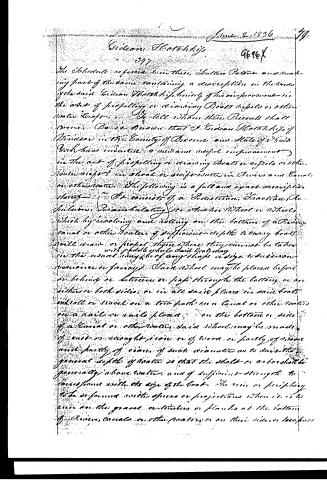
The Schedule referred to in these Letters Patent and making part of the same containing a description in the words of the said Edison Shotship, himself of his improvement in the art of propelling or drawing Boats, vessels or other water crafts.
To all whom these Presents shall come:
Be it known that I, Edison Shotship of Windsor in the County of Orange and State of New York have invented a new and useful improvement in the art of propelling or drawing Boats or vessels or other water crafts in short or swift waters in Rivers and Canals or other waters.
The following is a full and exact description thereof:
It consists of a Pedestrian, Fractional, Inclination, Propelling Wheel or Wheels which by revolving and rolling on the bottom of a River, canal or other waters of sufficient depth to carry boats will draw or propel them where they cannot be taken with paddle wheels said boat may in the usual way be of any shape or size to suit any purpose or journey. Said Wheel may be placed before or behind or between or fast through the bottom or on either or both sides or in all said places in said boat and all or travel on a tow path or a Canal or other waters on a rail or rails placed on the bottom or side of a Canal or other water said Wheel may be made of cast or wrought iron or of wood or partly of wood and partly of iron of such diameters as to suit the general depth of water so that the shaft or axle shall be generally above water and of sufficient strength to correspond with the size of the boat. The rim or periphery to be deformed with spokes or projections when it is to run on the ground or stones or planks at the bottom of Rivers, canals or other waters or on their sides or banks.
Page 3.
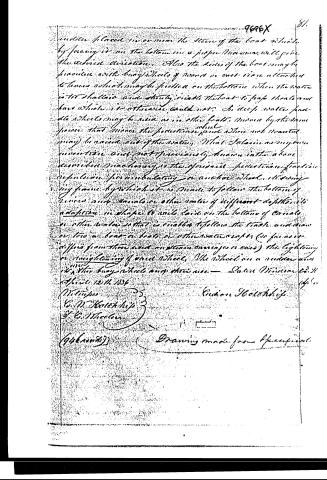
or if it is to move on a rail on the side or bottom of rivers canals or other roads to be formed so as to correspond with the form of the rail whether it be with or without, with a projection or flange on each side, so as to make the wheel follow the rail similar to those on steam carriages to run on rail roads. The shaft or axle to be about one fourth of the diameter of the wheel in length with flanges on each end and a key way to keep the frame together. The frame to be made with two arms one fourth greater in length than the diameter of the pedestal wheel and the two side frames on the axle ways to project one fifth of the diameter of the wheel below same to support above so as to clear the wheel with a cup on the top to correspond with the length of the shaft of the pedestal wheel. In the lower end of the posts the wheel is hung the other end of the arms to be tied to about two thirds of the diameter of the wheel and strongly braced to keep it from rocking or moving and fastened to the boat by hinges or pivots so as to keep the wheel in nearly a vertical position and permit it to rise and fall in an opening between two boats or through the boat so that it may roll on the bottom or rail at different depths of water over thirty days or propel the boat or boat forward. This wheel may be raised up or pushed down on the bottom or rail by fulcrum and weights or by levers and pulleys or by springs. Said wheel may be fast and continued in motion by steam or any other power communicable to a wheel or on near the center of motion of the wheel frame, and from that to the pedestal wheel by an overcast or strap chain running over a corresponding wheel for the action of the pedestal wheel or in any of the known methods of gearing. When the usual anchor becomes insufficient to guide the boat by reason of short water there may be a wheel on the
Page 4.
9696X 81.
wedges placed in or near the stern of the boat which by forcing it on the bottom in a proper manner, will give the desired direction. Also the sides of the boat may be provided with buoyant blocks of wood or other items attached to levers which may be fastened on the bottom when the water is too shallow and thereby enable the boat to float shallows and have which it otherwise could not. In deep water paddle wheels may be used as in other boats, moved by the same power that moves the propulsion paddle which may be raised out of the water. What I claim as my own invention and not previously known in the above described machinery is the provided propulsion friction repulsion for propelling an anchor wheel, it being a my frame by which it is made to follow the bottom of rivers and canals or other water of different depths, its adaptation in shape to well laid on the bottom of canals or other water so that it enables to follow the track and draw on tow a boat or boats or other vessels except (so far as it differs from those used on steam carriages or cars) the lightening or weightening of said wheel. The wheel on a tender and its other buoy wheel and their use. Patent Wmson 62 H April 12th 1836.
Witnesses
C. D. Holtschiff
J. C. Wacker
(46 known)
Indian Holtschiff
Drawing made from the original.
Published accounts: journal notice
Notice in the monthly list of patents
Journal of the Franklin Institute, new ser., vol. 18 (1836), p. 215 · View the page
397. Propelling boats, &c. Gideon Hotchkins, Broon county, N. Y.
DATAMP: illustration
Illustrations from DATAMP

DATAMP (Directory of American Tool and Machinery Patents), via the Internet Archive · Archived DATAMP page
About this record
- Patentee
- DATAMP
- Date
- the Name and Date index of patents, DATAMP, USPTO records
- Invention
- DATAMP
- Listed in
- the Name and Date index of patents, DATAMP, USPTO records, Jim Shaw's X-patent list, the Journal of the Franklin Institute, Burke's List of Patents (1847)
- The Franklin Institute's journal spells the name differently.
- Burke's 1847 Patent Office list gives the same patent.