

Drawings and documents
USPTO scan
The patent as scanned by the USPTO
-
 Page 1
-
 Page 2
-
 Page 3
-
 Page 4
-
 Page 5


U.S. Patent and Trademark Office · Google Patents
Show the transcription Hide (1,259 words)
Machine transcription (LightOnOCR) of the pages as scanned by the USPTO, most of them the handwritten copies made when the records were restored after the 1836 fire. Not checked; it can misread handwriting, so compare it with the scan.
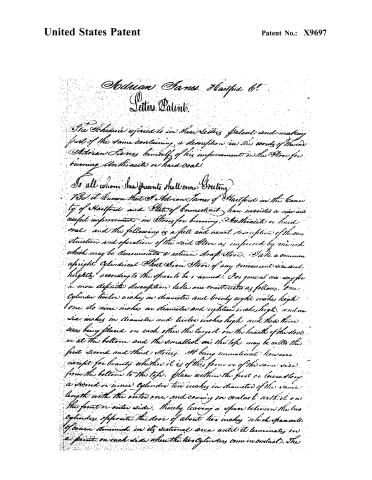
Page 2.
United States Patent
Patent No.: X9697
Adrian James Hartford & Co.
Letters Patent.
The Schedule referred to in these Letters Patent and making part of the same containing a description in the words of the said Adrian James himself of his improvement in the Stove for burning Anthracite or hard coal.
To all whom these presents shall come Greeting.
Be it known that I, Adrian James of Hartford in the County of Hartford and State of Connecticut, have invented a new and useful improvement in Stoves for burning Anthracite or hard coal, and the following is a full and exact description of the construction and operation of the said Stove as improved by me and which may be denominated a return draft Stove. It is a common upright cylindrical Sheet Iron Stove of any convenient size and height according to the space to be occupied. For general use say for a more definite description, let one constructed as follows. One Cylinder twelve inches in diameter and twenty eight inches high, one to nine inches in diameter and eighteen inches high, and one six inches in diameter and twelve inches high, and these three sizes being placed one after the largest on the hearth of the stove or at the bottom and the smallest on the top, may be called the first, second and third Stoves. It being immaterial, however, except for beauty whether it is of this form or of the same size from the bottom to the top. Place within the first or lower stove a second or inner Cylinder ten inches in diameter of the same length with the stated one, and coming in contact with it on the front or outer side, thereby leaving a space between the two cylinders opposite the door of about two inches which space will of course diminish in its sectional area until it terminates in a point on each side where the two cylinders come in contact. The
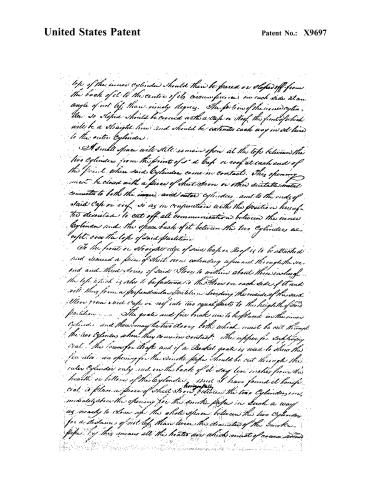
Page 3.
United States Patent
Patent No.: X9697
tops of the inner cylinders should then be fused or sloped off from the back of it to the center of its circumference, in each side at an angle of not less than ninety degrees. The front of the inner cylinder so sloped should be covered with a cap or roof, the front of which will be a straight line and should be extended each way in a line to the outer cylinder.
A small space will still remain open at the top between the two cylinders from the points of said cap or roof at each end of the front where said cylinders come in contact. This opening must be closed with a piece of sheet iron or other suitable metal connected to both the inner and outer cylinders and to the ends of said cap or roof, so as in conjunction with the portions hereof to be described to cut off all communication between the inner cylinder and the space back of it between the two cylinders except over the top of said partition.
On the front or straight edge of said cap or roof is to be attached and secured a piece of sheet iron extending up and through the second and third stories of said stove to within about three inches of the top, which is also to be fastened to the stove on each side of it and will thus form a perpendicular partition dividing the inside of the said stove from said cap or roof into two equal parts to the height of said partition.
The grate and fire brick are to be placed in the inner cylinder and there may be two doors both which must be cut through the two cylinders where they come in contact. The upper for supplying coal. The lower for draft and if a heated grate is used to show the fire also, an opening for the smoke pipe should be cut through the outer cylinder only and on the back of it may be made from the back or bottom of the cylinder, until it have found it beneficial to place a piece of sheet iron between the two cylinders immediately above the opening for the smoke pipe in such a way as nearly to close up the whole space between the two cylinders for a distance of not less than twice the diameter of the smoke pipe. By this means all the heat is which must of course ascend
Page 4.
United States Patent
Patent No.: X9697
on front of the furnace, pass over it and descend behind it and between said two cylinders is drawn, as near as possible to the bottom of the stove before it escapes through the upward pipe.
An opening should then be made through the inner cylinder on the back of it between the grate and the lower part or bottom of the stove for the dust and light ashes to pass off into the smoke pipe where the fire is regulated or stirred. This opening may be also made in length by four or six inches and should be tight closed by a chamber except when the fire is regulated to expel the ashes from the coal. The chamber may be attached to a wire passing horizontally through the outer cylinder beneath the smoke pipe and at right angles therewith or by a wire passing perpendicularly through the space between the two cylinders coming out behind the second story of the stove. This stove when placed on a cast iron hearth has all the external appearance of a common upright cylindrical sheet iron stove except the location of the pipes and this may be varied as convenience requires.
The above description corresponds with the stove as used by me but the dimensions of the stove and the corresponding parts may be indefinitely varied. This stove may also be square, oblong, octagonal or any other form in its body as well as cylindrical and may be made of cast iron as well as sheet iron.
By means of any improvement, among other things, the outer cylinder of the stove is defended from that intense heat which otherwise destroys the solids and frequently the material of the stove. The heat is also retained within the stove for a long period and so diffused around the outer cylinder as nearly to expand itself before the current reaches the smoke pipe and thereby renders any great length of pipe wholly unnecessary.
The opening for the dust and light ashes, being so intimately connected with the principal draft of the stove through the smoke pipe, they are effectively carried off and from the location of the pipe it may be inserted into any common fireplace with
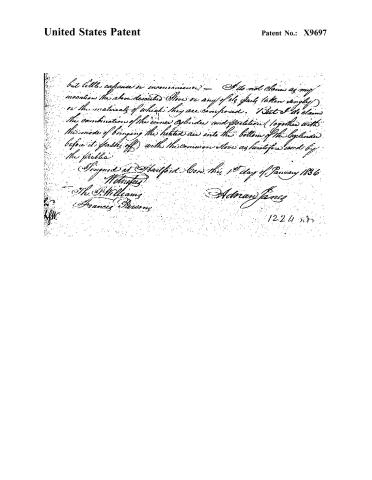
Page 5.
United States Patent
Patent No.: X9697
but little expense or inconvenience. — I do not claim as my invention the above described stove or any of its parts taken singly or the materials of which they are composed. But I do claim the combination of the inner cylinder and partition (together with the mode of bringing the heated air into the bottom of the cylinder before it floats off) with the common stove as heretofore used by the public.
(Signed) at Hartford, Conn. this 1st day of January 1836
Wm. S. Williams
Francis Parsons
Adrian Jancy
12.24.37
Published accounts: journal notice
Notice in the monthly list of patents
Journal of the Franklin Institute, new ser., vol. 18 (1836), p. 214 · View the page
389. Stove for anthracite.-Adrian Jones, Hartford, Conn.
About this record
- Patentee
- DATAMP
- Date
- the Name and Date index of patents, DATAMP, USPTO records
- Invention
- DATAMP
- Listed in
- the Name and Date index of patents, DATAMP, USPTO records, Jim Shaw's X-patent list, the Journal of the Franklin Institute, Burke's List of Patents (1847)
- Burke's 1847 Patent Office list gives the same patent.