

Drawings and documents
National Archives restored drawings: drawing
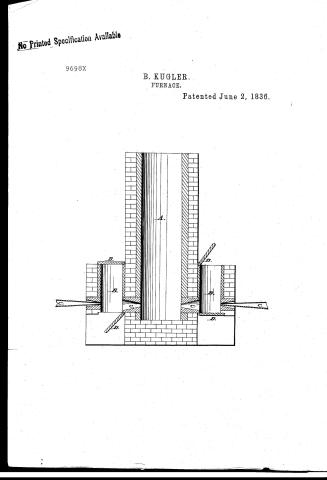
B. Kugler's Patent Drawing for an Improved Furnace

National Archives, Restored Patent Drawings (Record Group 241) · Full-size scan at the National Archives · Catalog record
Show the text on the drawing Hide (56 words)
Words on the drawing as machine-read by the National Archives; not checked. Useful mainly for searching.
75. METALLURGY. / Cupolas. / 75 METALLURGM / the / B. KUCLER'S / Cupola-Furnaces. / CLASSIFICATION / Improved Furnace, / 9698.4 / Patented June Rea 5836. / DIVISIONT / 9698 X / 1. / of / References. / A. Themain furnace / B. Suna 22 chamber 02 stack. / c. Tryyer hole and bellows prope / D. Botion and top of small chamber or STack,
USPTO scan
The patent as scanned by the USPTO
-
 Page 1
-
 Page 2
-
 Page 3


U.S. Patent and Trademark Office · Google Patents
Show the transcription Hide (742 words)
Machine transcription (LightOnOCR) of the pages as scanned by the USPTO, most of them the handwritten copies made when the records were restored after the 1836 fire. Not checked; it can misread handwriting, so compare it with the scan.
Page 1.
No Printed Specification Available
9698X
B. KUGLER.
FURNACE.
Patented June 2, 1836.

Page 2.
June 2, 1836
Benjamin Riegelman - Penn
9698X Sellers Patent
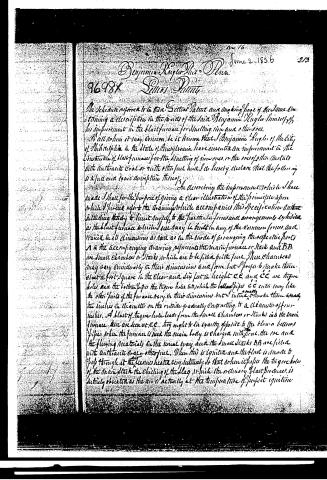
The Schedule referred to in these Letters Patent and making part of the same containing a description in the words of the said Benjamin Riegelman himself of his improvement in the blast furnace for smelting iron and other ores.
To all to whom it may concern, be it known that I Benjamin Riegelman of the city of Philadelphia in the State of Pennsylvania have invented an improvement in the construction of blast furnaces for the smelting of iron ores or the ores of other metals with anthracite coal or with other fuel and I do hereby declare that the following is a full and exact description thereof.
In describing the improvement to which I have made I shall for the purpose of giving a clear illustration of the principles upon which I proceed refer to the drawings which accompany this specification without intending thereby to limit myself to the particular form and arrangement exhibited as the blast furnace to which I refer may be built in any of the common forms and varied in its dimensions as well as in the mode of arranging the respective parts.
A in the accompanying drawing represents the main furnace or stack and B B are small chambers or stacks which are to be filled with fuel. These chambers may vary considerably in their dimensions and form, but I propose to make them about a foot square in the clear and six feet in height. C C and C C are tiger holes and the bottom pipes the tiger holes into which the bellows pipes C C enter may like the other parts of the furnace vary in their dimensions but I intend to make them nearly the same in diameter on the outside gradually contracting to a diameter of four inches. A blast of tiger hole leads from the small chambers or stacks into the main furnace, as are seen at C C. They might be in exactly opposite to the blow or bellows pipes when the furnace is used the main body is charged with ore, etc. and the fusing materials in the usual way and the small stacks B B are filled with anthracite coal or other fuel. When this is ignited and the blast is made to pass through it the furnace heats very intensely so that when it passes the tiger holes of the main stack the chilling of the slag which the ordinary blast produces is entirely obviated as the air is actually at the temperature of perfect ignition.
Page 3.
211. 9698 X
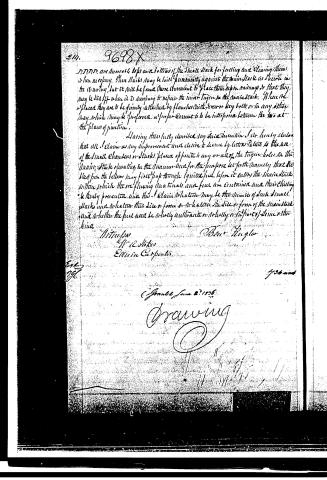
D.D.D. are movable tops and bottoms of the Small stack for feeding and cleaning them when necessary. These stacks may be built permanently against the main stack as shown in the drawing, but it will be found more convenient to place them upon railways, so that they may be slid off when it is necessary to repair the inner tubes in the main stack. When so placed they are to be firmly attached by flanges with screws or key bolts or in any other way which may be preferred, a proper cement is to be interposed between the two at the places of junction.
Having thus fully described my said invention I do hereby declare that all I claim as my improvement and desire to secure by letters Patent is the use of the small chambers or stacks placed opposite to any or all of the furnace holes in the main stack operating in the manner and for the purpose set forth namely that the blast from the bellows may first pass through ignited fuel before it enters the main stack without which the air flowing through the tubes and fuel are contained and their heating is thereby prevented and this I claim whether may be the number of such small stacks used whether their size or form or whether the size or form of the main stack and whether the fuel used be wholly anthracite or wholly or in part of some other kind.
Witness
Wm. H. Stokes
Elias Carpenter
Ben. Hughes
Filed June 2, 1856
Drawing
Published accounts: journal notice
Notice in the monthly list of patents
Journal of the Franklin Institute, new ser., vol. 18 (1836), p. 214 · View the page
390. Blast furnace. Benjamin Kugler, Philadelphia, • The compound here alluded to is a combination of silica (silex) and potassa (pot- ash), and is frequently called liquor of flints. Silica is a body still generally ranked
About this record
- Patentee
- DATAMP
- Date
- the Name and Date index of patents, DATAMP, USPTO records
- Invention
- DATAMP
- Listed in
- the Name and Date index of patents, DATAMP, USPTO records, Jim Shaw's X-patent list, the Journal of the Franklin Institute, Burke's List of Patents (1847)
- Burke's 1847 Patent Office list gives the same patent.