

Drawings and documents
National Archives restored drawings: drawing
A. Davidson's Patent Drawing for a Washing Machine

National Archives, Restored Patent Drawings (Record Group 241) · Full-size scan at the National Archives · Catalog record
Show the text on the drawing Hide (64 words)
Words on the drawing as machine-read by the National Archives; not checked. Useful mainly for searching.
68, / UNDRY. / [91] Wush ug Mach's / POUNDERS. / $1.50 / 9711.4 / DIVIDION / 9711* / All II DAVIDSONS / WASHANG MACHINE / tatented 1836., / A. Rox / 23 Braters / c. / D. shuft / I connecting / F. Handles / Geo Stuckanance / Patent office 15th Sept 1858 / Made under the direction of the Commission of / Patents in comformity with act3? March 1837 / Henry EMmooth / Commition of Patents
USPTO scan
The patent as scanned by the USPTO
-
 Page 1
-
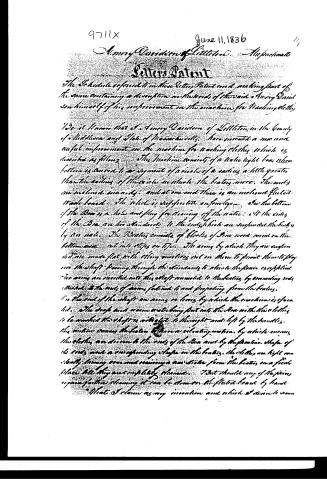 Page 2
-
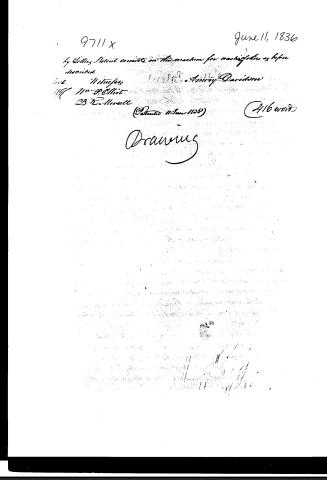 Page 3


U.S. Patent and Trademark Office · Google Patents
Show the transcription Hide (472 words)
Machine transcription (LightOnOCR) of the pages as scanned by the USPTO, most of them the handwritten copies made when the records were restored after the 1836 fire. Not checked; it can misread handwriting, so compare it with the scan.
Page 1.
9711X
A. Davidson,
Washing Machine,
Patented June 11, 1836.

Page 2.
9711x
June 11, 1836
Henry Davidson of Lilliston, Massachusetts
Letters Patent
The Schedule referred to in these Letters Patent and making part of the same containing a description in the words of the said Henry Davidson himself of his improvement in the machine for washing clothes,
It is known that H. Henry Davidson of Lilliston, in the County of Middlesex and State of Massachusetts, have invented a new and useful improvement in the machine for washing clothes which is described as follows: The Machine consists of a water tight box whose bottom is curved to an segment of a circle of a radius a little greater than the radius of the circle in which the beating moves. The ends are inclined inwardly and at one end there is an inclined fluted wash board. The whole is supported on four legs. On the bottom of the Box is a hole and plug for draining off the water. At the sides of the Box are two standards to the ends which are suspended the boxes by two nails. The Beaters consist of blocks of pine wood curved on the bottom side, cut into steps on top. The arms by which they are suspended are made flat with strong mortices cut in them to permit them to play over the shaft passing through the standards to which the boxes are applied. The arms are inserted into the shaft connected to the beaters by connecting rods attached to the ends of arms internal to and projecting from the beaters. On the end of the shaft are arms or levers by which the machine is operated. The drop and woven water being put into the Box with the clothes to be washed the shaft is set at right to the right and left by the handles. This motion causes the beaters to have a vibrating motion, by which means the clothes are driven to the ends of the Box and by the peculiar shape of its ends and a corresponding shape on the beaters, the clothes are lifted and slowly thrown over and receiving a new stroke from the beaters in a front place till they are completely cleaned. That should any of the pieces require further cleaning it can be done on the fluted board by hand.
That I claim as my invention and which I desire to secure
Page 3.
9711x
June 11, 1836
By letting Patent consists in the machine for washing clothes as before described.
Witnesses:
Henry Davidson
Mr. P. Elliot
B. K. Howell
(Patented 11 June 1836)
416 words
Drawing
Published accounts: journal notice
Notice in the monthly list of patents
Journal of the Franklin Institute, new ser., vol. 18 (1836), p. 215 · View the page
404. Washing machine. Amory Davidson, Littleton, Mass.
About this record
- Patentee
- DATAMP
- Date
- the Name and Date index of patents, DATAMP, USPTO records
- Invention
- DATAMP
- Listed in
- the Name and Date index of patents, DATAMP, USPTO records, Jim Shaw's X-patent list, the Journal of the Franklin Institute, Burke's List of Patents (1847)
- Burke's 1847 Patent Office list gives the same patent.