

Drawings and documents
National Archives restored drawings: drawing
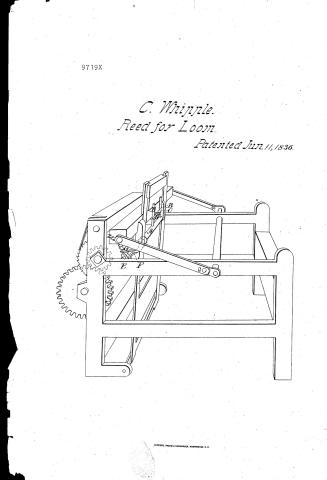
C. Whipple's Patent Drawing for a Loom

National Archives, Restored Patent Drawings (Record Group 241) · Full-size scan at the National Archives · Catalog record
Show the text on the drawing Hide (49 words)
Words on the drawing as machine-read by the National Archives; not checked. Useful mainly for searching.
139. WEAVING. / [95] Reeds & Read Making. / Clario-rep - Rod A KCKE to keep the seed and secure / $150 / its power throughout its whole length. / CLASSISTOATION / 9719-t / DIVISION. / 9719X / C. WHIPPLE / LOOM / patented 11" June 1836, / 12 / do
USPTO scan
The patent as scanned by the USPTO
-
 Page 1
-
 Page 2
-
 Page 3


U.S. Patent and Trademark Office · Google Patents
Show the transcription Hide (702 words)
Machine transcription (LightOnOCR) of the pages as scanned by the USPTO, most of them the handwritten copies made when the records were restored after the 1836 fire. Not checked; it can misread handwriting, so compare it with the scan.
Page 1.
9719X
C. Whipple.
Reed for Loom.
Patented Jun. 11, 1836.
Page 2.
24314
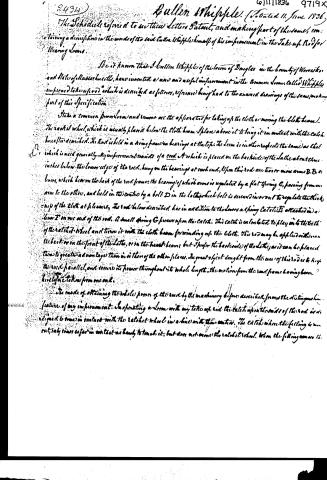
Bullen Whipple. (Patented 11. June 1836.)
The Schedule referred to in their Letters Patent, and making part of this same, containing a description in the words of the said Bullen Whipple himself of his improvement in the Take-up Rod for Wearing Looms.
Be it known that I Bullen Whipple of the town of Douglas in the county of Worcester and State of Massachusetts, have invented a new and useful improvement in the common looms called "Whipple improved take-up rod" which is described as follows, reference being had to the annexed drawings of the same, making part of this Specification.
State a common power loom and looms are the apparatus for taking up the cloth or moving the cloth beam. The ratchet wheel, which is usually placed below the cloth beam. Place a rod to bring it in contact with the catch beneath described. The rod is held in a strong frame on bearings at the top. The loom is in other respects the same as that which is used generally. My improvement consists of a rod A which is placed on the backside of the lathe about three inches below the lower edge of the rod, hung on the bearings at each end, from this rod are two or more arms B, B, or levers, which bear on the back of the rod frame; the bearings of which arms is regulated by a flat spring C, passing from one arm to the other, and held in this condition by a bolt D in the lathe which bolt is secured in order to regulate the thickness of the cloth at pleasure. The rod below described has in addition to the arms a spring catch E attached in a lever F on one end of the rod. A small spring G passes upon the catch. This catch is calculated to play on to the teeth of the ratchet wheel and turns it with the cloth beam for winding up the cloth. This rod may be applied either on the back or on the front of the lathe, or on the head beams but I prefer the backside of the lathe, as it can be placed there to greater advantage than in either of the other places. The great object sought from the use of this rod is to keep the rod parallel, and secure its power throughout its whole length—the motion from the rod frame having been heretofore taken from one end.
The mode of obtaining the whole power of the rod by the machinery before described, forms the distinguishing feature of my improvement. In operating a loom with any take-up rod the catch upon the end of the rod is designed to come in contact with the ratchet wheel in a line with the motion. The catch where the falling is run out, only comes so far in contact as barely to touch it, but does not move the ratchet wheel. When the falling comes to
Page 3.
6/11/1836 9719X
107
reed to bring it will vibrate the rod and move the ratchet wheel at the same winding up the cloth, and will continue to take up as long as the reed swings the required distance. There being no weight of initial of any consequence the motion of the reed perfectly governs the catch on the ratchet wheel, making the cloth move sure, especially when thin cloth, than any other method.
What I claim as my invention, and which I desire to secure by Letters Patent consists in the before described, combination of machinery for taking up the cloth in weaving, whether constructed in the precise manner above described, or in any other containing the same principle as herein set forth; particularly the rolling rod or lever with the roller rod or lever furnished acting on the ratchet wheel connected to the end of the cloth beam.
Wittigues
Jonathan Spurgeon
Lipman Parsons
(160 words)
Loullen Whipple
Expt. 1836.
Drawing
Published accounts: journal notice
Notice in the monthly list of patents
Journal of the Franklin Institute, new ser., vol. 18 (1836), p. 215 · View the page
403. Weaving, improvement in. -Cullen Whipple, Douglass, Mass.
About this record
- Patentee
- DATAMP
- Date
- the Name and Date index of patents, DATAMP, USPTO records
- Invention
- DATAMP
- Listed in
- the Name and Date index of patents, DATAMP, USPTO records, Jim Shaw's X-patent list, the Journal of the Franklin Institute, Burke's List of Patents (1847)
- Burke's 1847 Patent Office list gives the same patent.