

Drawings and documents
National Archives restored drawings: drawing
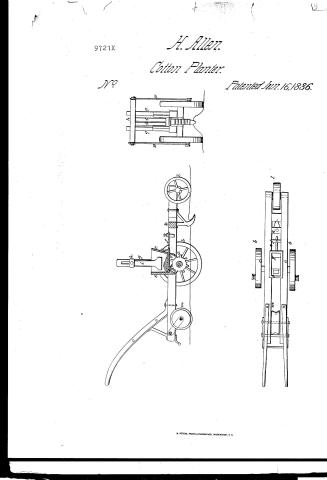
H. Allen's Patent Drawing for a Cotton Planter

National Archives, Restored Patent Drawings (Record Group 241) · Full-size scan at the National Archives · Catalog record
Show the text on the drawing Hide (109 words)
Words on the drawing as machine-read by the National Archives; not checked. Useful mainly for searching.
Interect. / vol. 25. page 149 / 111, SEEDERS&PLA ITERS. / [133] Cotton. / Planters / HALLEN / Salented 16" June 1836 / cotton Planter / 9721-X / 9721X / a. Frame b. Mheels confened to tixle c / d. Teeth wheel e Box or hopper / f. Rod. I Regulating gate g. unight bass / or rods h. sliding cross bar with PitmansH / allached to wrists on Wheels b- / i Pestous attached to steding erosbas / sheckland Del' / K. cross bar with bull-tongue l. nhulearli / m. hollowed cylinder / Patent offici and 30 1843 / Made under the direction of the Commercement / of Patents in court minuty with actof 3'March 1335 / Hillermonth / Communications Palents
USPTO scan
The patent as scanned by the USPTO
-
 Page 1
-
 Page 2
-
 Page 3


U.S. Patent and Trademark Office · Google Patents
Show the transcription Hide (695 words)
Machine transcription (LightOnOCR) of the pages as scanned by the USPTO, most of them the handwritten copies made when the records were restored after the 1836 fire. Not checked; it can misread handwriting, so compare it with the scan.
Page 1.
9721X
H. Allen.
Cotton Planter.
Patented Jun. 16, 1836.
Nº

Page 2.
June 16, 1836
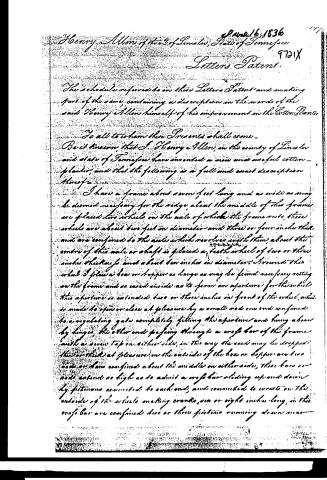
Henry Allen of the County of Lincoln, State of Tennessee
Letters Patent.
The schedule referred to in this Letters Patent and making part of the same, containing a description in the words of the said Henry Allen himself of his improvement in the Cotton Planter.
To all to whom these Presents shall come—
Be it known, that I, Henry Allen, in the county of Lincoln and state of Tennessee have invented a new and useful cotton-planter, and that the following is a full and exact description thereof.
I have a frame about seven feet long and as wide as may be deemed necessary for the ridge, about the middle of this frame are placed two wheels on the axle of which the frame rests, these wheels are about two feet in diameter and three or four inches thick and are confined to the axle which revolves with them; about the centre of this axle or shaft is placed a teeth wheel of two or three inches thickness and about ten inches in diameter. Around this wheel I place a box or hopper as large as may be found necessary resting on the frame and so eased inside as to form an aperture for the wheel. This aperture is extended two or three inches in front of the wheel, which is made to open or close at pleasure by a small rod one end confined to a regulating gate completely filling the aperture and hung above by hinges, the other end passing through a cross bar of the frame with a screw tap on either side, in this way the axle may be stopped thin or thick at pleasure. On the outside of the box or hopper are two rods or bars confined about the middle on either side, these bars or rods extend so high as to admit a cross bar sliding up and down by pistons connected to each end, and connected to cranks on the outside of the wheels making cranks, six or eight inches long, in this cross bar are confined two or three pistons running down as
Page 3.
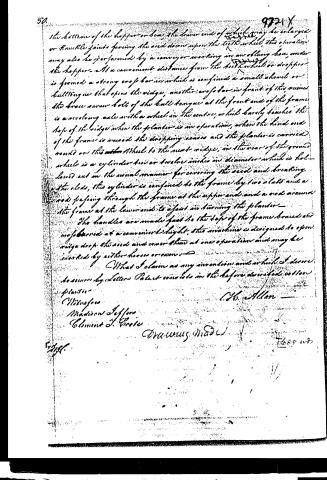
the bottom of the hopper or box, the lower end of which may be enlarged or knuckle joints forcing the seed down upon the teeth wheel, this operation may also be performed by a conveyor working in an oblong box under the hopper. At a convenient distance from the teeth wheel or dropper is formed a strong cross bar on which is confined a small shovel or bull tongue that opens the ridge, another cross bar in front of this moves the brace screw bolt of the bull tongue at the front end of the frame is a revolving axle with a wheel in the centre, which barely touches the top of the ridge when the planter is in operation, when the hind end of the frame is raised the dropping ceases and the planter is carried round on this wheel to the next ridge, in the rear of the ground wheel is a cylinder ten or twelve inches in diameter which is hollowed out in the usual manner for covering the seed and breaking the clods, this cylinder is confined to the frame by two slats and a rod passing through the frame at the upper end and a rod around the frame at the lower end to adjust in turning the planter.
The handles are made fast to the top of the frame braced and cross barred at a convenient height. This machine is designed to open ridge drop the seed and cover them at one operation and may be worked by either horses or oxen.
What I claim as my invention and which I desire to secure by Letters Patent consists in the before described cotton planter.
Witnesses
Madison Jeffers
Clement J. Coote
Chas. Allen
Drawing Made
Expt.
Published accounts: journal notice
Notice in the monthly list of patents
Journal of the Franklin Institute, new ser., vol. 18 (1836), p. 215 · View the page
424. Cotton planting machine. Henry Allen, Fayetteville, Tenn.
About this record
- Patentee
- DATAMP
- Date
- the Name and Date index of patents, DATAMP, USPTO records
- Invention
- DATAMP
- Listed in
- the Name and Date index of patents, DATAMP, USPTO records, Jim Shaw's X-patent list, the Journal of the Franklin Institute, Burke's List of Patents (1847)
- Burke's 1847 Patent Office list gives the same patent.