

Drawings and documents
National Archives restored drawings: drawing
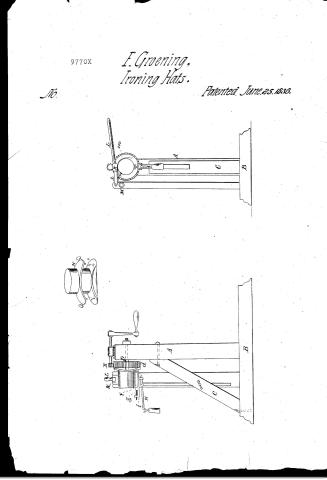
F. Groening's Patent Drawing for a Machine for Manufacturing Palm-leaf Hats

National Archives, Restored Patent Drawings (Record Group 241) · Full-size scan at the National Archives · Catalog record
Show the text on the drawing Hide (115 words)
Words on the drawing as machine-read by the National Archives; not checked. Useful mainly for searching.
2. 823. Abparel Apparatus, / Hate / Hat Machines- / Dol. 25 page 141 / DIY, 15 / Ironers. / R GROENING / 9770-t / Manusac's Palm-leaf Huts / Patenled 25" June 1836 / INVIDION. / 9770X / A. upright / B. sillipeice / C.B Brace / D. Slationary spindle. a cogwieel / E. Speer wheel / F. Slide f. strap. 9. Guidequine & spring presing slide / containg Spenga againstrat / HI. weighten E.CVET / I. unrightion tastened by thumb screw / K. Trom / L. Short (17 771 E handle / M. Roller with colton Cloth m / N. 0. Flecated Iron M coulds / C. / Patent office In 30 11443 / Stricklanch Del / Made under the denection of the of Patents / in conformet with ach of 3' March 1837 / womenth / Commerce of patents
USPTO scan
The patent as scanned by the USPTO
-
 Page 1
-
 Page 2
-
 Page 3
-
 Page 4
-
 Page 5


U.S. Patent and Trademark Office · Google Patents
Show the transcription Hide (1,788 words)
Machine transcription (LightOnOCR) of the pages as scanned by the USPTO, most of them the handwritten copies made when the records were restored after the 1836 fire. Not checked; it can misread handwriting, so compare it with the scan.
Page 1.
9770X
No.
F. Groening,
Ironing Hats.
Patented June 25, 1836.

Page 2.
June 25, 1836
Frederick Groening of Brooklyn, New York. 9770X
Letters Patent.
The schedule referred to in these Letters Patent, and making part of this case containing a description in the words of the said Frederick Groening of his improvement in the manufacture of Palm Leaf hats.
To all to whom these presents shall come,
Be it known that I, Frederick Groening of the town of Brooklyn in the county of King and the state of New York, have invented a new and useful improvement in the manufacture of Palm Leaf hats, and in certain machinery for pressing and finishing the same, and that the following is a full and exact description of the said improvement.
The inner part of the vine or palm leaf hat, as they have hitherto been manufactured, or more properly the junction of the crown and vine forms a circle, and the vine itself is perfectly flat; any variation from this shape which we are being produced by the pressing when these hats are put on owing to the oval shape of the head, the front and back part of the vine are forced downward to the annoyance of the wearer, obstructing the view &c. and the shape of the hat otherwise disfigured, the defect increasing in proportion as the hat is worn and assuming the original shape from which it had been forced by pressing, my improvement is intended to obviate this defect, and consist in brading the hats so as to make the junction of the vine and crown an ellipse instead of a circle, and also to dish or oval the vine on its lower side from front to rear. This is effected by using an oval block and working into the vine by the 4 quadrants of its circumference, an additional number of ditches proportionable to the convexity of the ellipse or oval and the required dish which anyone acquainted with this kind of work will sufficiently understand & be able to put into practice. The machinery for pressing and finishing consists of several parts as follows.
The first is the machine for pressing the crown, a strong, upright timber is tied and into a little piece or frame that rests upon the floor, the upright being braced from the side towards the side on which the pressing is performed, through the upright is passed, a stationary iron spindle confined by a nut on one side and
Page 3.
and projecting sufficiently far on the other to secure also certain an iron cog wheel with a socket at its centre (attached to the wheel) that enters the hat block, and forms the main bearing; the socket and spindle should enter deep into the block and the diameter of the latter upon which the socket plays freely, should be about 3 inches, this better to sustain the pressure. The the block being secured to the socket by wedges or otherwise, on the face of the cogwheel is a short lock pin that enters the block and causes it to revolve with the wheel, also two small arms project horizontally from the same face of the wheel diametrically opposite to each other, to ends of which are secured by thumb screws by which their length are regulated, two hooked slides which catch the margin of the rim of the hat the latter being secured by screw nuts between two plates of metal, conforming very nearly to its shape and hold the hat on the block. A small spur wheel immediately above the cog wheel and which meshes into it, has its bearing or shaft running into a suitable box; on the top of the upright and to this shaft is attached the wheels by which the machine is operated, the diameter of the wheels may be varied so as to suit the power and speed. Immediately under the hat blocks is the sponge, by which the hat is kept in a proper state of humidity for the operation of pressing; it consists of a metal or wooden slide, to the upper side of which the sponge is attached. This slide rests upon a strip of metal, the end of which under the hat or block has a slot or groove in which works a guide pin or screw fixed in the main side of the slide, the other end of the slide being guided by a pin that passes through a hole in a rectangular arm raised on the strip, the object of this sliding motion being to keep the sponge close to the rim of the hat, whilst according to effect which a spiral spring is placed on the guide pin between the arm and slide also the end of the slide next to the hat rim is beveled from the main slide, to support the sponge. It is connected with the short arm of a weighted lever immediately under it by a pin that passes through two short bores on the lower side of the strip; this forming at the same time a joint for hinge the lever having its fulcrum in an upright iron rod or bar that passes through the base of the upright, which is movable up and down, and is made stationary by a thumb screw, in the base of the brace, by this means the pressure
Page 4.
of the sponge may be regulated, and it will adjust itself to hats of different sizes. The iron is a square box, the length of which is nearly equal to the height of the crown of the hat; the bottom next to the side of the hat projecting a short distance is pressed during the operation against one of the plates which inclines the side and the iron following the inflections or disk of the rim, has a lateral motion that causes it to operate on every part of the crown contiguous to the rim without injury to the latter.
A short arm projects from one side of the box, the end of which is connected by a pin to the top of a foot at the side of the machine opposite the block, and a long handle at the opposite side, the arm and handle forming together a lever situated transversely across the block, by bearing on the end of which with the hand or by weight, whilst the hat is in position, the required degree of pressure of the iron is produced. A hot iron belt or heater of which there may be several having been first introduced into the box, also the same foot with the iron is hooked or attached by a roller or cotton cloth that is spread on the hat before the iron is applied for the purpose of protecting it from the dust and removing any extra moisture obtained from the sponge. I prefer the roller upon which the cloth may be worn as it becomes too much soiled for use by which means a clean part of it may be always brought under the iron and much trouble in shifting cloths saved. For pressing the top of the crown, as also the brim, I employ heated cast iron moulds. For the first a circular flat mould with a round depression large enough to admit an ordinary hat is used, the hat is first put on a solid block or thin smooth plate of metal being first interposed between the hat and block. It is then set upright in the mould heated to a proper degree which the experience of the workman will dictate after which the whole is submitted to a very heavy pressure, by any of the presses in common use for a sufficient length of time to produce the desired effect.
The moulds in which the brims are pressed, are also of cast iron made very heavy so as to retain the heat. The lower mould is oval and of the shape of which it is designed the rim shall have the upper mould corresponds to the lower one exactly except that a large circular opening is left in the middle which admits the crown of the hat to pop through it.
Page 5.
they are also both cast with an or handle for the convenience of lifting and are likewise supplied with match pins, the hat being placed crown up on the lower mould (which is heated) a thin plate of metal of which there are several to fit hats of different sizes crowns and rims is placed on top of the rim having the same inflections as the mould, the upper mould also heated is then put on and the whole submitted to a heating pressure, as before. The lower mould is also used in connection with a cast iron mould having the same breadth as the rim, to keep into proper shape rims made of thick paper which are to be put between the inner side of the rim and its lining when the hat is trimmed, for the purpose of stiffening it. Before removing the paper rim from the upper mould its inner edge which projects past the mould for the purpose, is notched or cut after which a proper shaped block is forced through from the inner side and turns up said edge and perfectly adapts the rim, to the hat.
The paper rims should be broad enough to project past the outer circumference of the hat rim, to be trimmed off when the hat is bound, after folding the hats are to be lined and trimmed in the usual manner.
Now what I claim as new and as my invention for which I ask Letters Patent, is the method herein set forth of brading the junction of the rim and crown of the hat oval instead of round, and arched from front to rear. I also claim the heated cast iron moulds used in the manner herein described, and likewise the machine for ironing the crowns so far as regards the application of the sponge and its constitution; the cog and spur wheels together with the hooks and plates enclosing the rim by which the hat is held on the block, not meaning to claim solely the principle of a revolving plate which has already been used for similar purposes.
Given under my hand at the city of Washington this 23 day of May 1836.
F. G. Downing.
Wm. T. Steiger
D. R. Aldrich
Drawn by me. [1836]
Published accounts: journal notice
Notice in the monthly list of patents
Journal of the Franklin Institute, new ser., vol. 18 (1836), p. 287 · View the page
474. Palm leaf hats.-Fred. Groening, Brooklyn, N. Y.
About this record
- Patentee
- DATAMP
- Date
- the Name and Date index of patents, DATAMP, USPTO records
- Invention
- DATAMP
- Listed in
- the Name and Date index of patents, DATAMP, USPTO records, Jim Shaw's X-patent list, the Journal of the Franklin Institute, Burke's List of Patents (1847)
- Burke's 1847 Patent Office list gives the same patent.