

Drawings and documents
National Archives restored drawings: drawing
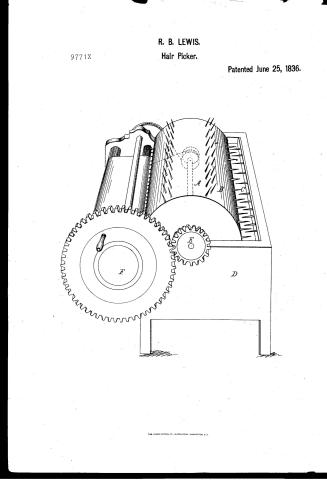
R.B. Lewis's Patent Drawing for a Hair Picker

National Archives, Restored Patent Drawings (Record Group 241) · Full-size scan at the National Archives · Catalog record
Show the text on the drawing Hide (25 words)
Words on the drawing as machine-read by the National Archives; not checked. Useful mainly for searching.
R.B.Lewis, / annix / Hair Picker. / Paterled June 25. 1836. / Braffish.
USPTO scan
The patent as scanned by the USPTO
-
 Page 1
-
 Page 2
-
 Page 3


U.S. Patent and Trademark Office · Google Patents
Show the transcription Hide (494 words)
Machine transcription (LightOnOCR) of the pages as scanned by the USPTO, most of them the handwritten copies made when the records were restored after the 1836 fire. Not checked; it can misread handwriting, so compare it with the scan.
Page 1.
R. B. LEWIS.
Hair Picker.
Patented June 25, 1836.
9771X

THE NORRIS PETERS CO., PHOTO-LITHO., WASHINGTON, D.C.
Page 2.
9771x
June 25, 1836
Robert Benjamin Lewis of Hallowell a Maine
Letters Patent.
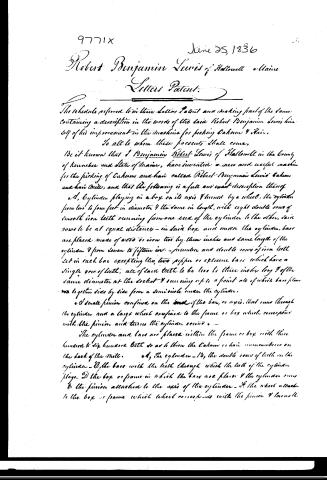
The schedule referred to in these Letters Patent and making part of the same, containing a description in the words of the said Robert Benjamin Lewis himself of his improvement in the machine for picking Cakew and Hair.
To all to whom these presents shall come,
Be it known that I Benjamin Robert Lewis of Hallowell in the county of Kennebec and State of Maine, have invented a new and useful machine for the picking of Cakew and hair called Robert Benjamin Lewis Cakew and hair Mill, and that the following is a full and exact description thereof.
A, Cylinder playing in a box on its axis & turned by a wheel, the cylinder from two to four feet in diameter & the same in length, with eight double rows of smooth iron teeth running from one end of the cylinder to the other, said rows to be at equal distances - in said box and under the cylinder, bars are placed made of wood or iron two by three inches and same length of the cylinder & from seven to fifteen in number and double rows of iron teeth set in each bar excepting two, two, upper or extreme bars which have a single row of teeth, all of said teeth to be two to three inches long & of the same diameter at the socket & running up to a point all of which bars placed together side by side form a semicircle under the cylinder.
B, A small pinion confined on the end of the bar, or axis, that runs through the cylinder and a large wheel confined to the frame or box which corresponds with the pinion and turns the cylinder round.
The cylinder and bars are placed within the frame or box with three hundred to six hundred teeth so as to throw the Cakew or hair unnumbered on the back of the mill.
A, The cylinder - B, the double rows of teeth on the cylinder - C, the bars with the teeth through which the teeth of the cylinder play. D the box or frame in which the bars are placed & the cylinder runs to the pinion attached to the axis of the cylinder - E, the wheel attached to the box or frame which wheel corresponds with the pinion & turns the
Page 3.
June 25, 1836
9771X
In witness of the hereof, I said Robert have hereunto set my hand this 11th day of April A.D. 1836.
Witnesses:
John Anderson
John Pearson
Robert Benjamin Lewis
450 no
Drawing
Published accounts: journal notice
Notice in the monthly list of patents
Journal of the Franklin Institute, new ser., vol. 18 (1836), p. 287 · View the page
488. Buildings, constructing.-Lewis Knapp, N. Y.
About this record
- Patentee
- DATAMP
- Date
- the Name and Date index of patents, DATAMP, USPTO records
- Invention
- DATAMP
- Listed in
- the Name and Date index of patents, DATAMP, USPTO records, Jim Shaw's X-patent list, the Journal of the Franklin Institute, Burke's List of Patents (1847)
- Burke's 1847 Patent Office list gives the same patent.