

Drawings and documents
National Archives restored drawings: drawing
Benjamin Lapham's Patent Drawing for the Improvement in the Power Loom

National Archives, Restored Patent Drawings (Record Group 241) · Full-size scan at the National Archives · Catalog record
Show the text on the drawing Hide (131 words)
Words on the drawing as machine-read by the National Archives; not checked. Useful mainly for searching.
139. WEAVING, / 1 150 / Take Ups and Let Offs, / Let Offs. 59 / Patented 28thgand 1836. / Vzy P.45. / CLASSWIDATION / 9791.4 / Benjamin Lapham's / 9791X / Improvement in the Ruver Loom. / A Loom frame / Sicle elevation / B Harp. roll or yarn -heam / c Wheel with skew teeth / d Horm or endlefs screw / e Herm shuft or artor / f Stud / is Middle side rail / 10/6/19 / h Ratchet wheel / i Mand / les / f Spiral Spring / Has c 6 / C Ellow / To that secures stud t lo side rails / D Sword of the batlen / l Back roller / 20 Second zoller / n Lever / Patent Office Septing 1850. / 0 Sever-spring / Calline under the direction of the Countify / -sioner of Talents in conformly ur do the act / p Rod with shoulder / of 3rof march 1837. / Acting
USPTO scan
The patent as scanned by the USPTO
-
 Page 1
-
 Page 2
-
 Page 3
-
 Page 4


U.S. Patent and Trademark Office · Google Patents
Show the transcription Hide (970 words)
Machine transcription (LightOnOCR) of the pages as scanned by the USPTO, most of them the handwritten copies made when the records were restored after the 1836 fire. Not checked; it can misread handwriting, so compare it with the scan.
Page 1.
9791X
B. Layham.
Take-Up.
Patented Jun. 28, 1836.

Page 2.
June 28, 1836
Benjamin Lapham, Waterford, U.S.
Letters Patent.
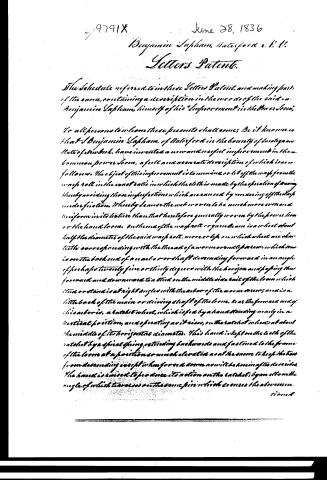
The Schedule referred to in these Letters Patent, and making part of the same, containing a description in the words of the said Benjamin Lapham, himself of his "Improvement in the Power Loom,"
To all persons to whom these presents shall come, Be it known that I Benjamin Lapham, of Waterford in the county of Susquehanna State of New York, have invented a new and useful improvement in the Power Loom, a full and accurate description of which is as follows: The object of this improvement is to remove or let off the warp from the warp roll in the exact ratio in which the cloth is made by the operation of weaving thereby avoiding those imperfections which are caused by running off the warp under friction. I thereby cause the web to be much more even and uniform in its texture than that heretofore generally woven by the power loom or the hand loom. On the end of the warp roll or yarn beam is a wheel about half the diameter of the said warp roll, more or less, on which wheel are attached corresponding with the thread of a worm or vulcan paper, which is on the back end of a shaft or rod descending forward in an angle of perhaps twenty-five or thirty degrees with the horizon and passing through forward and downward to a stick on the middle side rail of the loom which stick or stand is at right angles with the axis of the worm or screw, and is a little back of the main or driving shaft of the loom. Near the forward end of this axis is aatchet wheel, which is fed by a hand standing nearly in a vertical position, and operating as it rises, on theatchet wheel at about the middle of its horizontal diameter. This hand is kept on the teeth of theatchet by a spiral spring extending backwards and fastened to the frame of the loom at a position so much elevated as at the same to keep the hand from descending except when forced down as with the raising of the reed. The hand is raised to produce its action on theatchet by an elbow with the angle of which turns on the same pin which secures the axis or screw.
Page 3.
June 28, 1836
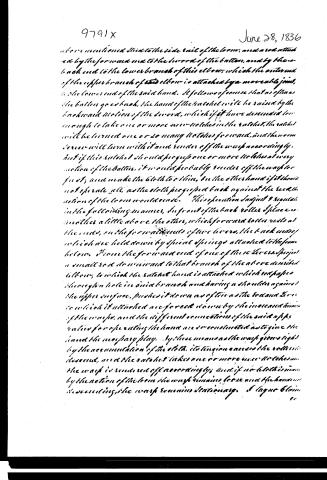
where mentioned slid to the side rail of the loom; and a rod attached by the forearm and to the sword of the button, and by the back end to the lower branch of this elbow, which the extremity of the upper branch of said elbow is attached by a moveable joint, to the lower end of the said hand. It follows of course that as often as the button goes back, the hand of the ratchet will be raised by the backward motion of the sword, which if it have descended low enough to take one or more new notches in the ratchet, the ratchet will be turned one or so many notches forward, and the warp thread will come with it and render off the warp accordingly. But if this ratchet should progress one or more notches at every motion of the button, it would probably render off the warp too fast, and make the cloth too thin, on the other hand if it should not operate all, as the cloth progressed back against the reed, the action of the loom would cease. This operation I adjust & regulate in the following manner, by means of the back roller & piece & another a little above the other, which forward rollers rest at the ends, on the forward ends of the levers, the back ones of which are held down by spring springs attached to the frame below. From the forward end of one of these levers projects a small rod downward to that branch of the above described elbow, to which the ratchet hand is attached which wraps through a hole in said branch and having a shoulder against the upper surface, pushes it down as often as the button lever to which it is attached are forced down by the increase and diminution of the warp, and the different connections of the said upper roller for operating the hand are so constructed as to give the hand the necessary play. By these means as the warp grows tight by the accumulation of the cloth, its tension causes the rollers to descend, and the ratchet takes one or more new notches and the warp is rendered off accordingly; and if no cloth is woven by the action of the loom the warp remains loose and the hand not descending, the warp remains stationary. I have no claim to
Page 4.
9791x
June 28, 1836
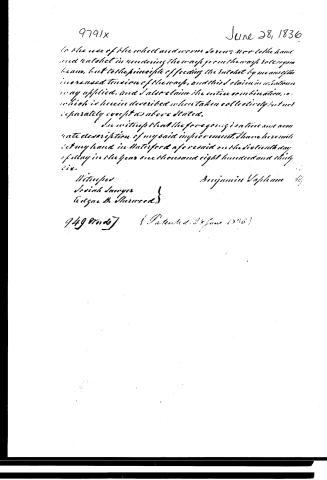
to the use of the wheel and worm screw, nor to the hand andatchet in winding the warp from the warp to the yarn beam, but to the principle of feeding theatchet by means of the increased tension of the warp, and this I claim in whatever way applied, and I also claim the entire combination, which is herein described when taken collectively but not separately except as above stated.
In witness that the foregoing is a true and accurate description of my said improvement, I have hereunto set my hand in Waltham aforesaid on the sixteenth day of May in the year one thousand eight hundred and thirty six.
Witnesses
Benjamin Lapham
Joseph Sawyer
Eugene B. Shumock
949 words (Patented 28 June 1836)
Published accounts: journal notice
Notice in the monthly list of patents
Journal of the Franklin Institute, new ser., vol. 18 (1836), p. 287 · View the page
486. Power loom.—Benjamin Lapham, Waterford, N. Y.
About this record
- Patentee
- Jim Shaw's X-patent list
- Date
- the Name and Date index of patents, USPTO records, Jim Shaw's X-patent list
- Invention
- the Name and Date index of patents
- Listed in
- the Name and Date index of patents, USPTO records, Jim Shaw's X-patent list, the Journal of the Franklin Institute, Burke's List of Patents (1847)
- Burke's 1847 Patent Office list gives the same patent.