

Drawings and documents
National Archives restored drawings: drawing
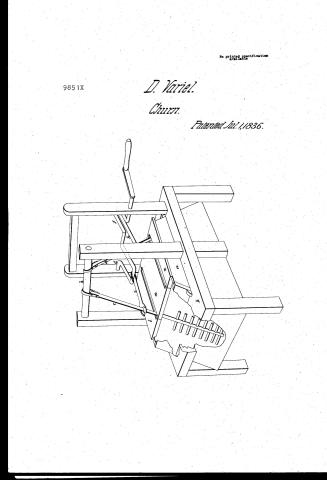
David Variel's Patent Drawing for a Churn

National Archives, Restored Patent Drawings (Record Group 241) · Full-size scan at the National Archives · Catalog record
Show the text on the drawing Hide (81 words)
Words on the drawing as machine-read by the National Archives; not checked. Useful mainly for searching.
31. DAIRY. / Vibrating Churns. / Periproe Channs / til / David antrodents Variel / Patented July 1. 1836. / TION / Vol.27. 333. / 9851.4 / DI / 83 9851x / Churn / Reference / a. the bax. f. the bench exd breaks. J.d g double / orank. h. che pin. id K. connecting carr. / l. m n cover. / ON / Patentoffice hag not 1845 / Anal march che direction of the Commisions of / Patents in conformity with act of s . march 183> / fionn of Patents.
USPTO scan
The patent as scanned by the USPTO
-
 Page 1
-
 Page 2
-
 Page 3


U.S. Patent and Trademark Office · Google Patents
Show the transcription Hide (750 words)
Machine transcription (LightOnOCR) of the pages as scanned by the USPTO, most of them the handwritten copies made when the records were restored after the 1836 fire. Not checked; it can misread handwriting, so compare it with the scan.
Page 1.
9851X
D. Variel.
Churn.
Patented Jul. 1, 1836.
No printed specification available
Page 2.
July 1, 1836
Davis Caried
Letters Patent
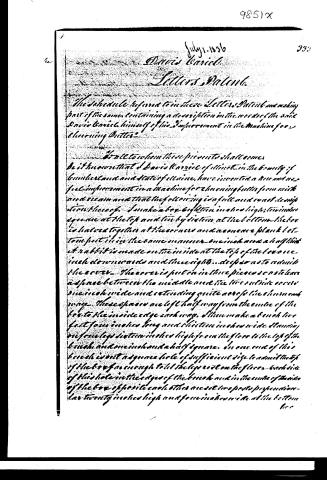
The Schedule referred to in these Letters Patent and making part of the same, containing a description in the words of the said Davis Caried himself of his Improvement in the Machine for Churning Butter.
To all to whom these presents shall come, Be it known that I Davis Caried of Illinois in the County of Cumberland and State of Maine, have invented a new and useful improvement in a Machine for churning butter from milk and cream and that the following is full and exact description thereof. I make a box eight feet in a box high; two inches square at the top and ten by sixteen at the bottom. The box is halved together at the corners and a corner plank bottom put in the same manner. One inch and a half thick at a butt it is made on the inside at the top of the box one inch downwards and three eights deep so as to admit the cover. The cover is put on in three pieces so as to leave a space between the middle and the two outside pieces one inch wide and extending quite across the churning way. These spaces are left half way from the angle of the box to the inside edge each way. I then make a bench two feet four inches long and sixteen inches wide standing on four legs sixteen inches high from the floor to the top of the bench and one inch and a half square. In one end of this bench is cut a square hole of sufficient size to admit the top of the box far enough to let the legs rest on the floor. Back side of this hole in the edges of the bench and in the center of the sides of the box opposite each other are set two posts perpendicular twenty inches high and four inches wide at the bottom.
Page 3.
7/11/1836 9851x
334.
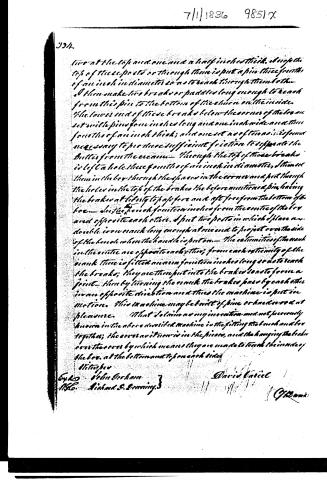
two at the top and one and a half inches thick. Strip the top of these posts so through them is put a pin three fourths of an inch in diameter so as to reach through them both. I then make two breaks or paddles long enough to reach from this pin to the bottom of the churn on the inside. The lower end of these breaks below the corners of the box are set with pins four inches long and one inch wide and three fourths of an inch thick; and one set as often as is found necessary to produce sufficient friction to separate the butter from the cream. Through the top of these breaks is left a hole three fourths of an inch in diameter, I then set them in the box through the spaces in the corners and put through the holes in the top of the breaks the before mentioned pin, leaving the breaks at liberty to pass fore and aft free from the bottom of the box. I then set each fourteen inches from the centre of the box and opposite each other. I put two posts in which I place a double iron crank long enough at one end to project over the side of the box where the handle is put on. The extremities of the crank in the centre are opposite each other; from each extremity of the crank there is fitted a man fourteen inches long so as to reach the breaks; they are then put into the breaks so as to form a joint. Then by turning the crank the breaks pass by each other in an opposite direction and thus the machine is put in motion. This machine may be built of pine or hard wood at pleasure. What I claim as my invention and not previously known in the above described machine is the fitting the crank and box together; the secret art now is in the pins, and the hanging the breaks over the secret by which means they are made to touch the inside of the box at the bottom and to pass each side.
Witnesses
Exto John Sorkam
Nko Richard S. Gunning
David Vaziel
G. D. D.
DATAMP: illustration
Illustrations from DATAMP


DATAMP (Directory of American Tool and Machinery Patents), via the Internet Archive · Archived DATAMP page
About this record
- Patentee
- DATAMP
- Date
- the Name and Date index of patents, DATAMP, USPTO records
- Invention
- DATAMP
- Listed in
- the Name and Date index of patents, DATAMP, USPTO records, Jim Shaw's X-patent list, Burke's List of Patents (1847)
- Burke's 1847 Patent Office list gives the same patent.