

Drawings and documents
USPTO scan
The patent as scanned by the USPTO
-
 Page 1
-
 Page 2
-
 Page 3
-
 Page 4


U.S. Patent and Trademark Office · Google Patents
Show the transcription Hide (961 words)
Machine transcription (LightOnOCR) of the pages as scanned by the USPTO, most of them the handwritten copies made when the records were restored after the 1836 fire. Not checked; it can misread handwriting, so compare it with the scan.
Page 2.
United States Patent
Patent No.: X9852
S. Walker of J. Walker
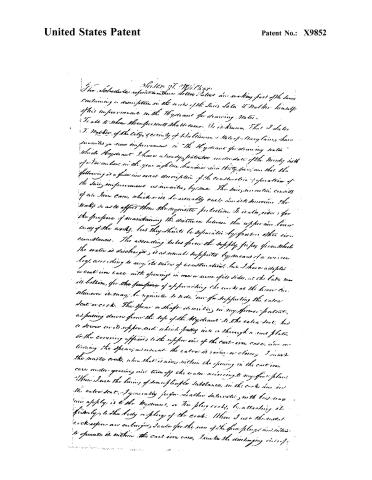
The Schedule referred to in this Letter Patent are making part of the Laws containing a description in the arts of the said S. Walker himself of his improvement in the Hydrant for drawing Water.
To all to whom these presents shall come, It is known, That I S. Walker of the City, & County of Baltimore, State of Maryland, have invented a new improvement in "the Hydrant for drawing water" which Hydrant I have already patented under date of the twenty sixth of November, in the year eight hundred and thirty-five, and that the following is a full and exact description of the construction & operation of the said improvement as invented by me. The said invention consists of an Iron case, which will be usually cast, and is to surround the works so as to afford them the requisite protection. It is also used for the purpose of maintaining the distance between the upper and lower ends of the works, lest they should be separated by force or other circumstances. The ascending tubes from the supply pipes from which the water is discharged, is as usual supported by means of a wooden leg, according to my, the mode of construction, but I have adopted a cast-iron case, with openings in one or more of its sides, at the base near its bottom, for the purpose of approaching the works at the lower end whenever it may be requisite to do so, for supporting the valve seat or cock. The gear or shaft described in my former patent, as passing down from the top of the Hydrant to the valve seat, has a screw on its upper end which passes into or through a nut plate, or the covering officer to the upper end of the cast-iron case, and turning the gear, as usual, the valve is raised or closed. I insert the waste cock, when that is used, within the opening in the cast-iron case under opening and turn off the water according to my first plan. When I use the lining of some pliable substance, in the cock and in the valve seat, I generally prefer leather saturated with tar, and may apply it to the Hydrant, or the plug cocks, by attaching it firmly to the body or plug of the cock. When I use the metal cock upon an enlarged scale for the use of the fire plugs and similar to operate it within the cast-iron case, I make the discharging end of
Page 3.
United States Patent
Patent No.: X9852
the cock to turn upwards within the body of the case, and from it is a little tube, so as to receive the upper end of the ascending pipe to which I attach two or more nozzles for the discharging of the water by, so as to be able to attach two or more hoses to the same plug, or for the purpose of having an convenient mode of attachment at or near the surface of the ground, it also answers in this case to increase the head of water, and remove the possibility of obstruction of the flow of water, from a bend or pressure that might otherwise be in the hose when elevated to the other end of the cork. I form a bell end and unite it to the supply pipe by a circular pipe intended for the purpose of receiving the front of the case, and the discharging pipes, so as to discharge the water in the same direction as has been found. I use the coupling joints for connecting the pipes, as in my patent, for the purpose of affording a ready means of detaching them from the cork or valve seat. In presence at all times the same distance between the upper and lower ends of the works, to prevent separation by frost or other circumstances, as before stated, the cork or valve seat, is placed in the opening in the lower end of the iron case, and the steel plate, or covering in which the gear or shaft works, which is used for raising the valves, to bring the same way for turning the plug of the cock, has a screw cut in it, I receive into it the iron on the upper end of the gear, where the lever is attached. What I claim as my invention, and for which I now ask letters patent, is the construction and use of a cast iron case, for the purpose of maintaining the distance as described, either with or without the wooden log, the iron case for protecting the other works of the hygrometer, and the plug, from injuries. But when it is used only as a covering, it is placed around the other works without the connection for maintaining the distance. In the beginning town of the log by means of screw bolts and nuts, it assists in easing and tightening the works. I have no further nozzles or mouthpieces to the discharging pipes for the purposes before mentioned, in describing the fire plug. I do not for the manner of using a circular pipe to the fire plug for receiving the nozzles, or front of the discharging pipes, as above.
Patentee: J. Walker
Patent No.: X9852
Date: 2nd July 1830
Words: 858 words
Page 4.
United States Patent
Patent No.: X9852
PRINTED SPECIFICATIONS AVAILABLE
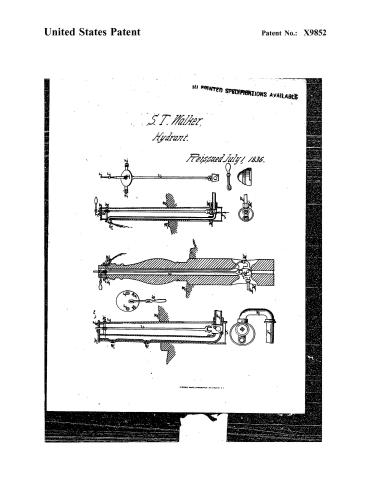
S. T. Walker,
Hydrant.
Reissued July 1, 1836.

PETER, PHOTO LITHOGRAPHER, BOSTON, U.S.
About this record
- Patentee
- DATAMP
- Date
- the Name and Date index of patents, DATAMP, USPTO records
- Invention
- DATAMP
- Listed in
- the Name and Date index of patents, DATAMP, USPTO records, Jim Shaw's X-patent list, Burke's List of Patents (1847)
- Burke's 1847 Patent Office list gives the same patent.