

Drawings and documents
USPTO scan
The patent as scanned by the USPTO
-
 Page 1
-
 Page 2
-
 Page 3
-
 Page 4


U.S. Patent and Trademark Office · Google Patents
Show the transcription Hide (686 words)
Machine transcription (LightOnOCR) of the pages as scanned by the USPTO, most of them the handwritten copies made when the records were restored after the 1836 fire. Not checked; it can misread handwriting, so compare it with the scan.
Page 2.
United States Patent
Patent No.: X9881
James H. Littel
Letters Patent (Patented July 2, 1856)
The subject referred to in these Letters Patent and making part of the same containing a description in the words of the said James H. Littel himself of his improvements in the Washing machine.
Description of the Washing Machine
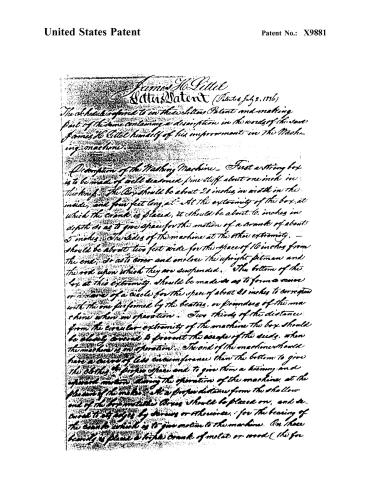
First a strong box is to be made of well seasoned pine stuff about one inch in thickness. The Box should be about 28 inches in width in the inside, and four feet long, at the extremity of the box, at which the crank is placed, it should be about 6 inches in depth so as to give space for the motion of a crank of about 5 inches. The sides of the machine at the other extremity, should be about two feet wide for the space of 16 inches from the end, so as to cover and enclose the upright pitman and the rod upon which they are suspended. The bottom of the box at this extremity should be made so as to form a curve or a curve of a circle for the space of about 28 inches to correspond with the one performed by the beaters, or prounders of the machine when in operation. Two thirds of the distance from the circular extremity of the machine the box should be closely covered to prevent the escape of the scuds, when the machine is in operation. The end of the machine should have a curve of less circumference than the bottom to give the clothes proper space and to give them a turning and upward motion during the operation of the machine, at the pleasure of the maker. At a proper distance from the shallow end of the box metallic boxes should be placed on, and secured to its edges by screws or otherwise, for the bearing of the crank to which is to give motion to the machine. On these bearings is placed a triple crank of metal or wood (the for
Page 3.
United States Patent
Patent No.: X9881
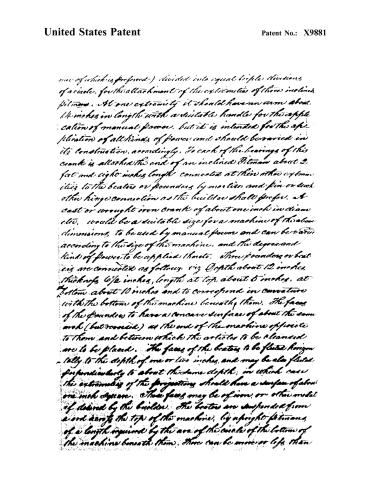
... (text continues in cursive script, partially obscured or faded in places)
... (text continues in cursive script, partially obscured or faded in places)
Page 4.
United States Patent
Patent No.: X9881
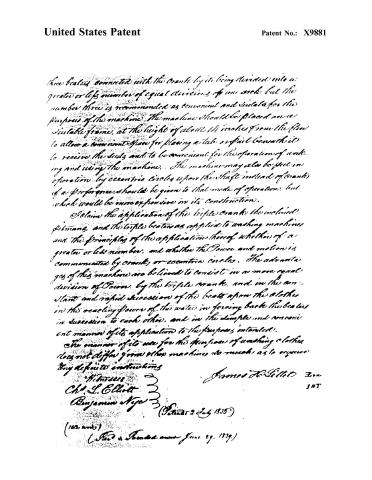
three beaters connected with the cranks by its being divided into a greater or less number of equal divisions of one arch but the number three is recommended as convenient and suitable for the purposes of the machine. The machine should be placed on a suitable frame, at the height of about 14 inches from the floor to allow a convenient space for placing a tub or fail beneath it to receive the scuds and to be convenient for the operation of working and using the machine. The machine may also be put in operation by eccentric circles upon the shaft instead of cranks if a preference should be given to that mode of operation, but which would be more expensive in its construction.
I claim the application of the triple cranks, the inclined filaments, and the triple beaters as applied to washing machines and the principles of the application thereof whether of a greater or less number, and whether the power and motion is communicated by cranks or eccentric circles. The advantages of this machine are believed to consist in a more equal division of power by the triple cranks, and in the constant and rapid succession of the beaters upon the clothes in the reacting power of the water in forcing back the beaters in succession to each other, and in the simple and convenient manner of its application to the purposes intended.
The manner of its use for the purposes of washing clothes does not differ from other machines so much as to require any definite instructions.
Witnesses:
Chas. L. Elliott
Benjamin M. Kip
James H. Gilleo
Exm
INT
(Patented 2 July 1838)
(102 words)
(Filed & Recorded anew June 29, 1839.)
About this record
- Patentee
- Jim Shaw's X-patent list
- Date
- the Name and Date index of patents, USPTO records, Jim Shaw's X-patent list
- Invention
- the Name and Date index of patents
- Listed in
- the Name and Date index of patents, USPTO records, Jim Shaw's X-patent list, Burke's List of Patents (1847)
- Burke's 1847 Patent Office list gives the same patent.