

Drawings and documents
National Archives restored drawings: drawing
William Loomis' Patent Drawing for an Improvement on His Machine for Getting Out Clover Seed

National Archives, Restored Patent Drawings (Record Group 241) · Full-size scan at the National Archives · Catalog record
Show the text on the drawing Hide (47 words)
Words on the drawing as machine-read by the National Archives; not checked. Useful mainly for searching.
130. THR SHING / Clovej Hullers. / william Loomis / Kmp 072 his machine for getting out Clover Secd / Patented 2 1836. / 9.882.X / DIVISION. / 9882X Plan Fig.Z / Pig: 2. / Vertical Section / rust / V4 / Drawn from a certified Copy
USPTO scan
The patent as scanned by the USPTO
-
 Page 1
-
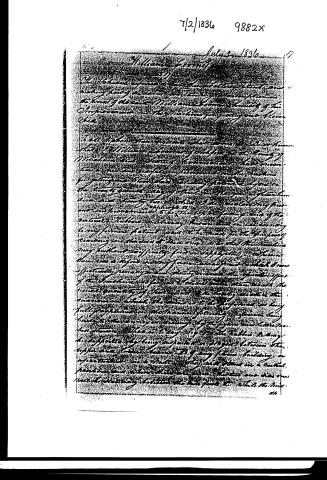 Page 2
-
 Page 3
-
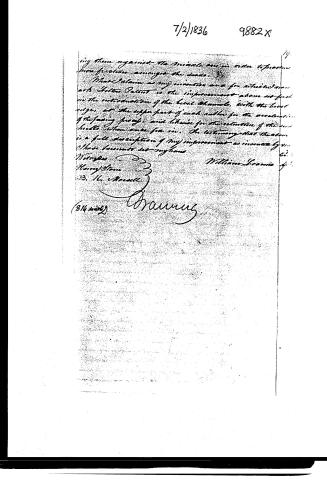 Page 4


U.S. Patent and Trademark Office · Google Patents
Show the transcription Hide (525 words)
Machine transcription (LightOnOCR) of the pages as scanned by the USPTO, most of them the handwritten copies made when the records were restored after the 1836 fire. Not checked; it can misread handwriting, so compare it with the scan.
Page 1.
9882X
W. Loomis,
Clover Hailer.
Patented July 2, 1836.
Fig. 1.
Fig. 2.
Page 3.
7/2/1836 9882x
All one will be kept in motion between them by the operation of the crank D, as applied in the ordinary saw mill. The combination of the three Hopper and Hopper will resemble as such as that the cutter will be all for more alike after the following improved form: Fig. 3. The upper end of each cutter is brought to an edge by a bevel B, from the inside so that it will thus form a sharp one for more easily penetrating the tough of wood that will be placed in the hopper. It above the cutter, of small space below. This bevel is formed another one as at A, though with less slope than the one just mentioned, and is formed according to the respective inclination of Fig. 2, not to form an angular channel or notch in the upper or lower edge of which, being to avoid above, and below, any undue stress the operation of the middle cutter may produce. Some of these bevels or channels, if they are necessary, are placed one below the other with intervals as at all. The remaining space is then to the bottom of the cutter is to be filled with rows of nails as at I, also having intervals which are to be adapted to the end. As in the form of sheet iron, it may be used instead of the nails, by roughening the surface that they may hold to the steel, which I perform by the hammering or shaping thereof, which shall form not such a partition as to project like into a spiken for the hammer movement.
The difference of the center or movable cutter consists in having each side formed with an angular channel etc., & the edge or top made by a double bevel and from each side the more easily to penetrate the wood, as which will by the smooth motion, to the middle and be drawn the same between the cutters on each side from the hopper. When it will be determined from raising out a grain by the hammering, etc. Offings etc. are applied to the parts so as to pass upon the side cutters (which are stationary) for the purpose of p...
Page 4.
7/2/1836 9882X
my them against the means one in order to produce
more friction amongst the ends.
That I claim as my invention and for which I now
ask Letters Patent is the improvement above set forth
in the introduction of the level channels, with the lower
edge, at the upper part of each ruler for the elevation
of the facing proof, and likewise for the retention of the
hinges when once set in. In testimony that the above
is a full description of my improvement as invented by
I have hereunto set my hand
Wm. G.
Henry Stone
B. R. Howell
William Loomis
(814 words)
About this record
- Patentee
- Jim Shaw's X-patent list
- Date
- the Name and Date index of patents, USPTO records, Jim Shaw's X-patent list
- Invention
- the Name and Date index of patents
- Listed in
- the Name and Date index of patents, USPTO records, Jim Shaw's X-patent list, Burke's List of Patents (1847)
- Burke's 1847 Patent Office list gives the same patent.