

Drawings and documents
National Archives restored drawings: drawing
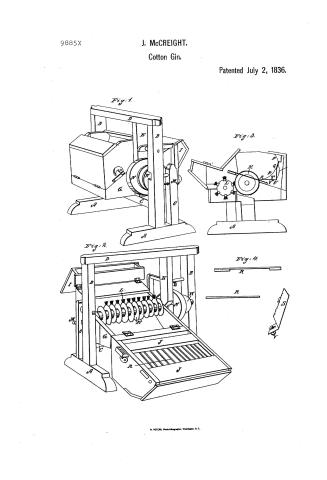
J. McCreight's Patent Drawing for a Cotton Gin

National Archives, Restored Patent Drawings (Record Group 241) · Full-size scan at the National Archives · Catalog record
Show the text on the drawing Hide (24 words)
Words on the drawing as machine-read by the National Archives; not checked. Useful mainly for searching.
to / of / of / Fai / All / 30 / IT / sig / OiR
USPTO scan
The patent as scanned by the USPTO
-
 Page 1
-
 Page 2
-
 Page 3
-
 Page 4


U.S. Patent and Trademark Office · Google Patents
Show the transcription Hide (1,038 words)
Machine transcription (LightOnOCR) of the pages as scanned by the USPTO, most of them the handwritten copies made when the records were restored after the 1836 fire. Not checked; it can misread handwriting, so compare it with the scan.
Page 1.
9885X
J. McCREIGHT.
Cotton Gin.
Patented July 2, 1836.
Fig. 1.
Fig. 3.
Fig. 2.
Fig. 4.
N. PETERS, Photo-Lithographer, Washington, D. C.
Page 2.
9885X July 2, 1836 ar. 15 341.
James M. Wright
Letters Patent
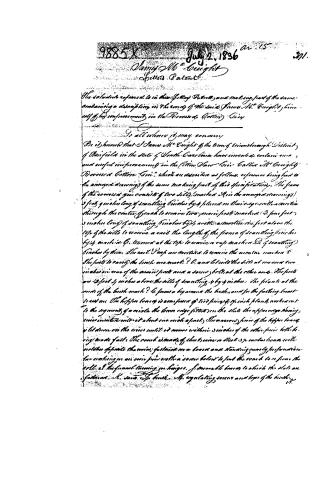
The solicitors referred to in this filing Patent, and making part of the same containing a description in the words of the said James M. Wright, himself of his improvements in the Process of Cotton Ginning.
To all to whom it may concern:
Be it known that I James M. Wright of the town of Winslow District of Fairfield in the State of North Carolina have invented certain new and useful improvements in the Cotton Ginning Process called “Wright Processed Cotton Gin” which are described as follows, reference being had to the annexed drawings of the same making part of this specification. The frame of the annexed gin consists of two sills (marked A in the annexed drawings) 3 feet 9 inches long of scantling 6 inches by 4 placed on their edge with a mortise through the center of each to receive two main posts (marked B) four feet 3 inches long of scantling 6 inches by 4, with a mortise one foot above the top of the sills to receive a cast the length of the frame of scantling 6 inches by 4, marked C, turned at the top to receive a cast marked D of scantling 6 inches by 4. The cast D and V are mortised to receive the mortise marked E. The posts to carry the bush are marked F, G, and let into the sills at one end two inches in each of the main posts and a screw bolt at the other end. The posts are 3 feet 9 inches above the sills of scantling 4 by 4 inches. The frame at the ends of the bush marked F, G, forms a by around the bush, and for the falling breast board on. The hopper board is composed of two pieces of 12 inch plank, worked into the segments of a circle the lower edge fitted on the slats the upper edge having a cross inserted into it at about one inch apart. The narrow lower of the hopper board is let down on the sides until it comes within 3 inches of the other piece both being made fast. The comb is made of three pieces of steel 3 1/2 inches broad with notches of 3/4 inch the sides, fastened on a board and standing nearly perpendicular for working on an axis pin with a screw below to put the comb to or from the roll. At the funnel turning on hinges. A movable board to which the slats are fastened. A. and B. bush. A. regulating screw and box of the bushing.
Page 3.
242. 98857
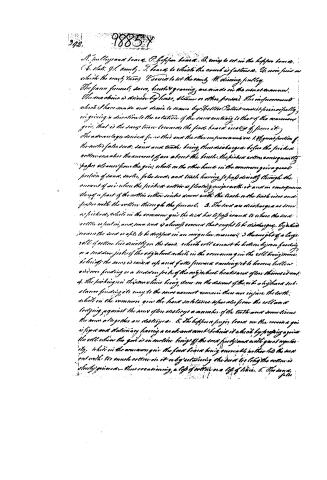
A. Pulley and band. B. hopper board. C. way to set in the hopper board. (E. slot. F. comb.) I. board to which the comb is fastened. U. wire pins on which the comb turns. V. screw to set the comb. W. driving pulley.
The same funnel, sieve, broom, gearing, are made in the usual manner. The machinery is driven by hand, steam or other power. The improvement which I have made and claim is shown by the following Patent number, principally in giving a direction to the rotation of the sieve contrary to that of the common gin, that is the sieve turns towards the feed board instead of from it.
The advantage derived from this and the other improvements are 1. A great portion of the seeds, false seed, sand and trash being thus discharged before the pickers act, so that the amount of sand about the teeth, the picked cotton consequently passes cleaner from the gins, while on the other hand in the common gin a great portion of sand, seeds, false seed, and trash having to pass directly through the amount of air when the picked cotton is floating upon it and in consequence there is a part of the cotton either sinks down with the trash or the trash rises and passes with the cotton through the funnel. 2. The seed are discharged as soon as picked, while in the common gin the seed has to pass round to where the seed cotton is put in, and some seed is always carried that ought to be discharged. By which means the seed is apt to be dropped in an irregular manner; 3. the weight of a large roll of cotton lies directly on the sieve, which roll cannot be broken by one feeding or a sudden jerk of the adjustable wheel in the common gin the roll being more behind; the sieve is raised up and falls forward causing it to become hollow and one feeding or a sudden jerk of the adjustable wheel and often throws it out. 4. The picking in this machine being done on the amount of the roll a high head substance feeding it's way to the sieve cannot remain there nor injure the teeth, while in the common gin the head substance separates from the roll and lodging against the sieve often destroys a number of the teeth and sometimes the sieve altogether are destroyed. 5. The hopper or feeder board on the common gin is fixed and stationary having a rack and wheel behind it which by pressing against the roll when the gear is in motion brings off the seed, seeds and with great rapidity, while in the common gin the feed board being movable is thrown to the next roll with too much cotton on it or by retaining the seed too long the cotton is slowly ground thus consuming a lot of cotton or a lot of time. 6. The sand, false
Page 4.
343.
false scale, notes, much before the stick pop out with the scale and no good action is lost in any way; while in the common gin much action is wasted and lost and comparatively imperfectly drawn from the source before stated, which causes an entirely contrary effect to the improvement made in the cotton gin.
Wright
James Cattman
W. M. Wright
10 20th
The. M. Wright
Drawing
E. 4
ayw.
Published accounts: journal notice
Notice in the monthly list of patents
Journal of the Franklin Institute, new ser., vol. 18 (1836), p. 359 · View the page
589. Cotton gin.-James McCreight, Winnsborough, S. C.
About this record
- Patentee
- the Journal of the Franklin Institute, Journal
- Date
- the Name and Date index of patents, USPTO records, Jim Shaw's X-patent list
- Invention
- the Name and Date index of patents
- Listed in
- the Name and Date index of patents, USPTO records, Jim Shaw's X-patent list, the Journal of the Franklin Institute, Burke's List of Patents (1847)
- The patentee's full name comes from the Franklin Institute's journal.
- The residence comes from the Franklin Institute's journal.
- Burke's 1847 Patent Office list gives the same patent.