

Drawings and documents
USPTO scan
The patent as scanned by the USPTO
-
 Page 1
-
 Page 2
-
 Page 3


U.S. Patent and Trademark Office · Google Patents
Show the transcription Hide (799 words)
Machine transcription (LightOnOCR) of the pages as scanned by the USPTO, most of them the handwritten copies made when the records were restored after the 1836 fire. Not checked; it can misread handwriting, so compare it with the scan.
Page 1.
7040X
G. Pritchard,
Riding Saddle.
Patented May 3, 1832.
Fig. 1.
Fig. 2.
Page 2.
7040X
May 3 1832
George Bitchard, of Clarkburg, Va.
Letters Patent
The schedule referred to in these Letters Patent and making part of the same, containing a description in the words of the said George Bitchard himself of his improvement called the worm steel spring saddle.
To all to whom these presents shall come, George Bitchard of Clarkburg, in the County of Harrison, and State of Virginia, Gentleman, Greetings:
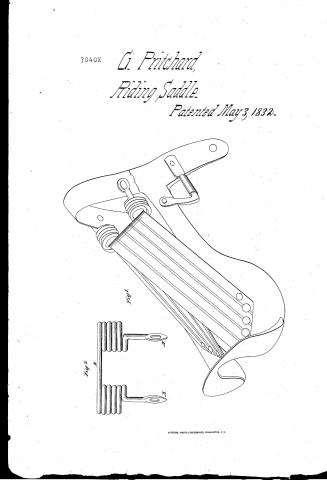
For it known that I the said George Bitchard have invented, constructed, made and applied to use a new and useful improvement in the mode of making manufacturing saddles, by the application of a steel spring to the seat of the saddle called the worm steel spring; This my said improvement in the mode of making manufacturing saddles (which I claim as my own invention which I believe was never before known or used till I executed the same) consists simply in the making of and applying to use in the seat of the saddle a steel spring made and applied in the manner hereinafter described. The steel should be carefully drawn out to a small rod (or wire) of about one eighth of an inch thick. About five feet in length, it can be drawn out either by a hammer, or a wire plate; they are best to be drawn out with a hammer, as by hammering, the pores of the steel are closed, and the flaws are all worked out, otherwise if drawn out by a wire plate, the pores of the steel are left open, and oftentimes, flawed, a space of two or three inches in the middle of the rod should be left somewhat thicker than the other part, for the purpose of receiving the swelling.
Then form it into a worm by closely wrapping it around a rod of the size of about four eighths of an inch in width and three eighths of an inch in thickness, beginning to wrap at each side of the centre, leaving sufficient room in the centre of the spring to receive the swelling of full width.
This spring when wrapped should be heated to a blood red heat, to prevent it from breaking or cracking while bending. The ends of the spring which go under the cap plate, of the head of the saddle tree, should be made flat & punched for the purpose of riveting it fast on the head of the tree and left sufficiently strong that when riveted to the tree it should not break.
The spring when thus made should be properly tempered so as to possess and
Drawing made from the 1st part of a worm
Page 3.
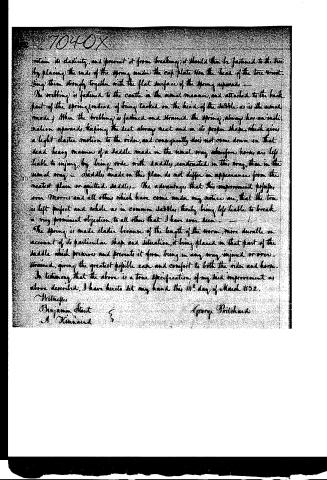
retain its elasticity, and prevent it from breaking; it should then be fastened to the tree by placing the ends of the spring under the cap plate on the head of the tree riveting them strongly together with the flat surface of the spring upwards.
The webbing is fastened to the cantle in the usual manner, and attached to the back part of the spring (instead of being tacked on the head of the saddle as is the usual mode.) When the webbing is fastened and strained the spring always has an inclination upwards, keeping the seat always neat and in its proper shape, which gives a light elastic motion to the rider, and consequently does not come down in that dead heavy manner of a saddle made in the usual way, wherefore horses are less liable to injury by being rode with saddles constructed in this way, than in the usual way. Saddles made on this plan do not differ in appearance from the neatest plain or quilted saddles. The advantages that this improvement possesses over Morris and all others which have come under my notice are, that the tree is left perfect and whole as in common saddles, thereby being less liable to break a very prominent objection to all others that I have ever seen.
The spring is made elastic because of the length of the worm, more durable on account of its particular shape and situation, it being placed in that part of the saddle which preserves and prevents it from being in any way injured or overstrained, giving the greatest possible ease and comfort to both the rider and horse.
In testifying that the above is a true specification of my said improvement as above described, I have hereto set my hand this 14th day of March 1852.
Witnesses,
Benjamin Stout
A. Kinnaird
George Britchard
Published accounts: journal notice
Notice in the monthly list of patents, with remarks
Journal of the Franklin Institute, new ser., vol. 10 (1832), p. 321 · View the page
3. For an improvement in Saddles; George Pritchard, Clarksbury, Harrison county, Virginia, May 3.
Remarks. Steel springs are to be formed by winding pieces of wire, of oneeighth of an inch in diameter and five feet long, round quadrangular bars of iron, five-eighths of an inch wide and three-eighths thick. Two of these springs are to be used with each saddle. They are to be fastened by one end under the cap plate, and on the head of the tree, and by the other to webbing attached to the cantle in the usual manner, thus giving a high degree of elasticity to the seat, which cannot exist when the webbing extends to the head of the tree. The patentee alludes to other modes, previously patented, of fixing elastic springs to saddles, but considers that just described as more durable, and as preferable on several accounts.
About this record
- Patentee
- DATAMP
- Date
- the Name and Date index of patents, DATAMP, USPTO records
- Invention
- DATAMP
- Listed in
- the Name and Date index of patents, DATAMP, USPTO records, Jim Shaw's X-patent list, the Journal of the Franklin Institute, Burke's List of Patents (1847)
- Burke's 1847 Patent Office list gives the same patent.