

Drawings and documents
National Archives restored drawings: drawing
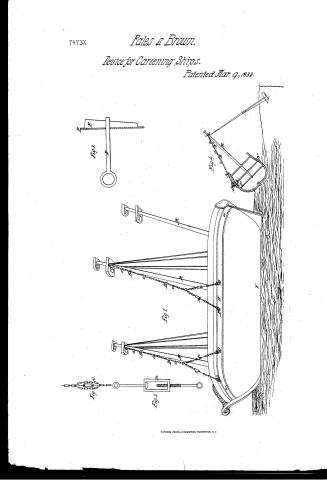
James Tales and Thomas D. Brown's Patent Drawing for a Machine for Hauling Down Ships

National Archives, Restored Patent Drawings (Record Group 241) · Full-size scan at the National Archives · Catalog record
Show the text on the drawing Hide (147 words)
Words on the drawing as machine-read by the National Archives; not checked. Useful mainly for searching.
so / 114. SHIPS, / 1. CONTRUCTION. / [188] Masts & Spare. / James Tales Thomas D. Brown. / Hauling down Ships / CLASSIFICATION / 7473-X / DIVISION. / Vol.17 17. pg 415 / Patented March. 1833. / Tigh / Stoper. / Mis / Fig 1: / Fig.3 / Fight. / V. / Tig 3. / References M. M. M. M. masts of the vessel. a portion of chain fixed to the masts. B. B. shackles. C. e.e.e. portionsofchain. n.n nuts through / which the serews passes. see Sig 3. 9 9 9 D & botts through the wales w. EE Key p. P. plates spiked to the vessel. / W.W.W. Wales of the vessel. V. Bottom Sig 2 represents a stopper. Tig.3 a bolt and Key with plate. Fig 4. betion of bessel. / Patent affice becomber / made under the direction of the Comissioner of Patents / in conformity with act of 30 march 1837. / ch. L. flishman freit. / Hd. Sumoith / Commipion of Patents.
USPTO scan
The patent as scanned by the USPTO
-
 Page 1
-
 Page 2
-
 Page 3


U.S. Patent and Trademark Office · Google Patents
Show the transcription Hide (570 words)
Machine transcription (LightOnOCR) of the pages as scanned by the USPTO, most of them the handwritten copies made when the records were restored after the 1836 fire. Not checked; it can misread handwriting, so compare it with the scan.
Page 1.
7473X
Fales & Brown.
Device for Careening Ships.
Patented Mar. 9, 1833.

Page 2.
March 9, 1833
Letters Patent of James Sales and Thomas D. Broon, dated 9th March, 1833
The schedule referred to in these Letters Patent, and making part of the same, containing a description in the words of the said James Sales and Thomas D. Broon themselves of their improvement in the machine for preventing accidents in careening or hauling down ships or vessels, called "a Safety Chain."
Be it known that we James Sales & Thomas D. Broon both of New Bedford in the county of Bristol and Commonwealth of Massachusetts Mechanics, have invented a method of preventing accidents in the careening or hauling down ships or vessels for the purpose of spanning, repairing, or repairing their bottoms called "A Safety Chain" which is described as follows to wit:
Whereas in the common mode of careening ships for the aforesaid purposes, serious accidents sometimes occur by too great a strain upon the masts or shrouds of the vessel, we propose to affix a chain to the top of the mast or masts by which the vessel is hauled down to expose her bottom, which chain is to be connected with two nuts & screws to other chains to be fastened to the wales or sides of the vessel by tightening the chain by means of the screw to relieve the strain on the masts or shrouds of the vessel, occasioned by the force applied to the opposite side of the mast of the vessel to free her side out of water. The application of these chains & screws may be better understood by reference to the drawing annexed & made part of this specification.
In the drawing Fig 1st M. is the mast of the vessel, A, the portion of the chain affixed to the top of the mast BB, shackle connecting different parts of the chain, c.c.c.c.c. different portions of the chain, M M nuts thro which the screw passes.
Page 3.
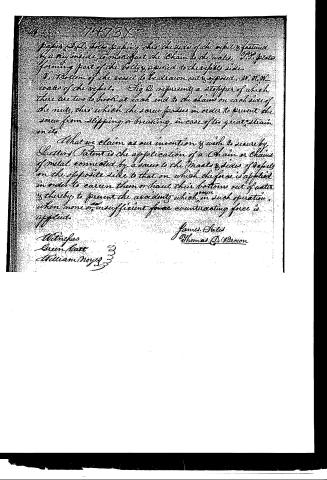
paper (P.D.) here passing thru the sides of the vessel is fastened by a key inside, to maintain the chain to the walls. P.P. plate forming part of the bolts & pierced to the vessel's side.
N. Bottom of the vessel to be drawn out & spread, W.W.W. coats of the vessel. Fig 2. represents a stopper of which there are two to look at each end to the chains on each side of the nuts, thru which the screw passes in order to prevent the screw from slipping or breaking in case of too great strain met.
What we claim as our invention & wish to secure by Letters Patent is the application of a chain or chains of metal connected by a screw to the inside sides of the vessel on the opposite side to that on which the force is applied in order to ease on them or haul their bottoms out of water & thereby to prevent the accidents which in such operation, when none or insufficient force counteracting force is applied.
Witnesses
Green Latt
William Noyes
James Hales
Thomas D. Dixon
Published accounts: journal notice
Notice in the monthly list of patents, with remarks
Journal of the Franklin Institute, new ser., vol. 12 (1833), p. 175 · View the page
19. For a Safety Chain to be used in careening Ships; James Fales and Thomas D. Brown. New Bedford, Bristol county, Massachusetts, March 9.
Remarks. The safety chain is intended to brace the mast, by connecting one end of it to the top of the mast, and the other end to chains connected with the wales. The chain leading from the top of the mast, is to be connected to those attached to the wales by the intermedium of a screw, which turns in nuts attached to the chains, and by which they may be rendered tort. These chains are to be fixed on the side opposite to that on which the vessel is to be hauled down. The claim is to the connecting such chains in the manner, and for the purposes described.
About this record
- Patentee
- DATAMP
- Date
- the Name and Date index of patents, DATAMP, USPTO records
- Invention
- DATAMP
- Listed in
- the Name and Date index of patents, DATAMP, USPTO records, Jim Shaw's X-patent list, the Journal of the Franklin Institute, Burke's List of Patents (1847)
- Burke's 1847 Patent Office list gives the same patent.