

Drawings and documents
National Archives restored drawings: drawing
J. Couch and J.A. Frary's Patent Drawing for a Gas Lamp

National Archives, Restored Patent Drawings (Record Group 241) · Full-size scan at the National Archives · Catalog record
Show the text on the drawing Hide (69 words)
Words on the drawing as machine-read by the National Archives; not checked. Useful mainly for searching.
CLASSIFICATION / mar, 10- / 7483 X / COUCH / Paten / DIVISION. / it / G S aDel / A.Body of Lamb. B. Tube. C.C.C. Wick Tube / D. Openings to move wick. E.E. Handles. F.Glass. / G. Reflector HH Suspending Suspending Chains / Patent office april 24th 1835. / Made the of Commysioner of Patents / conformity with Acty 3"March1837.
USPTO scan
The patent as scanned by the USPTO
-
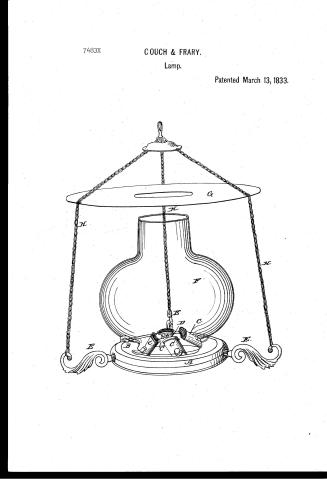 Page 1
-
 Page 2
-
 Page 3


U.S. Patent and Trademark Office · Google Patents
Show the transcription Hide (739 words)
Machine transcription (LightOnOCR) of the pages as scanned by the USPTO, most of them the handwritten copies made when the records were restored after the 1836 fire. Not checked; it can misread handwriting, so compare it with the scan.
Page 1.
7483X
COUCH & FRARY.
Lamp.
Patented March 13, 1833.

Page 2.
March 13, 1833
Sha. Couch & James A. Frary
Letters Patent
The Schedule refers to our said Letters Patent and making part of the same containing a description on the record of the said Sha. Couch & James A. Frary themselves of their improvement in Sumps for suspension called Couch & Frary's Barrel Sump.
Be it known that we Sha. Couch & James A. Frary both of Meriden in Said Town County State of Connecticut & both native born Citizens of the United States have invented a new & useful improvement in Sumps for suspension called "Couch & Frary's Barrel Sump" & that the following is a full & exact description of the construction & operation of the same as invented or improved by us. The body of the Sump is a circular barrel in the shape of a hollow circular tube or hoop about seven inches in diameter from out side to outside & on the outside a little that of four inches. When suspended the horizontal diameter of the hollow circle or tube forming the barrel is about one and a half inch from outside to outside the perpendicular diameter is about one quarter of an inch less so that deducting the thickness of the shell the hollow of the circular barrel will be a little more than one inch in diameter extending round an open circle of about four inches in diameter. This circular barrel is designed for the reception of oil & will hold about one pint extending nearly all round the circle. This is made of block tin or other suitable material in halves or a circular mould made to the shape of half the circular barrel in two castings the top & bottom being alike & are then patte or soldered together so as to form the barrelled circle. On the top of the barrel is mounted a filler tube with a screw top for supplying the barrel with oil & on the inner circle of the barrel are inserted four tubes for which opening into the circular barrel about 1/4 of an inch & rising about 1/4 inch inclining towards the center in an angle of about 20 degrees leaving an open space between the ends of about two inches in diameter. These tubes are of tin soldered or patte
Page 3.
into the circular bowl on the inner side of the circular rack forming an opening for each about one inch broad & 1/8 of an inch thick with suitable openings on the outside side for raising or moving the wicks on the outside of the circular bowl as places at equal distances three scrolls or handle each about 3 1/2 inches long by which the lamp may be suspended. Once the bowl lamp thus made, when suspended a globular glass is placed resting on the bowl to guard the blaze of the wicks from the room & above that & encircling the rack thereof is a bright tin reflector supported by the suspending chains in the usual manner. The advantages of this mode of constructing the lamp over any other lamp or inventors are that the supply of oil is brought nearer the blaze of the wicks & they will therefore continue to burn freely till the whole is exhausted. The orifice of the circular opening is also larger & the downward light is less intercepted than in any other and is thereby increased by the full force of the reflector. We do not claim as our invention the central opening merely for a downward light that has long been known & used, but we do claim as our invention the circular bowl as above specified & described & the circular form & construction of our lamp as above described, forming a lamp upon a new construction & altogether superior to any other now in use more especially when a downward light is required & for this they solicit Letters Patent & in testimony whereof we have hereunto set our hands in New Haven this 11th day of February AD 1833.
Witnesses
Wmeyer Baldwin
Homer Baldwin
See Couch
James A. Chary
Patented March 19, 1833
For 200 feet gallery
Published accounts: journal notice
Notice in the monthly list of patents, with remarks
Journal of the Franklin Institute, new ser., vol. 12 (1833), p. 179 · View the page
30. For an improvement in Lamps; Ira Crouch and James A. Frary, Meriden, New Haven county, Connecticut, March 13.
Remarks. This is a hanging lamp, the body, or reservoir, of which is a tube bent round in the form of a ring, having an exterior diameter of about seven, and an interior of about four inches; this tubular reservoir will hold about one pint of oil. Four tubes for wicks extend from the inside towards the centre of the hoop, bending upwards, and leaving a central space of about two inches in diameter. The burners may have spaces of an inch in breadth, and one-eighth of an inch in thickness; over these a glass chimney is to be placed. As regards claim, the patentees say "we do not claim as our own invention the central opening merely, for a downward light; that has long been known and used. But we do claim as our invention the circular band, and the peculiar form and construction of our lamp." On the 3d of March, 1831, Mr. Lawrence, of Meriden, obtained a patent for a lamp essentially like the foregoing, of which there is a description in vol. viii. p. 18; and another patent by the same gentleman for nearly the same thing, may also be found in vol. xi. p. 311. The main difference between these and the one before us being in the shape of the ring-like reservoir for oil; the present patentee makes the tube of which the ring is formed, oval, the longest diameter standing vertically: Mr. Lawrence made his of segments of two circles, as may be seen by turning to the articles referred to; this, we think, is one of those changes of form which would not, in law, be deemed an improvement.
About this record
- Patentee
- DATAMP
- Date
- the Name and Date index of patents, DATAMP, USPTO records
- Invention
- DATAMP
- Listed in
- the Name and Date index of patents, DATAMP, USPTO records, Jim Shaw's X-patent list, the Journal of the Franklin Institute, Burke's List of Patents (1847)
- Burke's 1847 Patent Office list gives the same patent.