

Drawings and documents
National Archives restored drawings: drawing
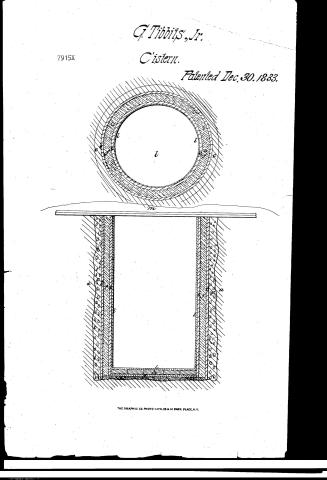
George Tibbitt's Patent Drawing for a Cistern

National Archives, Restored Patent Drawings (Record Group 241) · Full-size scan at the National Archives · Catalog record
Show the text on the drawing Hide (166 words)
Words on the drawing as machine-read by the National Archives; not checked. Useful mainly for searching.
Sheet 1. 72. MASONRY. / [51] Cisterns. / dore Decmber 15, "1835 flaimed is / George Tibbits. Junior / CLASSIFICATION / 7915-x / bisterns / DIVISION. / Topview. / Vol. 17 pg. 37. / Patented Dea 30th 1833. / and by / m. / Preferences. / a. circular pit. / b. circular tube / C carth and stone. / d a stratum of mortar / e the smaller tube / of mortar / g a stratum of mortar / h brick. / l Ll. plastering. / m covering. / Patent office September 10th 1841. / made under the Commissioner of Patents / in conformity with hot of 3d march 1837. / ch.L. Heischmana. del: / Section / Menigh Sumorth / Commissioner of Patents.
Sheet 2. 186. STEAM-VALVES, / Stude Valves SVEing / Puppet. / Puppet Valn / $150 STEPHEN H. LONG S / FICATION / Improvement / 79151 / in THE / Construction of the main sťeam valves of Locomolive and other s'eam- / DIVISION. / Engines, the force pumps of such Engines, and the Wheels for LOCOMOLiVEATEN / TED DEC.50 / Engines / Fig Jo. / Higr. / Fig 9. / LF / FL / LA / Fig.s. / Sigo. / Hig.5. / Sig. / 2. / in / b. / Hig.s. / Sign C / Higi. / a.
National Archives restored drawings: drawing
Stephen H. Long's Patent Drawing for an Improvement in the Construction of Steam Valves

National Archives, Restored Patent Drawings (Record Group 241) · Full-size scan at the National Archives · Catalog record
Show the text on the drawing Hide (80 words)
Words on the drawing as machine-read by the National Archives; not checked. Useful mainly for searching.
186. STEAM-VALVES, / Stude Valves SVEing / Puppet. / Puppet Valn / $150 STEPHEN H. LONG S / FICATION / Improvement / 79151 / in THE / Construction of the main sťeam valves of Locomolive and other s'eam- / DIVISION. / Engines, the force pumps of such Engines, and the Wheels for LOCOMOLiVEATEN / TED DEC.50 / Engines / Fig Jo. / Higr. / Fig 9. / LF / FL / LA / Fig.s. / Sigo. / Hig.5. / Sig. / 2. / in / b. / Hig.s. / Sign C / Higi. / a.
USPTO scan
The patent as scanned by the USPTO
-
 Page 1
-
 Page 2


U.S. Patent and Trademark Office · Google Patents
Show the transcription Hide (445 words)
Machine transcription (LightOnOCR) of the pages as scanned by the USPTO, most of them the handwritten copies made when the records were restored after the 1836 fire. Not checked; it can misread handwriting, so compare it with the scan.
Page 1.
7915X
G. Tibbits, Jr.
Cistern.
Patented Dec. 30, 1833.
THE GRAPHIC CO. PHOTO-LITH. 39 & 41 PARK PLACE, N.Y.
Page 2.
12/30/1833 7915x
Dec 30 1833
George Tibbits, Junior.
Letters Patent.
The schedule referred to in these Letters Patent and making part of the same containing a description in the words of the said George Tibbits Junr, himself of his improvement in constructing Cisterns.
Having dug a circular pit of a suitable size, place within it near the outside a tier of planks of any suitable length and thickness, braced so that when brought close together, they will form a circular tube, around the outside of this tube the earth or some other hard substance should be packed even with the top, upon the bottom of the first around the inside of this tube, spread a stratum of mortar, of water, lime, and sand, upon which place another tier of planks or boards prepared in like manner as the first, so as to form another tube with the first above mentioned of so much depth as to leave a space of from one to two inches in width between them, this space is to be filled with grout (a composition of water, lime, sand and water so thin as to flow) so in places where lime and water lime are plenty. This space may be from six to twelve inches wide and filled with small stone or gravel and grouted, when the grout has become sufficiently hard (which will require but a few minutes if the lime is good) the inside and top of the last mentioned tube should be plastered with mortar of the materials above mentioned, so as to cover all the wood and exclude from it the air and water. The bottom of the pit should then be plastered with like mortar, then covered with a stratum of stone or brick and grouted or plastered, again with mortar of the materials aforesaid. This done the whole should be covered so as to secure it from frost. The invention or improvement of which the petitioner claims to be the author is the using two tubes and filling the space between them with grout or stone or gravel & grout and excluding the air and water from the inner tube, thereby it is preserved from decay and the effects of storms.
In witness whereof I the petitioner above named have hereunto set my name the fifth day of December 1833.
George Tibbits, Junr.
Published accounts: journal notice
Notice in the monthly list of patents, with remarks
Journal of the Franklin Institute, new ser., vol. 14 (1834), p. 25 · View the page
63. For Constructing Cisterns; George Tibbetts, jr., Jamesville, Onondaga county, New York, December 30.
Remarks. A circular pit is to be dug, of such diameter and depth as may be required, and this is to be planked round with plank jointed in the manner of staves, the space between these and the ground being closely filled in. Hydraulic cement is then to be placed around on the bottom of the pit, so as to be in contact with the planking; upon this a second tier of plank is to be raised at the distance of one or two inches from the former; into this space, grout of hydraulic lime, either alone, or mixed with stones and gravel, is to be poured, so as completely to fill it up. Where water, lime, and stone are abundant, the space between the two plankings may be six inches. The inside of the inner planking is to be plastered with the hydraulic cement, and the top also, including both plankings, is to be securely covered with it, so as to exclude the air and moisture. The bottom of the pit is likewise to be thus plastered, then covered with stone, or brick, and grouted. The claim is to "the raising the two tubes of wood, and filling the space between with grout, or stone, or gravel, and grout, and excluding the air and water from the inner tube, whereby it is preserved from decay and the attacks of worms." On the 19th of November, a neighbour of the present patentee obtained a patent for constructing cisterns, by applying the hydraulic cement to the earth, without the employment of any partition or walling; (see page 322, vol. xiii.) we think so little of these plans, as improvements, that we would not, were we in want of a cistern, accept of a right from either patentee, under the condition of using it. We do not like the intermixing the wood and the cement, being convinced that one of them will be likely to crack the other. A wall of hard brick, or of rough stone, laid in hydraulic cement, and plastered over, would be but little, if any, more costly than the plans in question, and although unpatentable, would be incomparably better than either of them. The idea of effectually protecting wood from the action of water, by an inch or two of water proof cement, is altogether fallacious.
About this record
- Patentee
- Jim Shaw's X-patent list
- Date
- the Name and Date index of patents, USPTO records, Jim Shaw's X-patent list
- Invention
- the Name and Date index of patents
- Listed in
- the Name and Date index of patents, USPTO records, Jim Shaw's X-patent list, the Journal of the Franklin Institute, Burke's List of Patents (1847)
- The Franklin Institute's journal spells the name differently.
- The residence comes from the Franklin Institute's journal.
- Burke's 1847 Patent Office list gives the same patent.
Shaw: lists Long, S. H. here as 7915½