

Drawings and documents
National Archives restored drawings: drawing
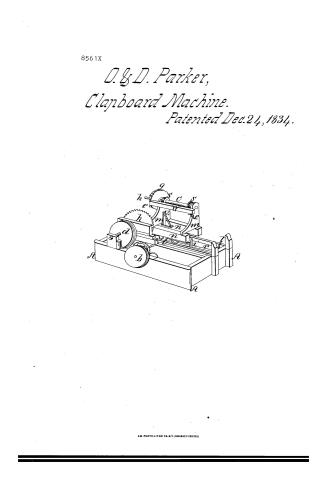
O. and D. Parker's Patent Drawing for a Clapboard Machine

National Archives, Restored Patent Drawings (Record Group 241) · Full-size scan at the National Archives · Catalog record
Show the text on the drawing Hide (42 words)
Words on the drawing as machine-read by the National Archives; not checked. Useful mainly for searching.
144 / SPECIAL YOUR WORK MAC / Hot / ClapboardMach / $1- D.PAREER'S / 143. WOOD SAWING: / Circular Saw Machines; / Angular. / Clapboard Machine. / CLASSIFICATION / Patented Dec. 24ᵗʰ1834 / 8561-X / DIVISION. / he / IL / ob
USPTO scan
The patent as scanned by the USPTO
-
 Page 1
-
 Page 2
-
 Page 3
-
 Page 4


U.S. Patent and Trademark Office · Google Patents
Show the transcription Hide (1,083 words)
Machine transcription (LightOnOCR) of the pages as scanned by the USPTO, most of them the handwritten copies made when the records were restored after the 1836 fire. Not checked; it can misread handwriting, so compare it with the scan.
Page 1.
8561X
O. & D. Parker,
Clapboard Machine.
Patented Dec. 24, 1834.

AM. PHOTO-LITHO CO. N.Y. (OSBORNE'S PROCESS)
Page 2.
Dec. 24, 1834 8561X
Otis Parker and Daniel Parker of Hubbardston in the county of Worcester and commonwealth of Massachusetts.
Letters Patent.
The schedule referred to in these Letters Patent and making part of the same, containing a description in the words of the said Otis Parker & Daniel Parker, themselves of their improvement in the method of sawing clapboards by means of a machine called "a clapboard Machine".
To all to whom these presents shall come.
Be it known, that we, Otis Parker & Daniel Parker, both of Hubbardston in the county of Worcester and commonwealth of Massachusetts, Millers, have invented, made, constructed & applied to use a new and valuable improvement in the method of sawing clapboards, by means of a machine called a clapboard Machine, specified and described in the words following to wit,
The Machine now in use for sawing clapboards being mostly designed for parts of the country where timber is very abundant, are constructed in such a way as to cause a prodigal waste of timber. The machines too, are built at an inconvenient expense. Our Machine it is believed, is free from both of these difficulties, and cures another evil which is the subject of much complaint, to wit, the edge of the clapboard. Our Machine performs the work in such a way as to leave the edge of the clapboard of the proper thickness.
The frame upon which the Machine rests is made of four iron bars, one is in the form of a parallelogram, parallel to the sides of the frame and at nearly an equal distance from them, being between them, are two beams firmly connected to the top pieces at each end of the frame.
The Drawing
Page 3.
The carriage bearing the timber to be moved, rests on one of these beams, and upon the side of the frame. Upon the carriage are two circular headblocks, upon which the timber to be moved rests. Through the tops of these headblocks passes a roller, having firmly attached to one end of it, a ratchet wheel, and also a crank. Near each end of this roller is a rope. One end of each of these ropes is fastened to the roller, so that when the roller is turned by the crank, the ropes are wound round it. The other ends of the ropes are fastened to the ends of a piece of wood, each end of which rests upon the headblocks. This piece of wood or bar, is accommodated with a dog at each end to hold the stick or timber to be moved. The timber is placed upon the headblocks and the underside of this bar, and by turning the roller the timber is drawn upwards. When it is drawn up to the proper place, it is there held by means of the ratchet wheel which is also accommodated with a dog or catch. This catch is lifted out of the ratchet wheel as often as the carriage goes back, and the weight of the timber brings it down thus a space equal to the thickness of the back of the clapboard and this space is regulated by the distance between the teeth of the ratchet wheel.
We use the circular saw upon the same shaft with the saw is a pulley, for a band to connect the machine with the moving power. There is another shaft, having also pulley, and band to connect it with the other pulley. Upon this last shaft is the necessary gearing to move the saw.
Explanation of the drawing—A.A.A. Frame of the machine. B. Saw. C. Pulley upon the same shaft with the saw. D.D.D. Circular blocks. E.E.E. Carriage bearing the headblocks. F. Rollers. G.G. Ropes passing over and attached to the roller. H. Ratchet wheel. I. Crank. J.J.J. Dogs to confine the timber to be moved. K. The bar to which they are attached. L. Timber which the timber is placed on. M. A pin
Page 4.
of the catch or dog for the ratchet wheel g. i. a pin for raising the catch z. t. Screw for throwing the carriage out of gear. v. a part of the lever. b. pulley. o. pinion for moving the carriage.
Operation of the Machine.—The stuff for clapboards is prepared in a common sawmill, by quartering the logs, and cutting the required lengths. The sharp edges of these quarters are then cut off so as to leave them of the desired width of the clapboards. They are then spotted or fixed for planing them upon the head blocks. When a stick prepared in this way, it is placed under the bar w. and fastened by the dogs e. The machine is put in motion, and when the carriage has passed by the saw, the pinion o. is thrown out of the catch attached to the bottom of the carriage, and by means of a weight, the carriage is drawn back to its original position; and as it passes back the catch or dog is raised out of the ratchet wheel g. and the wheel g. on the roller c. is turned by means of the weight of the timber attached to the bar w. and the timber slides down up the circular head blocks, a space equal to the thickness of the back or thick edge of the clapboard. When it has fallen through this space, it is stopped by the catch or dog of the wheel g. when the carriage was drawn back by the weight, the pinion o. was thrown into gear by the lever and the carriage again moves forward, and this operation is repeated until the timber or quarter is wholly sawed. All we claim as invention, is the manner of presenting the stuff or timber to the saw by means of circular head blocks, as is above described.
In witness whereof we have hereunto set our hands this twenty fifth day of October in the year of Lord one thousand eight hundred & thirty four.
Witnesses
Shmuel Simon
Reuben Simon
Olin Pickett
Samuel Pickett
Published accounts: journal notice
Notice in the monthly list of patents
Journal of the Franklin Institute, new ser., vol. 15 (1835), p. 144 · View the page
629. Clapboard machine.-Otis and Daniel Parker, Hubbardston, Mass.
Published accounts: journal notice
Notice in the monthly list of patents, with remarks
Journal of the Franklin Institute, new ser., vol. 16 (1835), p. 35 · View the page
In this machine, the clay is to be mixed in a pug mill, the vertical shaft which carries the knives being turned by a sweep, in the ordinary manner; from this shaft, also, is communicated the various motions necessary to the completion of the process. The clay is to be pushed out from the bottom of the mixing well, into a receiving box directly over the moulds, in which the bricks are to be pressed. A blow is to be struck on the clay, by the dropping of a heavy follower, previous to the final pressing. The claim made is to "the eccentric motion of the cam wheel for vibrating the front frame. The double follower by which a blow is first struck upon the mortar, and heavy pressure afterwards made. The sliding cutter with its appendages, operating in the manner described, and the general arrangement and combination of the respective parts, by which the machine differs in its character from all others previously used for the same purpose. دو 59. For a Clapboard Machine; Otis and Daniel Parker, Hubbardston, Worcester county, Massachusetts, December 24.
Remarks. The clapboards are to be cut by means of a circular saw, from timber prepared by quartering at an ordinary saw mill. The machine appears to be well arranged for the purpose in view; the only thing claimed is the manner of presenting the stuff, or timber, to the saw, by means of head blocks of the particular form described. In its general construction, it resembles some other machines for the same purpose.
About this record
- Patentee
- Jim Shaw's X-patent list
- Date
- USPTO records, Jim Shaw's X-patent list, Burke's List of Patents (1847)
- Invention
- the Name and Date index of patents
- Listed in
- the Name and Date index of patents, USPTO records, Jim Shaw's X-patent list, the Journal of the Franklin Institute, Burke's List of Patents (1847)
- The sources give different dates; the date shown is the one most of them agree on.
- The Franklin Institute's journal confirms the date shown.
- Burke's 1847 Patent Office list gives the same patent.