

Drawings and documents
USPTO scan
The patent as scanned by the USPTO
-
 Page 1
-
 Page 2
-
 Page 3
-
 Page 4


U.S. Patent and Trademark Office · Google Patents
Show the transcription Hide (833 words)
Machine transcription (LightOnOCR) of the pages as scanned by the USPTO, most of them the handwritten copies made when the records were restored after the 1836 fire. Not checked; it can misread handwriting, so compare it with the scan.
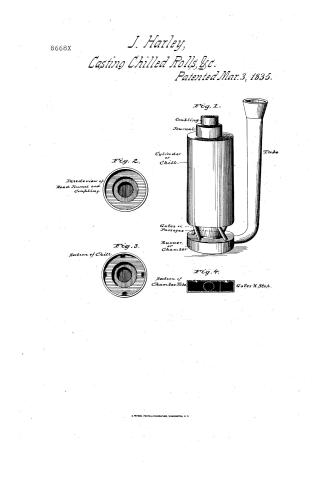
Page 1.
8668X
J. Harley,
Casting Chilled Rolls, &c.
Patented Mar. 3, 1835.
Fig. 1.
- Coupling
- Journal
- Cylinder or Chill
- Tube
- Gates or Passages
- Runner or Chamber
Fig. 2.
- Inside view of Head Journal and Coupling.
Fig. 3.
- Section of Chill
Fig. 4.
- Section of Chamber Tube
- Gates & Stop
Page 2.
Mar. 3, 1835
James Stanley, Pottsburgh, Pennsylvania
Letters Patent
The schedule referred to in these Letters Patent, and making part of the same, containing a description in the words of the said James Stanley himself of his improvement in the mode of casting chilled rollers and other metallic cylinders and cones.
To all to whom these presents shall come. Be it known that James Stanley of Pottsburgh in the County of Alleghany and State of Pennsylvania have invented a new and useful improvement in the mode of casting chilled rollers and other metallic cylinders & cones & that the following is a full and exact description of the construction and operation of said machine or improvement as invented or improved by me.
In order to show the effect of my improvement I state the usual methods as now practiced in casting chilled rollers as follows. The molds in which they are cast consist of a main central portion formed by a hollow metallic cylinder and the two ends called journals or couplings which are moulded in sand. Now if the metal be poured into such a mold in the usual manner that is through a tube descending to its lower extremity, the motion thus communicated to it as it rises in the mold tends to throw all the sand drops &c towards the external part of the roller and thereby occasion cracks flaws and other imperfections on its surface. Therefore in order to obviate this injurious tendency it is the custom to stir the fluid metal with a rod so as to give to it a rotary motion by thus stirring in order to bring the light substances to the center. But this operation of stirring is dangerous and does not effect its object with certainty.
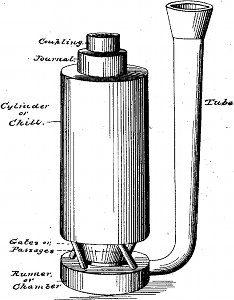
My method of construction is to insert a pipe or pipes (which may be called gates) at openings into or near the bottom of the main chilled cylinder or near the inner surface of the said cylinder and the line of elevation of said pipes or gates is not to be
Page 3.
that of a perpendicular to said Bottom or inner surface, but that of an oblique or slanting line usually about equal to thirty degrees that is approaching the direction of a tangent to the cylinder. Beneath these openings by which the pipes enter the main while cylinder is to be formed a circular chamber with as many openings as there are pipes to communicate with the openings into the cylinder and the pipes are to connect this chamber with the cylinder in the oblique or slanting direction above described. It is also advantageous to have this circular chamber closed by a partition across it on one side of the opening in the circumference left for the insertion of the descending tube by which the fluid metal is to be poured in. This is the construction of my improvement. The manner of using it is as follows. The melted metal is poured in at the descending tube by which it arrives at the opening at the bottom of this tube, leading on to the circular chamber, here the metal enters and on one side being arrested by the partition closing the chamber at the side of this opening. The stream or course of the metal will be driven and consequently continued round. The partition is to be so placed as to give the course of the stream in the same direction round as that to which the pipes or gates lean. The metal flowing up these inclined tubes or pipes acquires a rotary motion on entering the main cylinder which is the object I wish to attain, thereby preventing the necessity of stirring with a rod, and this rotary motion is necessary in order to bring the light substances to the centre and throw the heaviest and best metal to the circumference. What I claim as my own invention and not before or previously known in the above described machine or improvement is that the tube or tubes or passages called gates through which the metal is to be conveyed into the mould shall not enter the mould perpendicularly at the bottom but slanting or in a direction approaching to a tangent of the cylinder or if the Gates enter the mould horizontally, or nearly so that they shall not enter in the direction of the axis of the cylinder but in a tangent.
Published accounts: specification
Specification printed in the Journal of the Franklin Institute
Journal of the Franklin Institute, new ser., vol. 16 (1835), p. 259 · View the page
Text of the specification as printed in the Journal, from OCR; not proofread.
Specification of a Patent for an improvement in the method of Casting Chilled Iron Rollers. Granted to JAMES HARLEY, city of Pittsburgh, Pennsylvania, March 2nd, 1835. To all to whom these presents shall come, be it known, that I, James Harley, of Pittsburgh, in the county of Alleghany, and state of Pennsylvania, have invented a new and useful improvement in the "mode of casting chilled rollers, and other metallic cylinders and cones," and that the following is a full and exact description of the construction and operation of said machine, or improvement, as invented or improved by me. In order to show the object of my improvement, I state the usual method as now practised in casting chilled rollers, as follows. The mould in which they are cast consists of a main central portion, formed by a hollow metallic cylinder; and the two ends, called journals, and couplings, which are moulded in sand. Now, if the metal be poured into such a mould in the usual manner that is, through a tube descending to its lower extremity, the motion thus communicated to it, as it rises in the mould, tends to throw all the sand, dross, slag, &c., towards the external part of the roller, and thereby occasions cracks, flaws, and other imperfections on its surface; therefore, in order to obviate this injurious tendency, it is the custom to stir the fluid metal with a rod, so as to give it a rotary motion, in order, by this stirring, to bring the light substances to the centre. But this operation of stirring is dangerous, and does not effect its object with certainty. My method of construction is, to insert a pipe, or pipes, (which may be called gates,) at openings into, or near, the bottom of the main chill cylinder, or near the inner surface of the said cylinder; and the line of direction of said pipes, or gates, is not to be that of a perpendicular to said bottom, or inner surface, but that of an oblique, or slanting line, usually equal to about thirty degrees, that is, approaching the direction of a tangent to the cylinder. Beneath these openings, by which the pipes enter the main chill cylinders, is to be formed a circular chamber, with as many openings as there are pipes to communicate with the openings into the cylinder, and the pipes are to connect this chamber with the cylinder in the oblique, or slanting, direction above described; it is also advantageous to have this circular chamber closed by a partition across it, on one side of the opening in the circumference, left for the insertion of the descending tube, by which the fluid metal is to be poured in. This is the construction of my improvement; the manner of using it is as follows. The melted metal is poured in at the descending tube, by which it arrives at the opening at the bottom of this tube leading into the circular chamber; here the metal enters, and on one side being arrested by the partition closing the chamber at the side of this opening, the stream, or course, of the metal will be driven to the other, and, consequently, continued round. The partition is to be so placed as to give the course of the stream in the same direction round as that to which the pipes, or gates, lean. The metal flowing up these inclined tubes or pipes, acquires a rotary motion on entering the main cylinder, which is the object I wish to attain, thereby preventing the necessity of stirring with a rod; and this rotary motion is necessary, in order to bring the light substances to the centre, and throw the heaviest and best metal to the circumference. What I claim as my own invention, and not before or previously known, in the above described machine, or improvement, is, that the tube, or tubes, or passages, called gates, through which the metal is to be conveyed into the mould, shall not enter the mould perpendicularly at the bottom, but slanting, or in a direction approaching to a tangent of the cylinder; or if the gates enter the mould horizontally, or nearly so, that they shall not enter in the direction of the axis of the cylinder, but in a tangent from, or inclining towards a tangent of the cylinder. JAMES HARLEY.
Published accounts: journal notice
Notice in the monthly list of patents, with remarks
Journal of the Franklin Institute, new ser., vol. 16 (1835), p. 229 · View the page
2. For an improvement in the machine for Packing Flour in barrels; John Kinman, Hartley, Union county, Pennsylvania, March 2.
Remarks. A shaft is to be made to revolve vertically, which shaft has at its lower end four round spindles, projecting out from it at right angles, and, consequently, forming a horizontal cross; upon these four spindles are to be placed four conical rollers, which are to revolve freely on them; each roller is to be five and a half inches in length, three inches in diameter at its inner, and eight at its outer, end. The end of the shaft is to pass into the barrel, and the flour to be conducted into it by means of a trough, or spout, connected with the meal chest. Instead of making the shaft to revolve, it is said that the barrel itself may be carried round by suitable machinery; in either case, a vertical motion must be given to the shaft as the quantity of flour increases in the barrel. We do not think the machinery represented in the drawing, and described in the specification, is the best that might be devised for the purpose; the claim, however, is not to this particular arrangement, but to the machine for packing flour, as described, unconnected with the machinery for putting it in motion, as that will have to vary according to the situation of the machinery of the mills in which it is placed." By the machine, we presume, from the context, that we are to understand, the packing by means of the revolving rollers.
Published accounts: journal notice
Notice in the monthly list of patents, with remarks
Journal of the Franklin Institute, new ser., vol. 16 (1835), p. 231 · View the page
7. For an improvement in the mode of Casting Chilled Rollers, and other Metallic Cylinders and Cones; James Harley, Pittsburg, Allegheny county, Pennsylvania, March 2.
Remarks. (See the specification.)
Published accounts: journal notice
Notice in the monthly list of patents, with remarks
Journal of the Franklin Institute, new ser., vol. 16 (1835), p. 259 · View the page
D D C C B C E A C Remarks by the Editor. We have not published the foregoing specification from a conviction of the utility of the thing patented, as, on the contrary, we are aware that the patentee is entirely erroneous in his views; of this opinion he was aware at the time of obtaining his patent; but, like some other intelligent men, he appeared to labour under a temporary hallucination, a certain cure for which, however, would be found in the attempt to put the thing into practical operation; whether or not this has been done, we have not heard; the news of its success, we presume, would have reached us. Specification of a Patent for an improvement in the method of Casting Chilled Iron Rollers. Granted to JAMES HARLEY, city of Pittsburgh, Pennsylvania, March 2nd, 1835.
Remarks. To all to whom these presents shall come, be it known, that I, James Harley, of Pittsburgh, in the county of Alleghany, and state of Pennsylvania, have invented a new and useful improvement in the "mode of casting chilled rollers, and other metallic cylinders and cones," and that the following is a full and exact description of the construction and operation of said machine, or improvement, as invented or improved by me. In order to show the object of my improvement, I state the usual method as now practised in casting chilled rollers, as follows. The mould in which they are cast consists of a main central portion, formed by a hollow metallic cylinder; and the two ends, called journals, and couplings, which are moulded in sand. Now, if the metal be poured into such a mould in the usual manner that is, through a tube descending to its lower extremity, the motion thus communicated to it, as it rises in the mould, tends to throw all the sand, dross, slag, &c., towards the external part of the roller, and thereby occasions cracks, flaws, and other imperfections on its surface; therefore, in order to obviate this injurious tendency, it is the custom to stir the fluid metal with a rod, so as to give it a rotary motion, in order, by this stirring, to bring the light substances to the centre. But this operation of stirring is dangerous, and does not effect its object with certainty. My method of construction is, to insert a pipe, or pipes, (which may be called gates,) at openings into, or near, the bottom of the main chill cylinder, or near the inner surface of the said cylinder; and the line of direction of said pipes, or gates, is not to be that of a perpendicular to said bottom, or inner surface, but that of an oblique, or slanting line, usually equal to about thirty degrees, that is, approaching the direction of a tangent to the cylinder. Beneath these openings, by which the pipes enter the main chill cylinders, is to be formed a circular chamber, with as many openings as there are pipes to communicate with the openings into the cylinder, and the pipes are to connect this chamber with the cylinder in the oblique, or slanting, direction above described; it is also advantageous to have this circular chamber closed by a partition across it, on one side of the opening in the circumference, left for the insertion of the descending tube, by which the fluid metal is to be poured in. This is the construction of my improvement; the manner of using it is as follows. The melted metal is poured in at the descending tube, by which it arrives at the opening at the bottom of this tube leading into the circular chamber; here the metal enters, and on one side being arrested by the partition closing the chamber at the side of this opening, the stream, or course, of the metal will be driven to the other, and, consequently, continued round. The partition is to be so placed as to give the course of the stream in the same direction round as that to which the pipes, or gates, lean. The metal flowing up these inclined tubes or pipes, acquires a rotary motion on entering the main cylinder, which is the object I wish to attain, thereby preventing the necessity of stirring with a rod; and this rotary motion is necessary, in order to bring the light substances to the centre, and throw the heaviest and best metal to the circumference.
DATAMP: illustration
Illustrations from DATAMP
DATAMP (Directory of American Tool and Machinery Patents), via the Internet Archive · Archived DATAMP page
About this record
- Patentee
- DATAMP
- Date
- the Name and Date index of patents, DATAMP, USPTO records
- Invention
- DATAMP
- Listed in
- the Name and Date index of patents, DATAMP, USPTO records, Jim Shaw's X-patent list, the Journal of the Franklin Institute, Burke's List of Patents (1847)
- The Franklin Institute's journal spells the name differently.
- The Franklin Institute's journal gives a different date.
- Burke's 1847 Patent Office list gives the same patent.