

Drawings and documents
USPTO scan
The patent as scanned by the USPTO
-
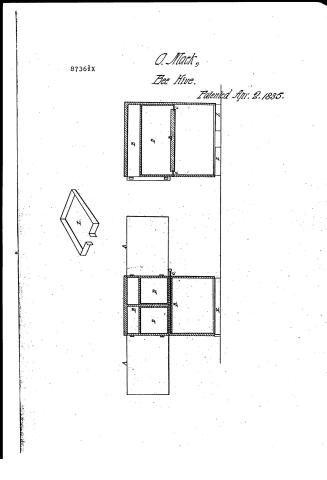 Page 1
-
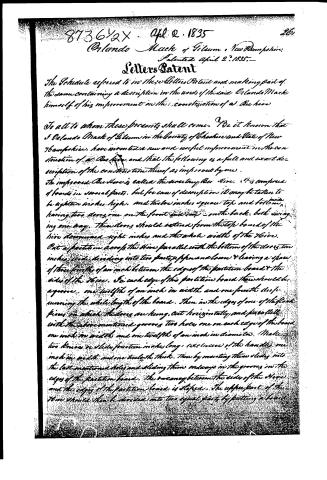 Page 2
-
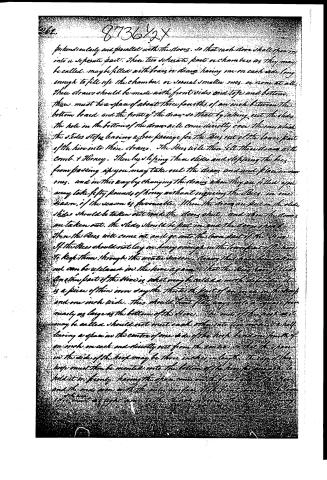 Page 3
-
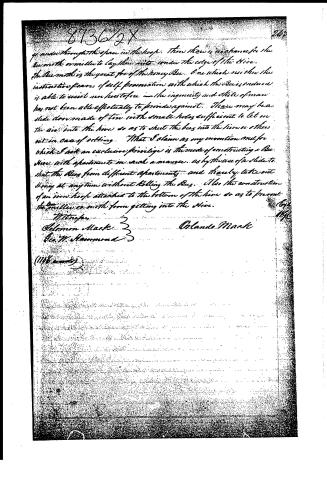 Page 4


U.S. Patent and Trademark Office · Google Patents
Show the transcription Hide (1,099 words)
Machine transcription (LightOnOCR) of the pages as scanned by the USPTO, most of them the handwritten copies made when the records were restored after the 1836 fire. Not checked; it can misread handwriting, so compare it with the scan.
Page 1.
8736½X
O. Mack,
Bee Hive.
Patented Apr. 2, 1835.

Page 2.
8736½X April 2, 1835 261
Orlando Mack of Gilsum, New Hampshire
Patented April 2, 1835.
Letters Patent
The Schedule referred to in these Letters Patent and making part of the same containing a description in the words of the said Orlando Mack himself of his improvement in the construction of a Bee Hive.
To all to whom these presents shall come. Be it known that I Orlando Mack of Gilsum in the County of Cheshire and State of New Hampshire, have invented a new and useful improvement in the construction of a Bee Hive, and that the following is a full and exact description of the construction thereof as improved by me.
The improved Bee Hive is called the Secretary Bee Hive. It is composed of boards in several parts, but for ease of description it may be taken to be eighteen inches high, and twelve inches square top and bottom, having two doors, one on the front and one on the back, both swinging one way. These doors should extend from the top board of the hive downward eight inches and the whole width of the Hive.
Put a partition across the Hive parallel with the bottom of the doors, two inches wide, dividing into two parts, upper and lower, leaving a space of three-fourths of an inch between the edges of the partition board and the sides of the Hive. In each edge of this partition board there should be a groove, one twelfth of an inch in width and one fourth deep running the whole length of the board. Then in the edges of one of the plank pieces on which the doors are hung, cut horizontally and parallel with the above mentioned grooves two holes, one on each edge of the board one inch in width and one twelfth of an inch in diameter. Make two knobs or slides fourteen inches long, exclusive of the handles, one inch in width and one twelfth thick. Then by mounting these slides into the last mentioned holes and sliding them on ways in the grooves in the edges of the partition board, the vacancy between the sides of the Hive and the edges of the partition board is stopped. The upper part of the Hive should then be divided into two equal parts by putting a board
Orlando Mack
Page 3.
262. 8736½X
perpendicularly and parallel with the doors, so that each door shall open into a separate part. These two separate parts or chambers as they may be called, may be filled with boxes or drawers having one on each side long enough to fill up the chamber, or several smaller ones, or none at all. These drawers should be made with front sides and tops and bottoms. There must be a space of about three-fourths of an inch between the bottom board, and the front of the frame so that by taking out the sides, the hole in the bottom of the drawer will come directly over the one which the sides stop, leaving a free passage for the bees out of the lower part of the hive into those drawers. The bees will then fill these drawers with comb and honey. Then by slipping these sides and stopping the bees from passing, if you may take out the doors and put in new ones, and in this way by changing the boxes when they are filled you may take fifty pounds of honey without injuring the bees in one season, if the season is favorable. When the frame is shut in the side, sides should be taken out and the doors shut, and when the doors are taken out, the sides should be put in and the doors opened. Then the bees will come out and go into the lower part of the hive. If the bees should not lay in honey enough in the lower part of the hive to keep them through the winter season, there is a little box that can be released in the hive again that the bees have filled. Another part of the hive is what may be called a moth deflector. It is a piece of thin iron say the thickness of an inch in thickness and one inch wide. This should have flat ways into a square form nearly as large as the bottom of the hive. The ends of the ways at may be called should not meet each other into the middle, leaving a space in the centre of one side of the box, being one-fourth of an inch on each and directly out from the centre so that the space in the side of the box may be three inches in length. The top of this box must then be mounted into the bottom of the box so as to hold it in firmly, having the space over on the first end of the box and the end over with the other end free of the box to allow the box to fit snugly at right angles to the frame of the hive. This box may
Page 4.
873624
go under through the space in the hoop. Then there is no chance for the bee moth or mites to lay their eggs under the edge of the Hive. The Bee moth is the great foe of the Honey Bee. One which neither the instinctive fears of self preservation with which the Bee is endowed is able to avail nor heretofore in the ingenuity and skill of man has not been able effectively to provide against. There may be a slide door made of tin with small holes sufficient to let in the air into the hive so as to shut the bees into the hive or others out in case of rioting. That I claim as my invention and for which I ask an exclusive privilege is the mode of constructing a Bee Hive with apartments in such a manner as by the use of a slide to shut the Bees from different apartments and thereby take out Honey at any time without killing the Bees. Also the construction of an iron hoop attached to the bottom of the hive so as to prevent the smaller or moth from getting into the Hive.
Witnesses
Solomon Mark
Geo. W. Hammond
Orlando Mark
(1186 words)
264
Copy
1196
Published accounts: journal notice
Notice in the monthly list of patents
Journal of the Franklin Institute, new ser., vol. 15 (1835), p. 434 · View the page
175. Straw cutter.-John Deakyne, Petersburg, Va.
Published accounts: journal notice
Notice in the monthly list of patents, with remarks
Journal of the Franklin Institute, new ser., vol. 16 (1835), p. 308 · View the page
5. For a Straw Cutter; John Deakyne, Petersburg, Dinwiddie county, Virginia, April 2.
Remarks. The things claimed in this machine are, "First. The method of obtaining the bearings for the feeding rollers, by lapping the sides of the box on the sides of the mouth-piece, the axes of the rollers resting on the mouth-piece, and working against the ends of the side-boards.
About this record
- Patentee
- the Name and Date index of patents, Burke's List of Patents (1847)
- Date
- the Name and Date index of patents, USPTO records, Burke's List of Patents (1847)
- Invention
- the Name and Date index of patents
- Listed in
- the Name and Date index of patents, USPTO records, Jim Shaw's X-patent list, the Journal of the Franklin Institute, Burke's List of Patents (1847)
- The name conflict was settled by Burke's 1847 list.
- The sources give different dates; the date shown is the one most of them agree on.
- The Name and Date index lists this patent twice.
- The Franklin Institute's journal confirms the date shown.
- Burke's 1847 Patent Office list gives the same patent.